

After years of jumping between brokers, testing platforms with real cash on the line, and watching how they handle everything from calm markets to absolute chaos, I’ve narrowed it down to two heavyweights that keep coming up in trader conversations: FBS and Exness. Both have massive global followings, but they serve slightly different crowds. One feels like the friendly neighborhood mentor with bells and whistles; the other is a sleek, no-nonsense machine built for speed and efficiency.
If you’re trying to decide between them in 2026, here’s my straight take based on what actually matters when you’re trading.
Quick Overview: Who Are These Brokers?
FBS has been around since 2009 and boasts millions of clients across 150+ countries. They’ve built a reputation on accessibility—super low entry barriers, generous bonuses, and a strong focus on education. It’s the kind of broker that throws seminars, runs promotions, and tries to feel like a community.
Exness, founded in 2008, has grown into a tech powerhouse. They emphasize raw performance: ultra-tight spreads, lightning-fast execution, and instant withdrawals that actually work even on weekends. They’re popular among serious retail traders and scalpers who hate paying extra for basic stuff.
Head to the official site
Both are legit and regulated by multiple bodies (CySEC, ASIC, FSCA, and offshore entities depending on the client location), but always double-check the entity that serves your region for the strongest protections.
Regulation and Trust: Neither Is Perfect, But Both Are Solid
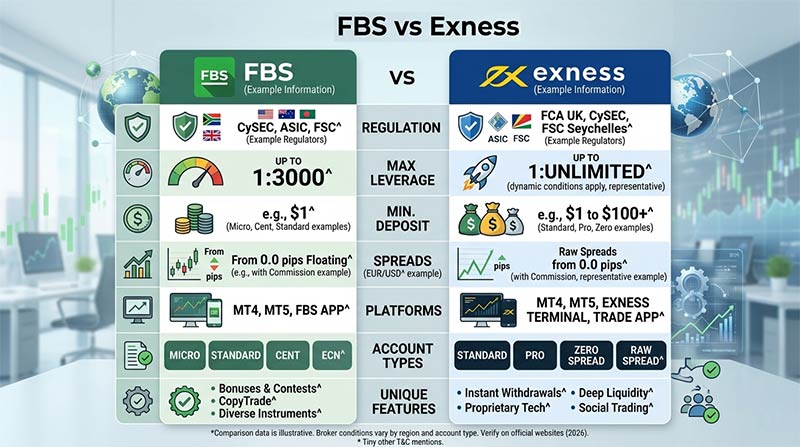
Safety first. FBS operates under CySEC (strong EU oversight), ASIC, and Belize FSC. Exness has a broader mix including FCA, CySEC, FSCA, and others. In practice, both segregate client funds and offer negative balance protection.
I’ve never had a major issue withdrawing from either after decent volume, but Exness consistently gets praised for near-instant processing—no waiting days for your money. FBS is reliable too, though some users report occasional delays with certain methods. In a world where brokers sometimes freeze accounts during big moves, both have decent track records, but Exness edges it on transparency and withdrawal speed.
Trading Conditions: Spreads, Leverage, and Costs
This is where the real differences show up.
- Spreads & Fees: Exness often wins here with raw spreads starting from 0.0 pips on professional accounts and low commissions. Their pricing stays tight even in volatile times. FBS offers competitive spreads (from 0.5–1 pip on majors) and zero-spread options on certain accounts, but they can widen more noticeably. For scalpers and high-frequency traders, Exness feels smoother.
- Leverage: FBS pushes higher leverage (up to 1:3000 in some regions), which is exciting but dangerous for beginners. Exness caps it lower in regulated entities but still offers flexible high leverage offshore. Use it wisely—leverage is a double-edged sword.
- Instruments: Both cover forex, metals, indices, stocks, and crypto. Exness has a slight edge in depth for some pairs and cryptos, while FBS feels broader for beginners dipping into multi-asset trading.
Exness also shines with swap-free (Islamic) accounts available globally and no deposit/withdrawal/inactivity fees. FBS has attractive bonuses, but read the fine print—those can come with trading requirements that trap capital.
Platforms and Tools
Both heavily rely on MetaTrader 4 and 5, which are battle-tested and support EAs, indicators, and copy trading. FBS has its own app and some proprietary touches that feel more beginner-friendly. Exness offers their own clean Exness Terminal alongside MT4/MT5, which many traders prefer for its modern interface and reliability.
Mobile apps for both are strong—great for monitoring on the go. If you love TradingView integration or cTrader, neither is the absolute best, but they cover the basics exceptionally well.
Education, Support, and Extras
FBS crushes it for new traders. Their academy, webinars, market analysis, and community events are genuinely helpful. If you’re still learning price action or risk management, this is a big plus.
Exness keeps it more streamlined—solid but less hand-holding. Their strength is in execution and tools for experienced traders. Customer support is 24/7 for both and multilingual, but Exness often feels faster in responses.
Head to the official site
Who Should Choose FBS?
- Beginners who want education, bonuses, and a supportive vibe.
- Traders okay with slightly higher spreads for more account flexibility and promotions.
- Those who value a $5 minimum deposit and lots of local payment options.
I’ve seen plenty of new traders thrive here because the resources reduce the learning curve.
Who Should Choose Exness?
- Active or professional traders who prioritize low costs, tight spreads, and fast withdrawals.
- Scalpers and day traders who can’t afford slippage or delays.
- Anyone tired of fees eating into profits—Exness’s model is built for volume.
In my experience testing both, Exness just feels more “pro” for consistent trading.
Head to the official site
There’s no universal winner—Exness comes out ahead for most serious traders right now due to better overall trading conditions, reliability under pressure, and those instant withdrawals that build real confidence. FBS remains excellent if you’re starting out or love the educational side and occasional bonuses.
Test both with demo accounts. Trade small live for a month. See which platform clicks with your style. The best broker is the one that lets you focus on the charts instead of fighting the broker.
Whatever you pick, remember: no broker makes you profitable. That’s on your strategy, risk management, and discipline. Trade safe out there.
Have you traded with either? Drop your experiences in the comments—I read them all.

•Most Trusted Broker — Asia 2026
•Broker of the Year — LATAM 2026
These awards confirm our commitment to building a rewarding trading environment and helping you uncover your potential. Thank you for choosing to trade with an award-winning broker!
Why choose MetaTrader 5 with Top Forex Brokers?
•Blazing-fast execution & enhanced stability
•38 built-in technical indicators & 21 timeframes for precision trading
•Optimized for all devices—desktop, mobile & web
•Trade a wide range of assets: Stocks, Commodities, Forex & more!
Disclaimer: Trading forex and CFDs carries a high level of risk and may not be suitable for all investors. Ensure you understand the risks involved and consider your financial situation before trading.