

Choosing between ForexMart and IC Markets comes down to what you prioritize at the execution level: ultra-low entry barriers and simplified MetaTrader 4 (MT4) access, or multi-platform raw-spread pricing built for active volume.
While both brokers operate across European and international jurisdictions and serve retail CFD traders, their core infrastructure, fee structures, and target audiences diverge sharply. Here is how they stack up across regulation, real trading costs, platforms, and day-to-day usability.
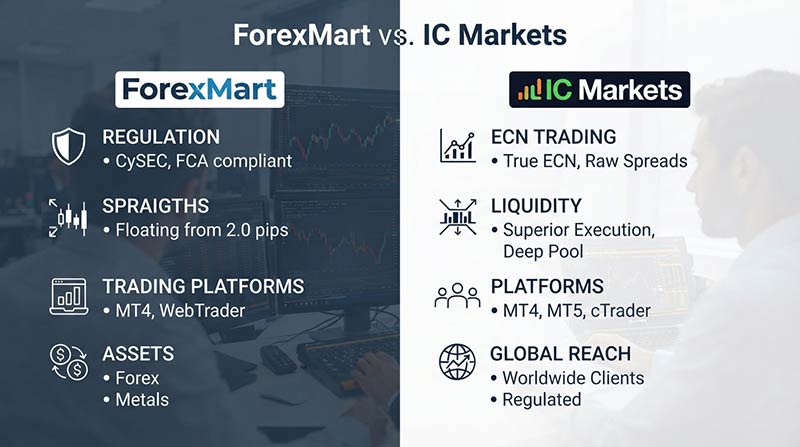
Quick Verdict & Who Each Broker Is For
If you are deciding between these two brokers, the right choice depends heavily on your account size, strategy frequency, and preferred trading software.
| Feature | IC Markets | ForexMart |
| Primary Focus | High-volume scalping, algorithmic trading, multi-platform ECN/raw execution | Low-deposit retail entry, straightforward MT4 trading, Cent accounts |
| Regulatory Entities | ASIC (Australia), CySEC (Cyprus), FSA (Seychelles) | CySEC (Cyprus), FSA (St. Vincent & the Grenadines) |
| Trading Platforms | MT4, MT5, cTrader, TradingView | MetaTrader 4 (MT4) & WebTrader |
| Pricing Models | Raw Spread (from 0.0 pips + commission) & Standard (spread-only) | Classic/Pro (spread-only, floating or fixed by entity) & Zero Spread (+ commission) |
| Minimum Deposit | $0–$200 (varies by entity/account tier) | From $1–$15 on entry/Cent accounts; higher on Pro/Zero Spread |
| Cent / Micro Accounts | No | Yes (Cent account available on international entity) |
- Choose IC Markets if: You are a scalper, day trader, or algorithmic trader running Expert Advisors (EAs) or cBots. Its raw spread infrastructure, deep liquidity aggregation, and support for MT4, MT5, cTrader, and TradingView make it far better suited for strategies sensitive to spread widening and execution latency.
Head to the IC Markets official site - Choose ForexMart if: You are a newer trader or low-capital retail trader who wants to test live market conditions with minimal upfront capital (such as a $15 deposit or a Cent account) inside a familiar MT4 environment without managing complex multi-platform setups.
Regulation & Safety of Funds
Both brokers utilize a multi-entity corporate structure—a standard practice in the retail forex and CFD industry that allows firms to serve European clients under strict regional rules while onboarding international clients under offshore entities.
- IC Markets operates through several regulated entities, including International Capital Markets Pty Ltd (authorized by Australia’s ASIC), IC Markets (EU) Ltd (regulated by CySEC in Cyprus), and Raw Trading Ltd (regulated by the FSA in Seychelles).
- ForexMart operates in Europe via Instant Trading EU Ltd (regulated by CySEC in Cyprus) and internationally via Tradomart SV Ltd (registered with the FSA in Saint Vincent and the Grenadines).
What This Means for Client Protection
Regulatory oversight directly dictates the guardrails around your capital:
- Segregated Client Funds: Under both CySEC and ASIC frameworks (as well as standard compliance protocols on their international arms), retail client deposits are kept in segregated bank accounts separate from corporate operating funds.
- Negative Balance Protection & Leverage Caps: Clients onboarded under CySEC (EU) or ASIC (Australia) receive mandatory negative balance protection and strict retail leverage caps (such as 1:30 on major forex pairs). By contrast, clients registered under offshore FSA entities can access significantly higher leverage (1:500 or higher depending on account tier), but forfeit statutory EU compensation schemes.
- Investor Compensation Schemes: Eligible retail clients under a CySEC-regulated entity fall under the Investor Compensation Fund (ICF), which covers up to €20,000 in the event of broker insolvency. Neither ASIC nor offshore FSA entities provide a statutory investor compensation fund.
Regulatory coverage, available entities, and historical compliance records differ significantly depending on where you live. Before funding an account, always verify the exact legal entity you are contracting with on the broker’s onboarding agreement and cross-check its license status directly on the official CySEC, ASIC, or relevant local regulator register.
Head to the IC Markets official site
Trading Costs: Spreads, Commissions & Account Types
Understanding how each broker charges for order flow is where you can save—or lose—the most money over hundreds of trades.
IC Markets Pricing Structure
IC Markets built its reputation on raw interbank-style pricing:
- Raw Spread Accounts (MT4/MT5 & cTrader/TradingView): Spreads on major pairs like EUR/USD regularly sit near 0.0 pips during liquid sessions, paired with a flat round-turn commission (typically around $6.00 per standard lot on cTrader/TradingView and $7.00 round-turn on MT4/MT5, with discounted tiers on high-balance Raw Pro accounts).
- Standard Account: A spread-only model with zero commission, where spreads start around 0.8 pips on EUR/USD.
ForexMart Pricing Structure
ForexMart segments its accounts primarily by deposit tier and spread type, with notable differences between its EU and international portals:
- Classic / Pro / Cent Accounts: Commission-free accounts where trading costs are built entirely into the spread. On international floating-spread accounts, standard spreads generally sit in the industry mid-range (often starting above 1.0–1.2 pips on majors), while its EU entity offers tiered fixed-spread accounts (Basic, Gold, Platinum).
- Zero Spread Account: Available on its international offering (typically requiring a $500 minimum deposit), this account drops base spreads toward 0.0 pips in exchange for a round-turn commission (around $6 per lot).
How Your Trading Style Affects Real Costs
- Scalping & High-Frequency Day Trading: Raw spread plus commission pricing almost always wins here. When targeting 5 to 12 pips per trade, paying a predictable $6–$7 round-turn commission with near-zero spread eliminates the friction of waiting for a 1.2+ pip spread to clear before a trade turns green. IC Markets’ Raw Spread environment is purpose-built for this.
- Swing & Position Trading: If you hold trades for days or weeks targeting 80 to 200+ pips, the difference between a 0.7-pip total raw cost and a 1.1-pip spread-only cost is marginal compared to overnight swap rates. Swing traders should compare live swap fees on their specific pairs and note that both brokers offer swap-free (Islamic) account options upon request.
- Micro-Position Testing: IC Markets lacks a Cent account, meaning the smallest standard 0.01 micro-lot still carries meaningful dollar-per-pip exposure for a tiny $50 balance. ForexMart’s Cent account denominates balances in cents, allowing beginners to practice risk management on live market ticks with minimal capital at stake.
Platforms, Tools & Tradable Markets
This is the widest operational gap between the two brokers.
Trading Platforms
- IC Markets supports four major front-ends: MetaTrader 4 (MT4), MetaTrader 5 (MT5), cTrader, and TradingView. Having cTrader and TradingView alongside MT5 gives discretionary chartists superior order-book visibility (Depth of Market), detachable multi-monitor charting, and native C# algorithmic capabilities without relying on third-party bridges.
- ForexMart relies almost exclusively on MetaTrader 4 (MT4) across desktop, mobile, and WebTrader. It does not support MT5, cTrader, or TradingView. While MT4 remains reliable for legacy Expert Advisors and simple charting, traders who want modern multi-asset depth, built-in economic calendars, or TradingView execution will find ForexMart’s tech stack restrictive.
Tradable Markets
- IC Markets offers a broad multi-asset CFD lineup spanning over 60 currency pairs, major global indices, commodities, bonds, cryptocurrencies, futures, and individual share CFDs (accessible via MT5).
- ForexMart provides a more compact CFD catalog—typically around 100 to 150+ instruments covering major/minor/exotic forex pairs, spot metals, energies, select indices, major stock CFDs, and crypto CFDs. It covers the core liquid markets most retail traders touch, though equity and futures traders will notice the narrower selection.
Both brokers offer Virtual Private Server (VPS) solutions for automated strategies, though minimum monthly volume or deposit thresholds apply—check each broker’s current VPS terms before relying on free hosting.
Head to the IC Markets official site
Deposits, Withdrawals & Practical Considerations
Funding friction often reveals more about a broker’s operational maturity than its marketing page.
- Minimum Deposit & Accessibility: ForexMart keeps the door wide open for small accounts, with entry deposits starting around $1 to $15 on Classic and Cent accounts (and $200–$500 for Pro and Zero Spread tiers). IC Markets historically enforces a $200 standard minimum deposit on its Australian entity, while its international entity allows lower or $0 initial minimums on standard/raw tiers (with $5,000+ thresholds reserved for Raw Pro tiers).
- Payment Methods & Fees: Both brokers support bank wire transfers, Visa/Mastercard, and major e-wallets like Skrill and Neteller. Neither broker charges internal deposit fees on standard funding methods, though intermediary bank charges can apply on international wire withdrawals (for example, IC Markets notes a flat fee on international bank transfers, while ForexMart advertises reimbursement of certain third-party payment fees depending on method and region).
- Withdrawal Experience & Account Maintenance: IC Markets is widely regarded for predictable, automated e-wallet and card withdrawal processing, though it does apply a $10 monthly inactivity fee after 12 months of dormancy. ForexMart processes withdrawals across cards, wires, and e-wallets, though user feedback across independent forums is more mixed regarding verification delays during withdrawals—making it essential to complete full KYC verification before trading actively.
Recommendation & Risk Disclaimer
To make the right call for your trading desk, match the broker to your exact operational profile:
- You trade actively, use EAs/cBots, or rely on modern charting: Go with IC Markets. Between raw 0.0-pip pricing, competitive commissions, and native support for MT5, cTrader, and TradingView, it is built to scale with serious retail volume.
Head to the IC Markets official site - You are testing live execution with under $50 or want a Cent account: ForexMart offers a lower-barrier sandbox via its MT4 Cent and Classic accounts—provided you verify which legal entity covers your country and understand the difference between its CySEC and offshore protections.
Note: Spreads, commission tiers, leverage limits, and minimum deposit rules change periodically by jurisdiction. Always confirm live contract specifications and regulatory disclosures directly on the official IC Markets and ForexMart websites before opening a live account.

•Most Trusted Broker — Asia 2026
•Broker of the Year — LATAM 2026
These awards confirm our commitment to building a rewarding trading environment and helping you uncover your potential. Thank you for choosing to trade with an award-winning broker!
Why choose MetaTrader 5 with Top Forex Brokers?
•Blazing-fast execution & enhanced stability
•38 built-in technical indicators & 21 timeframes for precision trading
•Optimized for all devices—desktop, mobile & web
•Trade a wide range of assets: Stocks, Commodities, Forex & more!
Risk Disclaimer: Trading foreign exchange (forex) and Contracts for Difference (CFDs) on margin carries a high level of risk and may not be suitable for all investors. Leverage can amplify both profits and losses, and you can lose more than your initial deposit depending on your account jurisdiction. Brokersss.com provides independent editorial comparisons for educational purposes only and does not offer personalized financial or investment advice.