

If you’ve spent any time shopping for a forex broker, you know the drill: one flashy ad after another promising tight spreads and huge leverage, but the real question that keeps smart traders up at night is simple—can I actually trust this platform with my money? FP Markets has been around since 2005, and in a crowded industry full of fly-by-night operations, its regulatory footprint is one of the stronger ones I’ve come across. But regulation isn’t a one-size-fits-all badge of honor. Different licenses mean different levels of protection depending on where you live and which entity you end up trading under.
I’ve dug into dozens of brokers over the years, and what stands out with FP Markets isn’t just the number of regulators—it’s the mix of top-tier oversight in key markets alongside a genuinely global setup. Let’s cut through the marketing speak and look at exactly how FP Markets is regulated in 2026, what that means for your funds, and whether it’s the right fit for you.
Head to the official site
Why Forex Regulation Actually Matters (And Why Most Traders Ignore It Until It’s Too Late)
Unregulated or poorly regulated brokers can vanish overnight with client money, manipulate prices, or simply refuse withdrawals when the market moves against them. Legitimate regulators force brokers to keep client funds in segregated bank accounts, maintain minimum capital reserves, undergo regular audits, and follow strict rules on advertising and leverage.
Top-tier regulators like Australia’s ASIC and Cyprus’s CySEC (which feeds into EU rules via MiFID) are the gold standard because they have real enforcement teeth and compensation schemes. Lower-tier or offshore licenses are often just table stakes for serving clients in regions where stricter rules don’t reach. The good news? FP Markets holds both.
FP Markets at a Glance
Founded in Sydney back in 2005, FP Markets has grown into a genuine multi-regulated global player. It’s picked up over 60 industry awards along the way, but awards are easy—real credibility comes from the licenses. The broker operates through several legal entities, each authorized in its own jurisdiction. That structure lets it serve traders worldwide while tailoring compliance to local rules.
Crucially, no matter which entity you’re under, FP Markets consistently applies core protections: client funds are segregated from company money and held with reputable banks, negative balance protection is standard (you can’t lose more than you deposit on margin trades), and financials get externally audited.
FP Markets’ Regulatory Licenses – The Full Picture
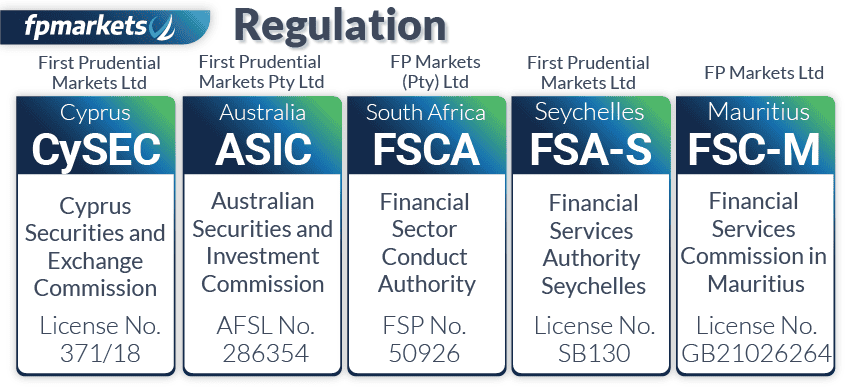
Here’s the clear breakdown of the main regulators as of early 2026:
| Regulator | Region / Clients Served | Entity / License Number | Tier / Key Strengths | Notable Protections |
|---|---|---|---|---|
| ASIC (Australia) | Australia & selected markets | First Prudential Markets Pty Ltd – AFSL 286354 | Tier 1 – Very strict capital & conduct rules | Segregated funds, high transparency, audits |
| CySEC (Cyprus / EU) | European Economic Area | First Prudential Markets Ltd – 371/18 | Tier 1 (via MiFID passporting) | Segregated funds + Investor Compensation Fund up to €20,000, negative balance protection |
| FSCA (South Africa) | South Africa | FP Markets (Pty) Ltd – FSP 50926 | Tier 2 – Solid local oversight | Segregated client funds |
| FSA (Seychelles) | International / Offshore | License SD130 | Tier 3 – Lighter touch | Segregated funds |
| CMA (Kenya) | Kenya | License details available on request | Local market access | Local compliance & segregation |
| FSC (Mauritius) / SCB (Bahamas) / Saint Lucia | Global / International clients | Various registrations | Tier 3-4 – Offshore flexibility | Basic segregation; used for non-restricted regions |
The ASIC and CySEC licenses are the real standouts. ASIC, in particular, is notoriously tough—it demands serious capital buffers and ongoing compliance that weeds out weaker players. CySEC brings the added safety net of the Investor Compensation Fund for EU clients. The offshore entities (FSA Seychelles, Saint Lucia registration, etc.) mainly serve clients in regions where the stricter licenses aren’t available or where higher leverage is preferred.
Pro tip from experience: Always confirm which legal entity your account is opened with during signup. It’s usually determined by your country of residence. If you’re in the EU, you should land under the CySEC entity; Australians go ASIC. International clients often default to Seychelles or Saint Lucia—still regulated, but with lighter protections.
What Client Protections Do You Actually Get?
Across all entities, the fundamentals are solid:
- Segregated client funds — Your money sits in separate bank accounts and can’t be used for the broker’s operations or debts.
- Negative balance protection — A lifesaver during volatile moves like surprise news events or flash crashes.
- Regular audits and reporting — External auditors review the books, and clients receive statements.
- Strict capital requirements — FP Markets must keep enough of its own money on hand to handle payouts even in tough markets.
EU clients get the extra €20,000 compensation layer if the broker ever fails (rare, but nice to have). Australian clients benefit from ASIC’s rigorous oversight but don’t have an equivalent compensation scheme like the UK’s FSCS.
Leverage also varies by regulator. EU and Australian retail clients face caps (typically 30:1 on majors), while international accounts under offshore licenses often offer much higher leverage—sometimes 500:1 or more. That’s great for experienced traders but dangerous for beginners.
Regional Differences and What They Mean for You
If you’re an EU trader, the CySEC license gives you MiFID-level transparency and dispute resolution through the Financial Ombudsman. South African clients enjoy local FSCA oversight tailored to their market. For traders in Asia, Latin America, or the Middle East, the Seychelles or Saint Lucia entities provide access without forcing you into restricted leverage.
One thing I’ve noticed reviewing brokers is that multi-jurisdictional setups like FP Markets’ are increasingly common—and smart. They let the company grow globally while keeping core operations under heavy scrutiny. It’s not perfect (no single broker covers every country with Tier-1 protection), but it beats the old model of one shady offshore license for everyone.
Any Red Flags or Things to Watch?
FP Markets doesn’t serve US clients (CFTC/NFA rules make that almost impossible for most foreign brokers), and there’s no FCA license for UK retail traders post-Brexit. That’s normal and transparent.The main consideration is entity shopping: some international clients end up under lighter offshore regulation by default. That’s not inherently bad, but it means fewer safety nets. Always read the client agreement during signup and verify the regulator on the official register (ASIC connect, CySEC website, etc.).
In over 20 years of operation and with a clean regulatory record, FP Markets has built real credibility. Trust scores from independent sites consistently land in the high 80s–90s, which is strong for a global CFD/forex broker.
Is FP Markets Worth It in 2026?
Look, I’m not here to sell you anything. Trading forex and CFDs is inherently risky—most retail accounts lose money, full stop. But if safety is high on your list, FP Markets is one of the more trustworthy options out there. The combination of ASIC and CySEC oversight plus consistent segregation and negative balance protection across the group gives me more confidence than many pure offshore brokers I’ve seen.
What I personally like is the transparency. They don’t hide behind a single license or make wild claims. They clearly list every entity and protection on their site. That level of openness is refreshing in an industry that loves smoke and mirrors.
If you’re in Australia or Europe, FP Markets is a very safe choice under their respective Tier-1 regulators. For international traders, it’s still well above average thanks to the top-tier licenses backing the brand. Just do the usual due diligence—verify your entity, start small, and never risk money you can’t afford to lose.
Regulation alone won’t make you a profitable trader, but it sure beats waking up to find your broker has disappeared with your account balance. FP Markets passes that basic test with flying colors.
Head to the official site

•Most Trusted Broker — Asia 2026
•Broker of the Year — LATAM 2026
These awards confirm our commitment to building a rewarding trading environment and helping you uncover your potential. Thank you for choosing to trade with an award-winning broker!
Why choose MetaTrader 5 with Top Forex Brokers?
•Blazing-fast execution & enhanced stability
•38 built-in technical indicators & 21 timeframes for precision trading
•Optimized for all devices—desktop, mobile & web
•Trade a wide range of assets: Stocks, Commodities, Forex & more!
Disclaimer: Trading forex and CFDs carries a high level of risk and may not be suitable for all investors. Ensure you understand the risks involved and consider your financial situation before trading.