

After spending several months testing both platforms with real money, I can tell you this decision isn’t as straightforward as the comparison sites make it look. Most traders I talk to end up stuck in the same place I was: staring at two well-known names, both claiming tight spreads, solid regulation, and “trader-friendly” conditions, and wondering which one will actually treat their capital better when the market turns chaotic.
I’ve scalped the London open on both, held swing positions through news events on both, and withdrawn profits (and a few painful losses) from both. What follows is my honest, first-hand Exness vs IronFX review — not a brochure, but the kind of breakdown I wish someone had given me before I funded the first account.
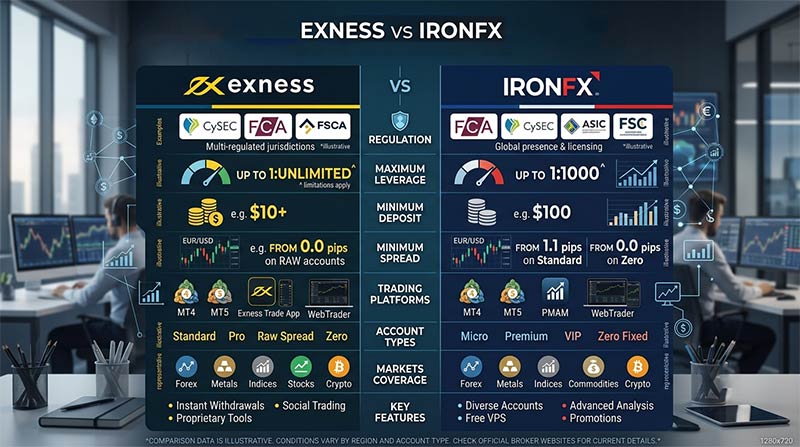
Company Background & Regulation
Exness launched in 2008. IronFX followed in 2010. Both have been around long enough to survive multiple market cycles, which already puts them ahead of the flash-in-the-pan brokers that appear every year.
On regulation, both hold respectable licenses, but the practical difference matters.
Exness operates under a multi-entity structure that includes the FCA (UK), CySEC (Cyprus), FSCA (South Africa), FSA Seychelles, FSC Mauritius, and others. Client funds are segregated, negative balance protection is standard on most entities, and the UK entity brings FSCS protection up to £85,000 for eligible clients. In my experience, the regulatory footprint feels broad and transparent.
Head to the official site
IronFX (operated primarily through Notesco entities) holds FCA, CySEC, and FSCA licenses, with some operations under BVI regulation depending on the client’s jurisdiction. They also segregate funds and offer negative balance protection. On paper this is solid Tier-1 coverage for many traders.
Here’s the reality check from my testing: both brokers are regulated, both keep client money separate from operational funds, and neither has the cleanest historical record of complaints. IronFX has faced more public regulatory scrutiny and client disputes over the years (especially around withdrawals and bonuses in certain markets). Exness has had its share of noise too, but the volume of positive long-term feedback is noticeably higher.
Exness vs IronFX regulation isn’t a clear knockout either way for pure safety. If you qualify for the UK or EU entity with both, the protection levels are comparable. The difference shows up more in day-to-day operational reliability than in the license certificates themselves.
Trading Conditions – Spreads, Commissions, Leverage, Execution Quality
This is where the rubber meets the road.
Spreads and Commissions
On a standard account, Exness typically showed me EUR/USD spreads starting around 0.2–0.6 pips during liquid hours, averaging closer to 0.8–1.1 pips in normal conditions. Their Raw Spread and Zero accounts push the spread to 0.0 pips for significant portions of the day on major pairs, with commissions that usually landed between $3–7 round turn per lot depending on the exact account and instrument.
Head to the official site
IronFX’s standard floating accounts came in wider — often 1.2–1.8 pips on EUR/USD in my logs. Their zero-spread and ECN-style accounts can reach 0.0, but the commission structure and overall cost still felt higher for the same volume in most of my side-by-side sessions. IronFX vs Exness spreads clearly favored Exness for cost-conscious trading, especially if you trade frequently.
What really stood out during high-volatility sessions was execution consistency. During NFP and FOMC releases I saw fewer requotes and less slippage on Exness, particularly on the Raw and Pro accounts. IronFX handled the same events adequately on their STP/ECN accounts, but the fill quality was more variable.
Leverage
Exness vs IronFX leverage is one of the bigger practical differences. Exness can offer up to unlimited leverage (or 1:2000 depending on entity, equity, and instrument) on many of its international accounts. IronFX typically tops out at 1:1000 on offshore entities and is restricted to 1:30 for EU/UK retail clients under ESMA rules — same as most regulated brokers.
I used high leverage on both for short-term scalping. The higher ceiling at Exness gave me more flexibility with smaller account sizes, but it also demands stricter risk management. Neither broker forces you into high leverage; both let you set it lower.
Overall Cost of Trading
For a scalper running 10–20 lots a day, the difference in average spread and commission compounds quickly. In my own logs over several months, Exness was cheaper by a meaningful margin on majors and gold. For pure swing trading with fewer trades, the gap narrows, but Exness still edged it.
Platforms & Tools
Both brokers lean heavily on MetaTrader.
Exness offers full MT4 and MT5 support, plus their own Exness Terminal (web and app) and a solid mobile app. Order execution is market-based on most accounts, with one-click trading, trailing stops, and full EA support. The Terminal is clean and fast; I used it alongside MT5 without issues.
IronFX is primarily an MT4 shop, with a WebTrader option. MT5 availability is more limited or absent on some account paths. The platform works fine, and they support EAs, but the overall ecosystem feels less modern than Exness’s dual MT4/MT5 + proprietary setup.
If you live inside MetaTrader and run automated strategies, both work. If you want the newer MT5 features or a smoother proprietary interface, Exness has the clearer advantage.
Account Types, Deposits & Withdrawals
Account Types
Exness keeps it relatively clean: Standard, Standard Cent, Pro, Raw Spread, and Zero. The Cent account is genuinely useful for testing strategies with tiny size. Minimum deposit starts as low as $10 on Standard accounts (varies slightly by region and payment method).
Head to the official site
IronFX offers a wider menu — Live Floating, Live Fixed, Premium, VIP, Zero Fixed, Absolute Zero, STP/ECN, and various copy-trading options. The variety looks impressive on the website, but in practice many of the “premium” tiers simply tighten the spread a little in exchange for higher minimum deposits (often $100+ and sometimes significantly higher for VIP).
Deposits and Withdrawals
Both accept cards, bank wires, e-wallets (Skrill, Neteller, etc.), and crypto in many regions. Deposits are generally instant or same-day on both.
Withdrawals are where the biggest real-world difference appeared for me.
Exness has built a strong reputation for Exness instant withdrawal. On several occasions I requested funds via local bank transfer or e-wallet and saw the money in my account within minutes to a couple of hours after approval. Processing is automated for many methods once KYC is complete.
IronFX withdrawals were slower and more inconsistent in my testing. Some requests cleared in 1–2 business days; others took longer and required extra back-and-forth. Client reviews on Trustpilot and forums frequently mention IronFX withdrawal delays or extra verification steps, which matches what I experienced on a couple of larger profit withdrawals.
If fast access to your capital matters (and it should), Exness currently holds a clear edge.
Detailed Pros & Cons
Exness – Pros
- Lower average trading costs on majors and metals
- Extremely fast withdrawals on most methods
- Very low minimum deposit
- Flexible high leverage options
- Full MT4 + MT5 + proprietary platforms
- Transparent account structure
Exness – Cons
- Customer support can feel stretched during peak hours
- Some advanced tools and research are basic compared to pure ECN specialists
- Leverage and conditions vary significantly by entity
Head to the official site
IronFX – Pros
- Wide range of account types and fixed-spread options
- Decent instrument selection including stocks and more exotic CFDs on some accounts
- Established brand with multi-regulator coverage
- Occasional promotions and copy-trading features
IronFX – Cons
- Higher average spreads on standard accounts
- Withdrawal speed and consistency lag behind top competitors
- Mixed client feedback on support and past operational issues
- Platform offering is more limited (heavy MT4 focus)
Who Should Choose Exness? Who Should Choose IronFX?
Choose Exness if:
- You are a beginner or intermediate trader who wants low barriers ($10 entry) and simple, competitive conditions
- You scalp or day-trade frequently and care about every pip of cost
- Fast, reliable withdrawals are non-negotiable
- You want high leverage flexibility and both MT4 and MT5
- You trade primarily forex, metals, and major indices
Head to the official site
Choose IronFX if:
- You specifically prefer fixed-spread accounts or a very wide menu of account tiers
- You value the particular mix of instruments or promotional structures they currently run
- You already have a long history with the platform and are comfortable with their processes
- Your trading volume is low enough that the spread difference doesn’t dominate your costs
For high-volume traders, pure scalpers, and anyone who prioritizes capital efficiency, Exness is the stronger default in my experience. IronFX can still work for certain styles, but it rarely wins on pure cost or operational speed these days.
If I had to choose one for my own trading today, it would be Exness.
The combination of tighter real-world spreads, genuinely fast withdrawals, low minimum deposit, and solid multi-platform support simply delivers a better day-to-day experience for the majority of retail traders I know — including myself. IronFX is not a bad broker, and its regulatory licenses are legitimate, but the friction around costs and withdrawals has been harder to ignore after testing both side by side.
That said, always verify the exact entity and conditions available in your country. Regulation, leverage, and payment methods change by jurisdiction. Test with a small live deposit first, run your own execution logs for a couple of weeks, and only then scale up.
Practical advice: open demo accounts on both, then fund the smallest possible live accounts and trade the same strategy for 30 days. Your own data will tell you more than any review — including this one.
For more detailed single-broker breakdowns, check the full Exness review and IronFX review pages on brokersss.com, along with comparisons against other popular names like IC Markets and XM.
FAQ
1. Which is better overall – Exness or IronFX? In my testing, Exness wins for most retail traders on cost, withdrawal speed, and platform flexibility. IronFX remains usable but trails in those key areas.
2. Who has tighter spreads – Exness or IronFX? Exness generally offers tighter average spreads, especially on Raw and Zero accounts. Standard accounts at IronFX tend to be wider.
3. Is Exness safer than IronFX? Both hold Tier-1 licenses (FCA, CySEC, etc.). Safety is comparable on paper; operational consistency and client feedback currently lean toward Exness.
4. Can I get high leverage on both? Yes, but Exness often allows higher maximum leverage (up to unlimited/1:2000 on certain entities) than IronFX’s typical 1:1000 cap.
5. How fast are withdrawals at Exness vs IronFX? Exness frequently processes withdrawals in minutes to hours on supported methods. IronFX is more commonly measured in business days and can involve extra steps.
6. What is the minimum deposit for each? Exness starts from around $10 on Standard accounts. IronFX typically requires $100 or more depending on the account type.
7. Do both support MT4 and MT5? Exness supports both fully. IronFX is primarily MT4-focused with more limited MT5 options.
8. Which broker is better for beginners? Exness, mainly because of the lower minimum deposit, Cent accounts, and simpler overall cost structure.

•Most Trusted Broker — Asia 2026
•Broker of the Year — LATAM 2026
These awards confirm our commitment to building a rewarding trading environment and helping you uncover your potential. Thank you for choosing to trade with an award-winning broker!
Why choose MetaTrader 5 with Top Forex Brokers?
•Blazing-fast execution & enhanced stability
•38 built-in technical indicators & 21 timeframes for precision trading
•Optimized for all devices—desktop, mobile & web
•Trade a wide range of assets: Stocks, Commodities, Forex & more!
Disclaimer: Trading forex and CFDs carries a high level of risk and may not be suitable for all investors. Ensure you understand the risks involved and consider your financial situation before trading.