

After spending several months testing both platforms with real money through quiet Asian sessions, London-New York overlaps, and full-blown news events in 2026, I can tell you the XM vs OctaFX choice is one of the more practical decisions many retail traders face. Both are popular, both accept small accounts, and both run MetaTrader. Yet the differences show up quickly once you start trading live.
I’ve scalped EUR/USD on both, held gold swings overnight, and tested copy-trading features. What really stood out during high-volatility sessions was how each handled spreads and execution under pressure. This is my honest, first-hand take.
Company Background & Regulation
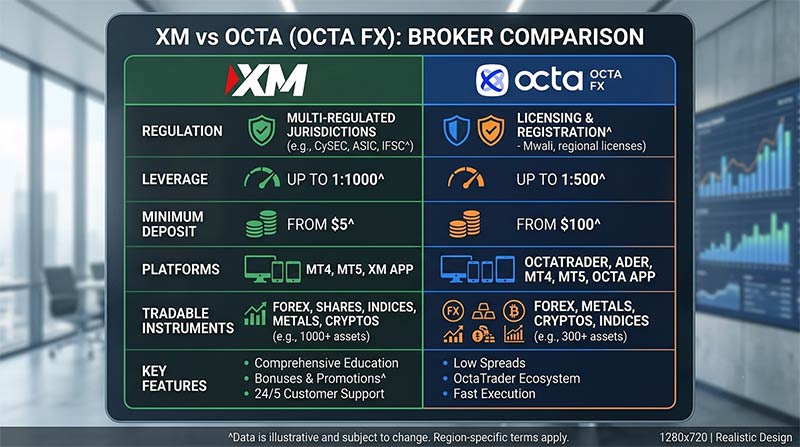
XM (Trading Point group) has been around since 2009. It operates multiple entities and holds licenses from CySEC (Cyprus), ASIC (Australia), DFSA (Dubai), FSCA (South Africa), FSC Belize, and others. For many clients the entity you land on depends on your country, but the overall regulatory footprint is solid. Client funds are segregated and negative balance protection is standard.
Head to the official site
Octa (formerly OctaFX) started in 2011. Its main regulated arms sit under CySEC and FSCA, with additional offshore registration (often MISA or SVG-related). The regulatory stack is lighter than XM’s. Funds are segregated and negative balance protection exists, but the depth of investor compensation schemes is generally thinner outside the CySEC entity.
In my experience, XM feels safer for larger balances or longer-term trading. Octa has operated cleanly for years and serves a huge client base, especially in Asia, Africa, and Latin America, but if regulation is your top priority, XM has the clearer edge.
Trading Conditions – Spreads, Commissions, Leverage, Execution
Spreads and commissions XM Standard accounts typically show EUR/USD around 1.6 pips. The Ultra Low account brings that down to roughly 0.6–0.8 pips with no commission. The Zero account offers raw spreads from 0.0 plus about $3.50 per side ($7 round-turn).
Octa runs a simpler commission-free model. Spreads on majors often start from 0.6 pips and average closer to 0.9 pips on EUR/USD in live conditions. No separate commission on the main accounts.
During normal London hours both felt competitive. On news spikes I saw XM’s Ultra Low hold tighter more consistently in my tests, while Octa sometimes widened a bit more. For pure cost on high-volume scalping, XM Zero or Octa’s tighter sessions can both work; it depends on the pair and the day.
Leverage Both offer high leverage outside strict jurisdictions. XM goes up to 1:1000 on many offshore entities (1:30 under CySEC/ASIC retail rules). Octa commonly advertises up to 1:500 or 1:1000 depending on the entity and region.
High leverage is a double-edged sword. I keep it low regardless of the broker.
Execution Both are fast enough for retail. I experienced occasional slippage on both during big releases, but nothing extreme. XM’s deeper instrument list and liquidity pool felt more consistent on larger sizes.
Platforms & Tools
Both support MT4 and MT5 fully, including Expert Advisors.
XM adds its own XM App and WebTrader. The mobile app is clean and reliable. Education resources (webinars, analysis, market updates) are stronger on XM.
Octa offers MT4, MT5, and its proprietary OctaTrader platform. OctaTrader is modern and mobile-friendly, and the built-in copy-trading feature is one of the smoother retail implementations I’ve used. If social trading or one-click copying is part of your plan, Octa has the advantage here.
For pure charting and EA work I preferred MT5 on both. For mobile simplicity and copy trading, OctaTrader stood out.
Account Types, Deposits & Withdrawals
Minimum deposit XM: $5 on most accounts. Octa: $25.
Account types XM: Micro, Standard, Ultra Low, Zero, and a Shares account (higher deposit). Islamic/swap-free available. Octa: Straightforward MT4/MT5/OctaTrader accounts, mostly commission-free, with Islamic options and strong copy-trading integration.
Deposits & withdrawals Both support cards, e-wallets, bank transfers, and local methods in many regions. Neither charges broker-side fees on standard methods in most cases.
What really stood out was withdrawal speed. Octa processed several of my e-wallet and crypto withdrawals very quickly—often within hours and sometimes faster. XM was reliable (usually same day or next business day for e-wallets in my tests) but not quite as snappy on average. Both require proper verification before larger withdrawals, which is normal and sensible.
Bonuses & Promotions
XM is well known for bonuses. Depending on your region and entity you may see no-deposit bonuses, deposit-match offers (often structured as 50% then lower percentages with volume requirements), and loyalty programs. Always read the fine print—bonus funds usually cannot be withdrawn until volume conditions are met, and withdrawing can cancel remaining bonus.
Octa frequently runs a 50% deposit bonus and other promotions. Copy-trading and loyalty elements are also part of the package for many clients. Same advice applies: understand the terms before relying on bonus capital.
Bonuses can help new accounts, but they should never drive your choice of broker. Treat them as optional extras.
Detailed Pros & Cons
XM Pros
- Strong multi-jurisdiction regulation
- Very low $5 minimum deposit
- Wide range of instruments (1,000–1,400+)
- Solid education and research
- Flexible account types including Zero for raw pricing
- Reliable MT4/MT5 ecosystem
XM Cons
- Standard account spreads are wider
- Inactivity fees possible after 90 days on some entities
- Bonuses come with conditions that can frustrate casual traders
Head to the official site
Octa Pros
- Simple commission-free pricing
- Competitive spreads on majors
- Strong proprietary OctaTrader + copy trading
- Fast withdrawals in many of my tests
- Zero-swap policy on many instruments is attractive for swing traders
- Clean, beginner-friendly experience
Octa Cons
- Lighter regulatory footprint overall
- Fewer instruments than XM
- Higher minimum deposit ($25)
- Education and advanced tools are more basic
Who Should Choose XM? Who Should Choose OctaFX (Octa)?
Choose XM if you:
- Value stronger regulation and fund protection
- Want the lowest possible entry ($5)
- Trade a broad range of instruments (stocks, indices, commodities, crypto CFDs)
- Use EAs or need solid educational content
- Prefer more account-type flexibility (especially Ultra Low or Zero)
Head to the official site
Choose Octa if you:
- Like simple, commission-free trading
- Want built-in copy trading or a clean proprietary platform
- Prioritize fast withdrawals
- Prefer zero-swap conditions for longer holds
- Are comfortable with a more offshore-leaning regulatory setup
Beginners often do well on either, but XM’s education and micro-lot flexibility give it a slight edge for learning. Scalpers should test both Ultra Low/Zero on XM and Octa’s live spreads during their trading hours. Swing traders may like Octa’s zero-swap approach. High-volume traders should run the numbers on XM Zero versus Octa’s all-in spread cost.
Head to the official site
If I had to choose one for my own trading today, I would lean toward XM. The stronger regulatory coverage, broader instrument list, lower entry barrier, and flexible pricing options (especially Ultra Low and Zero) make it the more complete package for most serious retail traders in 2026.
That said, Octa is a perfectly viable alternative, particularly if copy trading, platform simplicity, or fast cash-outs matter more to you. Both are legitimate, both have served millions of clients, and both can work if you manage risk properly.
Practical advice: open demos on both, trade the same strategy for a few weeks, measure real spreads and slippage during your preferred sessions, then fund a small live account. Verify the exact entity and terms that apply to your country before depositing serious capital. Never risk money you cannot afford to lose, and treat leverage as a tool, not a shortcut.
FAQ
1. Which broker has tighter spreads – XM or OctaFX? On standard commission-free accounts Octa often shows tighter average spreads. XM’s Ultra Low and Zero accounts can match or beat them once commissions are factored in. Test both live.
2. Is XM safer than OctaFX? XM generally has a stronger multi-regulator profile (CySEC + ASIC + others). Octa has CySEC and FSCA coverage but relies more on offshore entities for many clients.
3. What is the minimum deposit for XM vs Octa? XM: $5. Octa: $25.
4. Does OctaFX offer faster withdrawals? In my testing, Octa frequently processed e-wallet and crypto withdrawals faster. XM is reliable but usually not as instant.
5. Which has better leverage? Both offer high leverage outside strict jurisdictions (up to 1:1000 range). Actual limits depend on your entity and regulation. Use it carefully.
6. Are there bonuses on both? Yes. XM is known for no-deposit and deposit-match offers; Octa commonly runs 50% deposit bonuses. Terms and availability vary by region—always read the conditions.
7. Can I use Expert Advisors on both? Yes. Full MT4 and MT5 support on both brokers.
8. Which is better for beginners? XM edges it for most beginners thanks to the $5 entry, micro lots, and stronger educational content. Octa is simpler if you mainly want copy trading.

•Most Trusted Broker — Asia 2026
•Broker of the Year — LATAM 2026
These awards confirm our commitment to building a rewarding trading environment and helping you uncover your potential. Thank you for choosing to trade with an award-winning broker!
Why choose MetaTrader 5 with Top Forex Brokers?
•Blazing-fast execution & enhanced stability
•38 built-in technical indicators & 21 timeframes for precision trading
•Optimized for all devices—desktop, mobile & web
•Trade a wide range of assets: Stocks, Commodities, Forex & more!
Disclaimer: Trading forex and CFDs carries a high level of risk and may not be suitable for all investors. Ensure you understand the risks involved and consider your financial situation before trading.