

After spending several months testing both platforms with real money, I kept running into the same question from fellow traders: XM or ForexChief (now commonly branded as xChief)? Both promise high leverage, low barriers to entry, MT4/MT5 access, and attractive bonuses. One feels like a polished global name with stronger regulatory footing; the other positions itself as a flexible, cost-competitive option with aggressive incentives. Choosing between them is not about which is “perfect”—neither is—but about which lines up with how you actually trade, how much risk you are willing to take on the broker side, and what you value most day to day.
In this XM vs ForexChief review I share what stood out in live conditions: spreads during quiet sessions and news spikes, how withdrawals actually felt, leverage in practice, and the small friction points that only show up after you’ve been in and out of positions for weeks. I’ll keep it balanced but honest. If I had to choose one for my own trading today, the decision is clearer than it was when I first funded both accounts.
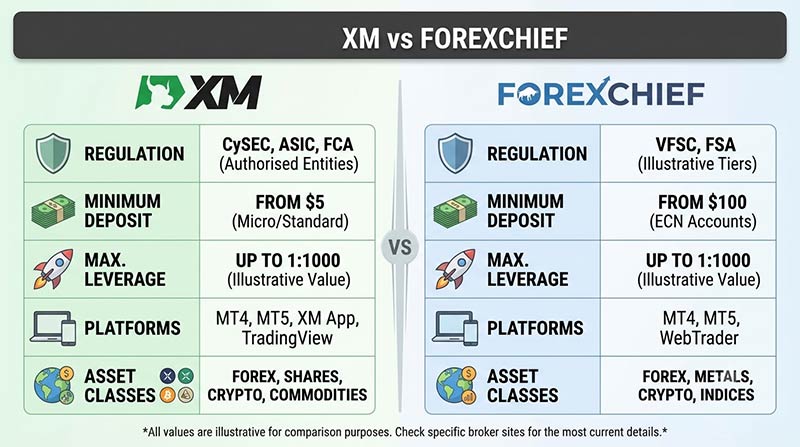
Quick Comparison Table
| Feature | XM | ForexChief (xChief) |
|---|---|---|
| Founded | 2009 | 2014 |
| Primary Regulation | CySEC, ASIC, DFSA, FSCA + offshore entities | Mainly VFSC (Vanuatu)/MISA (Comoros), some FSCA |
| Min. Deposit | $5 | $0–$10 (depends on account) |
| Max Leverage | Up to 1:1000 (non-EU) | Up to 1:1000 |
| Typical EUR/USD Spreads | Standard ~1.6 pips; Ultra Low ~0.6–0.8; Zero raw + commission | From ~0.0–0.9 pips depending on account + commissions on ECN-style |
| Platforms | MT4, MT5, XM App | MT4, MT5 |
| Account Types | Micro, Standard, Ultra Low, Zero (limited), Shares | Cent, Classic+, DirectFX, xPRIME |
| Education | Extensive | Limited |
| Overall Safety Feel | Stronger multi-jurisdiction | More offshore-focused |
Head to the official site
Regulation & Safety
This is the first place I look, and it’s where the gap is clearest.
XM runs multiple regulated entities. CySEC in Cyprus, ASIC in Australia, DFSA in Dubai, FSCA in South Africa, plus offshore arms. When I opened my account the entity I landed under mattered for leverage and protections, but the brand carries real multi-jurisdiction oversight. Client funds are segregated. Negative balance protection is standard. I never felt like my money was sitting in a regulatory grey zone.
ForexChief (rebranded in places as xChief) is primarily regulated offshore—Vanuatu VFSC and/or Mwali/Comoros MISA, with some FSCA South Africa presence mentioned in reviews. Some sources also reference ASIC-related entities, but the core offering most international traders get is offshore. Segregated funds and negative balance protection are claimed, yet the protective framework is thinner. No equivalent to CySEC’s investor compensation scheme for many clients.
I slept better with XM. That alone tilted a lot of my longer-term capital toward them. Regulation differences are not marketing noise—they decide what happens if something goes wrong.
Head to the official site
Account Types & Minimum Deposit
Both make it easy to start small.
XM’s $5 minimum across Micro, Standard, and Ultra Low accounts is genuinely beginner-friendly. The Micro account lets you trade tiny sizes (1,000-unit lots), which is perfect when you’re still figuring out position sizing. Ultra Low tightens the spreads without forcing a commission structure. Zero account (raw spreads + commission) exists but availability is often restricted by entity—frequently limited to CySEC clients.
ForexChief offers Cent accounts (sometimes near-zero or very low minimum), Classic+, DirectFX, and xPRIME. Cent accounts are useful for testing with tiny risk. DirectFX and xPRIME lean more ECN/raw with commissions. Minimums start around $0–$10 for entry accounts and climb for the prime tiers. More variety in execution models, which some traders like.
I used XM’s Micro and Ultra Low the most. The low barrier and clear progression felt cleaner. ForexChief’s Cent account was handy for short experiments, but the overall menu felt more fragmented.
Spreads, Commissions & Trading Costs
Real costs only show up after you trade volume.
On XM, Standard and Micro accounts run roughly 1.6 pips average on EUR/USD in normal conditions. Ultra Low brings that closer to 0.6–0.8 pips with no commission—my preferred everyday setup. Zero can get closer to raw but adds commission (around $3.50 per side in many reports) and isn’t always available.
ForexChief can look tighter on paper, especially on DirectFX (from ~0.3 pips + commission) or xPRIME (from 0.0 + higher commission). Classic+ sits around 0.6 pips commission-free. In practice, during my sessions the effective cost on majors was competitive on their better accounts, sometimes better than XM Standard, occasionally matching or beating Ultra Low once commission was factored in. Spreads still widen in news, same as everywhere.
Neither is the absolute cheapest raw-spread specialist. For pure cost on high-volume scalping, some pure ECN brokers beat both. Between these two, ForexChief can edge it on certain accounts if you trade enough volume to absorb the commission structure. XM’s Ultra Low is simpler and more predictable for most of my trading.
Head to the official site
Trading Platforms & Tools
Both run solid MetaTrader 4 and MetaTrader 5. Execution felt reliable on both; I didn’t notice consistent requotes or major slippage differences on liquid pairs during normal hours.
XM adds its own app and web options plus some extra tools and copy-trading features. The platform experience is polished and consistent across devices. ForexChief sticks closer to standard MT4/MT5 without as many proprietary extras. If you live inside MetaTrader and run EAs, either works. XM felt slightly more complete day-to-day.
Deposit & Withdrawal Methods + Speed
XM supports a wide range of cards, e-wallets, bank transfers, and local methods depending on region. Deposits were usually instant or same-day. Withdrawals to e-wallets were fast; bank wires took a few business days. I had one delayed bank withdrawal that required a follow-up, but it resolved.
ForexChief also offers cards, e-wallets, bank wires, crypto in many cases, and other options. Processing times were similar in my experience—deposits quick, withdrawals ranging from same-day (e-wallets/crypto) to several days for wires. Both can charge third-party fees depending on the method. Neither made me wait weeks, which is more than I can say for some brokers I’ve used.
Head to the official site
Customer Support
XM’s live chat and email were responsive during my tests. Agents generally knew the product. Multilingual support helps if English isn’t your first language. I got clear answers on account types and withdrawal status without endless ticket loops.
ForexChief support was available and functional—chat and email worked—but felt a bit thinner on complex questions. Response times were acceptable, not exceptional. For routine issues both got the job done. When something felt urgent, XM gave me more confidence.
Education & Research Resources
Clear win for XM. They put real effort into webinars, video courses, daily analysis, economic calendars, and educational articles. As someone who still reviews setups and market context regularly, the material is usable. ForexChief offers basic resources and some analysis, but it doesn’t come close in depth or consistency. If you’re still building knowledge, XM is noticeably stronger here.
Pros and Cons
XM Pros
- Stronger multi-jurisdictional regulation
- Very low $5 minimum and micro-lot friendly
- Solid Ultra Low account pricing
- Excellent education and research
- Polished platforms and support
XM Cons
- Standard account spreads are not the tightest
- Zero account often restricted by jurisdiction
- Occasional withdrawal friction on certain methods
Head to the official site
ForexChief Pros
- Competitive spreads and ECN-style accounts available
- Low or zero minimum on Cent accounts
- High leverage flexibility
- Decent range of deposit options including crypto
ForexChief Cons
- Primarily offshore regulation with thinner protections
- Weaker educational offering
- Support and overall polish feel secondary to XM
- Account structure can feel more complicated
Who Each Broker Is Best For
XM fits better if:
- Safety and regulation rank high for you
- You’re a beginner or intermediate trader who values education
- You want simple, low-deposit access with micro lots
- You prefer a more established global brand with broader tools
Head to the official site
ForexChief can make sense if:
- You’re comfortable with offshore regulation and prioritize tighter potential costs on raw/ECN accounts
- You want Cent accounts for ultra-small risk testing
- High leverage and flexible account options matter more than top-tier oversight
- You already know how to manage risk and don’t need heavy educational support
After months of real-money use, XM is the better overall choice for most traders in 2026. The regulatory difference is not minor. Stronger oversight, better education, reliable platforms, and a straightforward low-deposit path outweigh the occasional tighter spread I saw on ForexChief’s better accounts. I keep more of my capital with XM for that reason.
If your absolute priority is squeezing every possible pip of cost on an ECN-style account and you accept the regulatory trade-off, ForexChief can work—especially on DirectFX or xPRIME after you’ve tested execution yourself. For safety-first, beginner-friendly, or long-term use, I lean XM without hesitation.
Test both with small amounts if you’re still deciding. Spreads and execution can vary by session and account. Your own risk tolerance and jurisdiction will decide the final call more than any review.
Head to the official site
FAQ
Is XM safer than ForexChief? Yes. XM’s multi-entity regulation (CySEC, ASIC, DFSA and others) provides stronger protections for most clients than ForexChief’s primary offshore licenses.
Which has lower trading costs, XM or ForexChief? It depends on the account. ForexChief’s raw/ECN accounts can be competitive or tighter once commissions are included. XM’s Ultra Low is simpler and often better value for non-scalpers.
Can beginners use both brokers? Both accept low deposits. XM is more beginner-friendly thanks to micro accounts, education, and clearer structure.
Do both offer high leverage? Yes—up to 1:1000 on eligible accounts outside strict EU/ASIC retail limits.
How fast are withdrawals on XM vs ForexChief? E-wallets and similar methods are usually same-day or next-day on both. Bank wires take longer (a few business days). Always verify with small test withdrawals first.
Should I choose XM or ForexChief for scalping? Test execution and all-in costs on the specific account you’ll use. ForexChief’s DirectFX/xPRIME may edge pure cost; XM’s platforms and reliability still hold up well for many active traders.

•Most Trusted Broker — Asia 2026
•Broker of the Year — LATAM 2026
These awards confirm our commitment to building a rewarding trading environment and helping you uncover your potential. Thank you for choosing to trade with an award-winning broker!
Why choose MetaTrader 5 with Top Forex Brokers?
•Blazing-fast execution & enhanced stability
•38 built-in technical indicators & 21 timeframes for precision trading
•Optimized for all devices—desktop, mobile & web
•Trade a wide range of assets: Stocks, Commodities, Forex & more!
Disclaimer: Trading forex and CFDs carries a high level of risk and may not be suitable for all investors. Ensure you understand the risks involved and consider your financial situation before trading.