

After spending several months testing both platforms with real money, I kept running into the same question almost every trader faces at some point: XM or LiteFinance? Both promise low entry barriers, high leverage, MT4/MT5 access, and competitive conditions. Both attract beginners and more experienced traders alike. Yet the differences only become clear once you start trading live through news events, quiet Asian sessions, and those frustrating high-volatility moments when spreads blow out and execution quality is tested.
I’ve used XM for years as one of my core brokers and opened a proper live account with LiteFinance specifically for this comparison. I traded scalping setups on majors, held swing positions through overnight swaps, ran some copy-trading experiments, and paid close attention to deposit and withdrawal friction. What follows is the practical, no-brochure version of that experience.
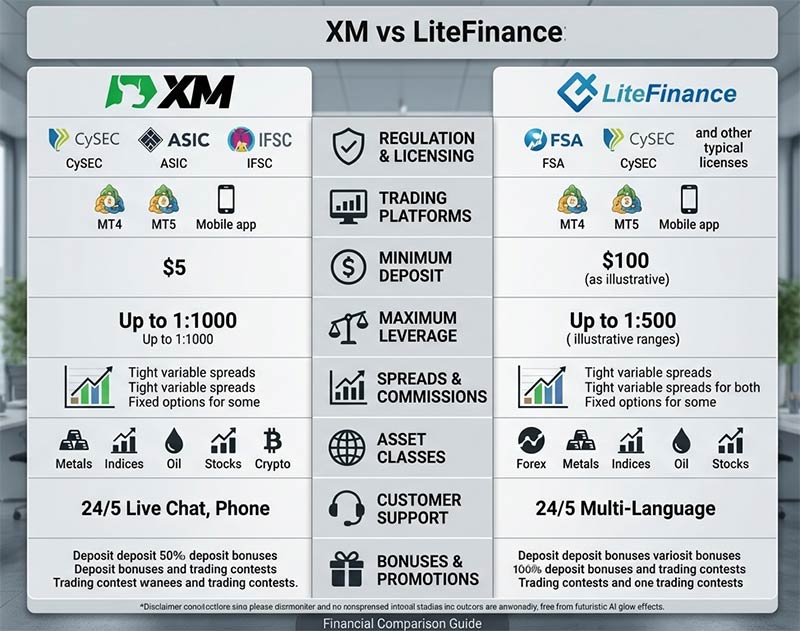
Company Background & Regulation
XM launched in 2009 and has grown into one of the better-known multi-entity brokers. Most retail clients outside the stricter jurisdictions end up under entities regulated by CySEC (Cyprus), ASIC (Australia), DFSA (Dubai), FSCA (South Africa), and offshore licences such as FSC Belize. The multi-licence structure matters. Client funds are segregated, negative balance protection is standard, and the overall regulatory footprint feels more robust than many offshore-heavy competitors.
Head to the official site
LiteFinance (formerly LiteForex) has been around longer, since 2005. Its European entity holds a CySEC licence, which is solid. However, the majority of international clients trade under offshore arrangements (Saint Vincent and the Grenadines registration or Mauritius entities are commonly cited). Segregated accounts and negative balance protection are still offered, but the depth of investor compensation schemes and regulatory scrutiny is thinner for non-EU clients.
Head to the official site
In my experience, XM’s regulatory stack simply gives more peace of mind when you’re holding larger balances or trading through periods of market stress. LiteFinance is not a fly-by-night operation, but the safety differential is real. If capital protection sits near the top of your checklist, XM edges this category clearly.
Trading Conditions – Spreads, Commissions, Leverage, Execution Quality
This is where the practical differences show up day to day.
XM offers several account types. The Standard and Micro accounts typically show EUR/USD spreads starting around 1.6 pips with no commission. The Ultra Low account tightens that to roughly 0.6–1.0 pips on majors during liquid hours, still commission-free. The Zero account pushes raw spreads from 0.0 with a commission (commonly around $3.50 per side). Leverage reaches 1:1000 on the offshore entities for eligible clients. Execution on XM has been reliable for me during normal conditions and remains usable during news, though spreads do widen as expected.
Head to the official site
LiteFinance’s Classic account starts wider (often from about 1.8 pips on EUR/USD) with no commission. The ECN account is the main attraction: raw spreads from 0.0 pips plus commission. Reported commission figures vary across sources and periods (sometimes cited as low as $0.25 per side, more commonly in the $2.50–$5 range per side or around $10 round-turn). Leverage also goes up to 1:1000. During my testing, ECN execution felt snappy, especially on majors, and the platform handled scalping reasonably well.
Head to the official site
What really stood out during high-volatility sessions was the difference in how costs behaved. On XM Ultra Low I could keep trading without constantly calculating commission drag. On LiteFinance ECN the raw spread looked attractive, but the commission added up quickly on higher frequency trades. For pure scalping of majors, LiteFinance ECN can be competitive if you size carefully. For mixed styles or news trading where you need predictable all-in costs, XM’s commission-free tighter accounts felt more straightforward.
Both allow scalping, hedging, and EAs. Neither is perfect in extreme conditions — spreads widen, slippage happens — but neither felt unusually punitive compared with other retail brokers I’ve used.
Platforms & Tools
XM sticks to the MetaTrader ecosystem: MT4, MT5, plus its own web and mobile apps. The mobile experience is functional and the charting is the familiar MetaTrader standard. Education and analysis tools are well developed — webinars, daily analysis, and a decent educational section for newer traders.
LiteFinance also offers MT4 and MT5, but adds cTrader and its own proprietary platform. The social/copy-trading interface is built into the client area and feels more native than third-party solutions. If you like Level II depth and a cleaner order-book feel, cTrader is a genuine advantage. For pure MetaTrader users the difference is smaller, though LiteFinance’s extra platforms give it more flexibility.
I still default to MT5 on both, but the option of cTrader on LiteFinance is useful for certain strategies.
Account Types, Deposits & Withdrawals
XM’s $5 minimum deposit is one of the lowest in the industry. You can start with almost nothing and still access the main account types. Multiple base currencies are available. Deposits are free and generally instant via cards and e-wallets. Withdrawals have been smooth in my experience — usually processed within a business day or two for e-wallets and cards, longer for bank wires. No broker-side withdrawal fees on standard methods.
LiteFinance’s Cent account can start from around $10, while Classic and ECN usually require $50. Crypto deposits (USDT, BTC, etc.) are well supported and often the fastest route. Withdrawals, especially crypto and certain e-wallets, can be very quick — sometimes within hours. Some methods may carry small fees or minimums, and larger amounts go through additional review. In practice I found LiteFinance withdrawal speed competitive, particularly if you stick to crypto or popular e-wallets.
The low barrier on XM makes it easier to test strategies with real money without committing meaningful capital. LiteFinance’s higher minimum on the better-priced accounts is still reasonable, but the difference is noticeable for absolute beginners.
Bonuses, Promotions & Copy Trading Features
XM regularly runs deposit bonuses (sometimes structured as 100% on the first portion then a lower percentage up to a high total credit) and has offered no-deposit bonuses in certain regions. These come with volume requirements and the usual caveat that withdrawing can cancel remaining bonus funds. Loyalty points are also available. The XM bonus system is one of the more generous in the mid-tier space, but you must read the terms carefully — trading against the bonus conditions is easy to get wrong.
Head to the official site
LiteFinance is less aggressive on large deposit bonuses. It has offered payment-fee rebates and occasional promotions, but the standout feature is its built-in copy trading / social trading system. You can browse signal providers, see performance metrics, and copy with adjustable risk settings directly in the platform. For traders who want passive or semi-passive exposure, this is a clear differentiator. XM does not match this native social trading depth (though third-party solutions or limited features may exist depending on region and time).
Head to the official site
If bonuses and education matter more, XM has the edge. If LiteFinance copy trading is central to your plan, the choice tilts the other way.
Side-by-Side Comparison Table
| Feature | XM | LiteFinance |
|---|---|---|
| Regulation | CySEC, ASIC, DFSA, FSC Belize, FSCA etc. | CySEC (EU) + offshore (SVG/Mauritius) |
| Min Deposit | $5 | $10 (Cent) / $50 (Classic/ECN) |
| Max Leverage | Up to 1:1000 | Up to 1:1000 |
| Spreads (EUR/USD typical) | Standard ~1.6; Ultra Low from ~0.6; Zero from 0.0 | Classic from ~1.8; ECN from 0.0 |
| Commission | None on most accounts; Zero ~$3.50/side | None on Classic; ECN variable ($0.25–$5/side range reported) |
| Platforms | MT4, MT5, proprietary apps | MT4, MT5, cTrader, proprietary |
| Account Types | Micro, Standard, Ultra Low, Zero, Shares | Cent, Classic, ECN |
| Withdrawal Speed | Generally 1–2 business days | Often hours (crypto/e-wallets); up to 24h |
| Bonuses | Deposit bonuses, loyalty points | Limited; occasional rebates |
| Copy Trading | Limited / not native strength | Strong built-in social/copy trading |
| Instruments | 1000+ | Several hundred |
Detailed Pros & Cons
XM Pros (from my trading)
- Extremely low minimum deposit and easy onboarding
- Strong multi-jurisdiction regulation
- Competitive commission-free tighter spreads on Ultra Low
- Solid education and analysis resources
- Reliable withdrawals and broad payment options
- Generous bonus structure when available
XM Cons
- Spreads on Standard accounts are not the tightest
- No deep native copy-trading ecosystem
- Bonus terms can be restrictive
Head to the official site
LiteFinance Pros
- Competitive ECN pricing for volume traders
- Excellent built-in copy trading
- cTrader option and solid platform variety
- Fast crypto deposits and withdrawals
- High leverage available
LiteFinance Cons
- Weaker overall regulatory coverage for most international clients
- Higher minimum on the better accounts
- Classic account spreads less competitive
- Commission on ECN can add up for high-frequency trading
Head to the official site
Who Should Choose XM? Who Should Choose LiteFinance?
Choose XM if you are a beginner or intermediate trader who values regulatory comfort, a very low entry point, education, and straightforward commission-free pricing. It also suits swing traders and those who prefer a stable, well-documented environment. High-volume traders who still want simplicity without constantly managing commission can do well on the Ultra Low or Zero accounts.
Head to the official site
Choose LiteFinance if copy trading is important to you, you prefer cTrader, or you are an experienced scalper/day trader comfortable with ECN commission structures and slightly higher minimum deposits. Traders who move money frequently via crypto will also appreciate the speed.
Head to the official site
For pure “best broker XM or LiteFinance” overall reliability and accessibility, I lean XM for most retail traders. For specialised needs around social trading or specific platform preferences, LiteFinance has a genuine case.
If I had to choose one for my own trading today for a general-purpose account that I fund and leave running, it would be XM. The combination of stronger regulation, lower barrier to entry, reliable execution, and competitive all-in costs on the right account type simply fits more of my trading than LiteFinance does. That said, I still keep the LiteFinance account active specifically for its copy-trading features and occasional ECN experiments.
Neither broker is perfect. Both will widen spreads in thin liquidity and both require proper risk management at high leverage. The practical advice is simple: open demo accounts on both, then fund small live accounts and test your actual strategy for a few weeks. Look at real fill quality during the sessions you trade, measure total cost per lot including any commission, and time a small withdrawal. Those three tests tell you more than any marketing page.
For more detailed individual broker breakdowns, see our full XM review and LiteFinance review on brokersss.com, along with comparisons against other popular names such as IC Markets, Exness, and Pepperstone.
Trade small, keep records, and never risk money you cannot afford to lose.
Head to the official site
FAQ
1. Is XM safer than LiteFinance? In most cases yes. XM’s multi-jurisdiction licences (including CySEC and ASIC) provide broader regulatory oversight than LiteFinance’s primary offshore setup for international clients.
2. Which has tighter spreads – LiteFinance vs XM spreads? LiteFinance ECN can show tighter raw spreads, but after commission the all-in cost is often comparable to or higher than XM Ultra Low or Zero depending on the pair and volume.
3. What is the maximum leverage on XM vs LiteFinance? Both offer up to 1:1000 on eligible offshore entities. EU clients face lower regulatory caps (typically 1:30 on majors).
4. Does LiteFinance withdrawal process quickly? Yes, especially via crypto and major e-wallets — often within hours. Bank wires take longer. Always verify current processing times in your client area.
5. Is the XM bonus worth it? It can be if you understand the volume requirements and the fact that withdrawals can cancel remaining credit. Treat it as extra margin, not free money.
6. Can I do copy trading on both? LiteFinance has a strong native social/copy trading system. XM does not match that depth.
7. Which is better for beginners – best broker XM or LiteFinance? XM, mainly because of the $5 minimum, stronger education resources, and more straightforward account structure.
8. Do both support MT4 and MT5? Yes. LiteFinance also offers cTrader as an extra option.

•Most Trusted Broker — Asia 2026
•Broker of the Year — LATAM 2026
These awards confirm our commitment to building a rewarding trading environment and helping you uncover your potential. Thank you for choosing to trade with an award-winning broker!
Why choose MetaTrader 5 with Top Forex Brokers?
•Blazing-fast execution & enhanced stability
•38 built-in technical indicators & 21 timeframes for precision trading
•Optimized for all devices—desktop, mobile & web
•Trade a wide range of assets: Stocks, Commodities, Forex & more!
Disclaimer: Trading forex and CFDs carries a high level of risk and may not be suitable for all investors. Ensure you understand the risks involved and consider your financial situation before trading.