

I’ve run real money through both XM and LQDFX for several months. Different account sizes, different strategies, same goal: see which one actually works when the market moves and when I need my money back. The XM vs LQDFX question comes up a lot because both look attractive on paper — low minimum deposits, MetaTrader, decent leverage. Once you trade them side by side, the differences become obvious, and some of them matter a lot more than the marketing suggests.
I started with smaller size on each, then scaled up. What follows is what I actually experienced, not brochure claims.
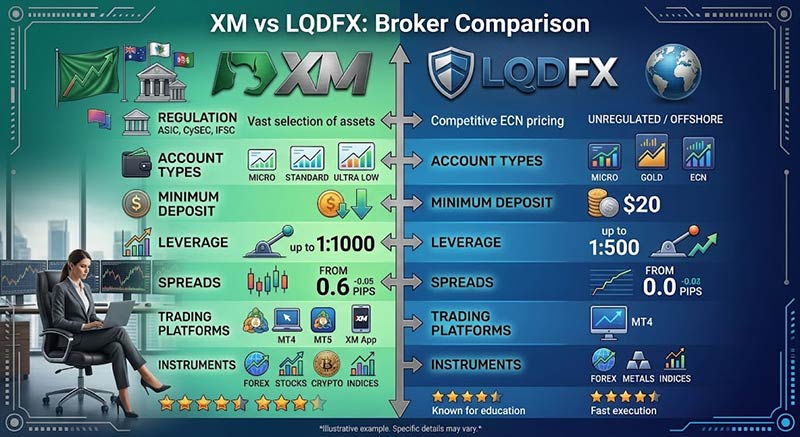
Quick Side-by-Side Comparison
| Feature | XM | LQDFX |
|---|---|---|
| Regulation | CySEC, ASIC, DFSA, FSCA, FSC Belize + others | Unregulated (offshore registration) |
| Minimum Deposit | $5 | $20 |
| Max Leverage | Up to 1:1000 (entity-dependent) | Up to 1:500 / 1:1000 (varies by account) |
| Spreads (EUR/USD typical) | From ~0.6 pips (Ultra Low / KIWAMI) | From ~0.1–1.0+ pips depending on account |
| Platforms | MT4, MT5 | MT4 |
| Account Types | Micro, Standard, Ultra Low/KIWAMI, Zero | Micro, Gold, ECN, VIP, Islamic |
| Deposit Methods | Cards, e-wallets, crypto, local options, wire | Cards, e-wallets, crypto, wire |
| Withdrawal Speed (my tests) | E-wallets same day; cards 1–3 days | Variable; sometimes slower / more friction |
| Education | Strong library + webinars | Decent basic materials |
| Asset Range | 1,000+ instruments | Forex, indices, commodities, metals, crypto |
Head to the official site
Regulation & Safety
This is the section that decides the comparison for me.
XM operates under multiple licences. CySEC (EU), ASIC (Australia), DFSA (Dubai), FSCA (South Africa), and FSC Belize for many international clients. The exact entity depends on where you live. Client funds are segregated. Negative balance protection applies. On the CySEC entity you get Investor Compensation Fund coverage up to €20,000. I verified the licences myself against the regulators’ public registers. It is not perfect — many non-EU clients sit under the Belize entity — but it is real multi-jurisdiction oversight.
Head to the official site
LQDFX has no meaningful regulation. It operated as an offshore broker (Marshall Islands / Saint Lucia style registration). The UK FCA issued a public warning against it for offering services without authorisation. It appeared on warning lists. By 2024–2025 multiple independent sources reported the brand had closed or rebranded (often linked to PlexyTrade), and the website has shown significant accessibility and trust issues. There is no investor compensation scheme, no tier-1 oversight, and no independent audit trail that protects client money the way regulated brokers must.
I treated LQDFX as higher risk from day one. Fund safety is not theoretical. When a broker has no real regulator, disputes become much harder. XM is not risk-free, but the regulatory gap between the two is large and material.
Account Types & Minimum Deposit
XM makes it easy to start. $5 minimum across Micro, Standard, Ultra Low (sometimes called KIWAMI Extreme), and Zero accounts. Micro uses smaller contract sizes (1,000 units), which is useful when you are still refining risk. Standard and Ultra Low use full lots. Zero is the raw-spread account with commission. Availability of Zero can depend on the entity.
LQDFX started at $20 for the Micro account. Gold and ECN accounts required $500. VIP sat at $25,000. Islamic accounts were available. The structure was clear enough, but the jump from Micro to better conditions was steeper than at XM.
I kept a Micro-style account on both for testing smaller size and moved capital into the tighter-spread accounts once I was comfortable with execution.
Spreads, Commissions & Trading Costs
On XM’s Ultra Low / KIWAMI account I regularly saw EUR/USD around 0.6–0.8 pips in liquid conditions, no commission. Standard was wider (often 1.0–1.6). Zero delivered near-zero spreads plus roughly $7–10 round-turn commission per standard lot. During major news the spreads widened, as expected, but I never felt artificially spiked beyond normal market behaviour.
LQDFX advertised tight ECN spreads (0.1 pips on majors on the right account) with commission, or higher fixed-style spreads on Micro/Gold with no commission. In practice the all-in cost on the better accounts was competitive on majors when liquidity was good. During volatile sessions I saw more variability and occasional slower fills than on XM.
Neither is the absolute cheapest broker in the industry, but both were usable. XM felt more consistent day to day.
Head to the official site
Trading Platforms & Tools
Both run MetaTrader 4. XM also offers MT5. The platforms themselves are the same software, so the difference comes down to the broker’s servers, liquidity, and any custom tools.
XM’s environment felt solid. Charts loaded cleanly, EAs ran without drama, and mobile apps were reliable. I used both MT4 and MT5 depending on the instruments. Execution during London open and high-impact news was acceptable for a retail broker — not institutional, but not full of requotes or freezes either.
LQDFX was MT4 only in my experience. It worked. Charts and one-click trading were fine. I had fewer custom indicators and less depth on the research side. Execution was generally fast on the ECN-style accounts, though I noticed more slippage on thin pairs and during spikes compared with XM.
If you live inside MetaTrader, both are functional. XM simply gives you more platform choice and, in my testing, slightly more reliable infrastructure.
Deposit & Withdrawal Methods + Real Experience
XM deposits were straightforward: cards, Skrill, Neteller, crypto, local options in some regions, and bank wire. Most methods credited instantly or within minutes. XM charges no deposit fees on the common methods (third-party or conversion fees can still apply).
Withdrawals were the stronger point. E-wallet requests I submitted were processed the same day, often within a few hours. Card refunds took 1–3 business days. Bank wires were slower (2–5 days) as expected. Minimums were low. I never had a request rejected once verification was complete. The process felt clean.
LQDFX accepted similar methods (cards, e-wallets, crypto, wire). Deposits worked. Withdrawals were more mixed. Some went through in a day or two. Others took longer and occasionally required extra back-and-forth. The lack of regulation meant there was less formal pressure on the broker to process quickly or transparently. That friction is the kind of thing you only notice when you actually need the money.
Customer Support
XM support is available 24/5 via live chat, email, and phone in multiple languages. Responses were usually prompt. Live chat solved most issues in one session. When I had a verification question, they handled it without drama.
LQDFX also offered live chat and email. Response times were decent during my testing, and the agents were polite. The difference showed up when the questions became more technical or account-related — fewer tools and less depth on the other side of the chat.
Education & Research Resources
XM has a solid education section: webinars, video courses, market analysis, economic calendar, and trading calculators. It is useful for newer traders and still worth checking as an experienced one.
LQDFX provided basic educational material, some video lessons, and analysis. It was adequate but thinner. I used XM’s resources more often.
Asset Range
XM offers a wide selection: forex pairs, indices, commodities, energies, metals, crypto CFDs, and a large number of stock CFDs / shares on the appropriate account. Over a thousand instruments in total depending on the entity.
LQDFX focused on forex, indices, commodities, metals, and some crypto. Enough for most currency and commodity traders, but noticeably narrower if you want broader equity exposure.
Pros and Cons
XM Pros
- Multi-jurisdiction regulation and segregated funds
- Very low $5 minimum
- Consistent platform performance and MT4 + MT5
- Reliable, mostly fee-free withdrawals in my experience
- Stronger education and research
- Broad asset range
XM Cons
- Spreads on Standard accounts are not the tightest in the industry
- Some international clients sit under the offshore Belize entity
- Leverage and conditions vary by regulatory entity
Head to the official site
LQDFX Pros
- Low $20 entry point
- Competitive spreads on ECN-style accounts
- High leverage available
- Simple MT4 setup
LQDFX Cons
- No real regulation and history of regulatory warnings
- Higher operational and counterparty risk
- Withdrawals less predictable
- Narrower platform and research offering
- Brand has faced closure / rebrand reports and website reliability issues
Who Each Broker Is Best For
Choose XM if you prioritise fund safety, want a regulated environment, like having both MT4 and MT5, value consistent withdrawals, or are still building experience. It suits beginners who need protection, intermediate traders who want reliability, and anyone who trades a mix of forex and other CFDs.
LQDFX (or its successor brand) only made sense for traders who fully understood and accepted the offshore risk in exchange for specific conditions or bonuses. High-leverage seekers and cost-focused scalpers sometimes looked at it, but the regulation gap is hard to ignore once you have real capital at stake. Given the reported status changes, many of those traders have already moved on.
Head to the official site
After months of real-money testing, XM is the clearer choice for the large majority of traders. The regulatory difference is not a minor detail — it is the foundation of whether your money is properly protected. XM delivers usable spreads, solid platforms, fast and reliable withdrawals in my experience, and enough education and instruments to grow with. LQDFX offered some attractive trading conditions on the right accounts, but the lack of regulation, past warnings, and operational uncertainty made it a higher-risk proposition that I was never fully comfortable with long term.
If safety and consistency matter more than chasing the absolute lowest advertised spread or highest leverage, go with XM. If you are deliberately seeking an unregulated offshore environment and accept the trade-offs, research the current operating status of any successor brand extremely carefully. In 2026, for most people reading this, XM is the better broker.
Head to the official site
FAQ
Is XM safer than LQDFX? Yes. XM holds multiple real regulatory licences and keeps client funds segregated. LQDFX operated without meaningful oversight and carried regulatory warnings. Fund safety is materially stronger at XM.
Which has lower trading costs — XM or LQDFX? It depends on the account. XM’s Ultra Low / KIWAMI accounts and LQDFX’s ECN accounts can both be competitive on majors. Overall consistency and all-in cost favoured XM in my testing.
Can I start with a small deposit on both? Yes. XM from $5, LQDFX from $20. Both are accessible for small accounts.
How fast are withdrawals on XM vs LQDFX? On XM, e-wallet withdrawals were typically same-day for me. LQDFX was more variable and sometimes slower. Regulated brokers generally face stronger incentives to process client funds promptly.
Does LQDFX still operate ? Multiple independent sources report that the original LQDFX brand closed or rebranded (commonly linked to PlexyTrade). Website accessibility and trust scores have been problematic. Always verify the current legal entity and regulatory status yourself before depositing.
Which is better for beginners? XM. The combination of regulation, low minimum, educational resources, and reliable operations makes it the more suitable starting point.

•Most Trusted Broker — Asia 2026
•Broker of the Year — LATAM 2026
These awards confirm our commitment to building a rewarding trading environment and helping you uncover your potential. Thank you for choosing to trade with an award-winning broker!
Why choose MetaTrader 5 with Top Forex Brokers?
•Blazing-fast execution & enhanced stability
•38 built-in technical indicators & 21 timeframes for precision trading
•Optimized for all devices—desktop, mobile & web
•Trade a wide range of assets: Stocks, Commodities, Forex & more!
Disclaimer: Trading forex and CFDs carries a high level of risk and may not be suitable for all investors. Ensure you understand the risks involved and consider your financial situation before trading.