

I’ve spent several months trading real money on both XM and RoboMarkets in 2026. Same strategy on majors, some stock CFDs, a bit of gold and indices, and a few withdrawals on each side. The choice isn’t as clear-cut as the marketing pages make it sound. One feels more polished for pure forex and multi-asset CFDs with strong beginner support. The other shines when you want deeper stock and ETF access plus more platform options. Here’s the honest breakdown after living with both.
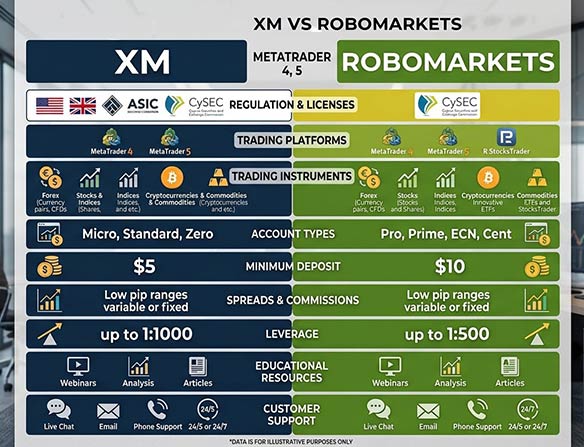
Quick Side-by-Side Comparison
| Feature | XM | RoboMarkets |
|---|---|---|
| Regulation | CySEC, ASIC, DFSA, FSCA, FSC Belize + others | CySEC (primary EU focus), additional offshore entities |
| Min. Deposit | $5 | Around $100 / €100 |
| Max Leverage (non-EU) | Up to 1:1000 | Up to 1:500 (varies by entity/account) |
| Max Leverage (EU retail) | 1:30 | 1:30 |
| Platforms | MT4, MT5 | MT4, MT5, cTrader, R StocksTrader |
| Spreads (EUR/USD typical) | Standard ~1.0–1.6; Ultra Low from ~0.6; Zero from 0.0 + commission | Standard from ~1.3; ECN/Prime from 0.0 + commission |
| Key Strength | Low barrier, education, multi-jurisdiction safety | Stock/ETF depth + multi-platform flexibility |
| Assets | 1,400+ CFDs | Thousands of stocks/ETFs + CFDs |
Regulation & Safety
XM spreads its licenses across multiple jurisdictions. CySEC covers EU clients properly under MiFID rules with investor compensation and negative balance protection. ASIC handles Australian clients. DFSA, FSCA and the Belize FSC entity cover other regions. This multi-entity setup gives broader geographic reach and different protection levels depending on where you live. I’ve always felt reasonably comfortable knowing which entity my account sits under.
Head to the official site
RoboMarkets leans heavily on its CySEC license (191/13). For EU/EEA traders this means the standard suite of protections: segregated funds, negative balance protection, and the Investor Compensation Fund up to €20,000. The group has also shifted its European retail focus more toward stocks, bonds and ETFs in recent years, with the Cyprus entity moving institutional in some cases. International clients may land under different entities. Both brokers keep client money segregated, which matters when markets get wild.
If you’re outside the EU and want higher leverage with solid multi-regulator coverage, XM feels more flexible. EU residents get solid protection from both, though RoboMarkets’ CySEC focus is straightforward.
Account Types & Minimum Deposit
XM wins on accessibility. You can open a Micro, Standard, Ultra Low or Zero account with just $5. Micro lots make it easy to test ideas without risking much. Ultra Low tightens spreads without commissions. Zero gives raw spreads plus a commission (around $3.50 per side per lot on many reports). There’s also a Shares account for real shares in select regions, though the minimum jumps higher.
RoboMarkets typically starts around $100. You’ll find Pro/Standard-style accounts with wider spreads and no commission, ECN or Prime accounts with raw spreads plus commission, Pro Cent for smaller sizing, and dedicated R StocksTrader accounts. The higher entry barrier is noticeable if you’re just testing the waters, but once funded the account range covers different styles well.
I started small on XM and felt zero pressure. On RoboMarkets I waited until I had a clearer plan because of the higher minimum.
Spreads, Commissions & Trading Costs
During quiet London sessions my EUR/USD spreads on XM Ultra Low hovered around the mid-to-high 0.something range on average. Standard accounts ran wider, closer to 1.5. Zero accounts delivered the tightest raw spreads but the commission adds up if you scalp heavily. Gold and some indices felt competitive too.
RoboMarkets Standard accounts sat a bit wider in my experience (around 1.3+ on majors). ECN and Prime accounts tightened things nicely with commissions that felt reasonable for the liquidity. On stocks and ETFs the pricing model shifts—often a percentage-based or per-share approach that can work out cheaper for longer-term equity positions than pure CFD spreads.
Neither is the absolute cheapest in the industry for pure raw ECN forex, but both stay competitive once you pick the right account. I watched costs more carefully on higher-frequency trades and switched accounts accordingly.
Head to the official site
Trading Platforms & Tools
This is where RoboMarkets pulls ahead for many traders. You get the familiar MT4 and MT5, plus cTrader for depth-of-market lovers, and the proprietary R StocksTrader. R StocksTrader is built for equities and multi-asset work. Level II data, corporate actions handling, fractional shares in some cases, and a strategy builder make it feel more like a proper investment platform than a pure CFD terminal. I used it for stock CFDs and actual equity exposure and preferred the interface over pure MetaTrader for that purpose.
XM sticks to MT4 and MT5 plus its own app and web trader. Execution felt solid during volatility—I didn’t experience major requotes or freezes on either broker when NFP or central bank decisions hit. XM’s platform is clean and reliable, especially if you already live in MetaTrader. RoboMarkets simply gives you more options without forcing you to open a second account elsewhere for stocks.
Head to the official site
Deposit & Withdrawal Methods + Real Experience
Both support cards, bank transfers, and popular e-wallets. XM also handles various local methods and some crypto depending on region. Deposits on XM were usually instant for cards and e-wallets. My first bank withdrawal took a couple of business days after verification; subsequent ones were faster. XM generally doesn’t charge its own fees on most methods (banks or processors might).
RoboMarkets deposits cleared quickly for cards and e-wallets. Withdrawals were reliable in my tests, though some card methods carried fees on their side. Processing times stayed within the stated windows. Neither broker made me chase money, which is the real test after a few months of use. Always complete full verification early—both require it before larger withdrawals.
Customer Support
XM’s live chat and email responses were consistently helpful and reasonably fast during my trading hours. They handle multiple languages well. RoboMarkets support was also responsive via chat and email; I never waited long for account or platform questions. Both are solid rather than exceptional. When markets are quiet you get quick answers. During major news the queues lengthen on both, as expected.
Education & Research Resources
XM puts real effort here. Daily webinars, video courses, market analysis, and a loyalty program that actually rewards volume. For someone still refining strategy or teaching others, the educational library is a genuine plus. RoboMarkets offers useful tools, economic calendars, and analysis, but it feels lighter on structured beginner-to-intermediate education compared with XM. Advanced traders who already know what they’re doing won’t mind.
Asset Range
XM gives you a broad CFD selection: 50+ forex pairs, hundreds of stock CFDs, indices, commodities, cryptos, and some thematic products—over 1,400 instruments in total. It’s more than enough for most multi-asset CFD traders.
Head to the official site
RoboMarkets stands out on the equity side. Through R StocksTrader you get access to thousands of real stocks and ETFs from US, European (including expanded Xetra listings), UK and other markets. The CFD range is solid too, but the depth in actual equities and ETFs is the differentiator. If your trading mixes leveraged forex with longer-term stock positions, RoboMarkets reduces the need for a second broker.
Pros and Cons
XM Pros
- Extremely low $5 minimum
- Strong multi-jurisdiction regulation
- Excellent education and loyalty rewards
- Reliable MT4/MT5 execution
- Easy for beginners and small accounts
XM Cons
- Fewer platform choices
- Stock/ETF offering is mostly CFDs rather than deep real equity access
- Spreads on standard accounts can feel average
Head to the official site
RoboMarkets Pros
- Four platforms including R StocksTrader
- Excellent stock and ETF selection
- Competitive raw spread accounts
- Solid CySEC protection for EU clients
- Flexible multi-asset setup
RoboMarkets Cons
- Higher minimum deposit
- Education resources less comprehensive
- EU retail leverage capped (same as XM)
- Some regional entity differences after the group’s strategic shifts
Who Each Broker Is Best For
XM suits:
- Beginners or traders starting with small capital
- Those who want strong educational support and regular webinars
- Multi-jurisdiction clients seeking higher leverage outside the EU
- Pure CFD/forex traders happy with MT4/MT5
Head to the official site
RoboMarkets suits:
- Stock and ETF-focused traders who want real equity access
- Traders who value platform choice (especially cTrader or R StocksTrader)
- EU residents comfortable with CySEC regulation
- Mixed-style traders who switch between leveraged CFDs and longer-term positions
High-leverage seekers outside strict ESMA regions will lean toward XM’s non-EU entities. Strict EU retail traders face the same 1:30 cap on both.
After months of real trading I keep both accounts open for different purposes. For pure forex and CFD work with low capital and good educational backup, XM remains the more practical daily driver. The low barrier, multi-regulator safety net, and consistent platform performance make it hard to beat for many traders in 2026.
If stocks, ETFs, and platform flexibility matter more—or if you want a stronger equities-focused environment under CySEC—RoboMarkets edges ahead. R StocksTrader alone justifies the higher minimum for equity-oriented accounts.
My personal recommendation: open a small XM account first if you’re still finding your style or trading mainly forex/CFDs. Move meaningful equity capital to RoboMarkets (or run both) once you know you need the stock depth and extra platforms. Test withdrawals early on whichever you choose. Conditions change, so always verify the latest spreads, leverage, and entity details for your country before funding.
Neither broker is perfect. Both are solid, regulated options that have treated my capital fairly. Pick based on your actual trading mix rather than marketing claims.
Head to the official site
FAQ: XM vs RoboMarkets
Which is better overall in 2026, XM or RoboMarkets? It depends on priorities. XM for accessibility, education and multi-regulator coverage. RoboMarkets for stocks/ETFs and platform variety.
Is XM safer than RoboMarkets? Both are properly regulated. XM’s multi-jurisdiction licenses give broader coverage. RoboMarkets’ CySEC focus is strong for EU clients. Safety also depends on the specific entity your account sits under.
Can EU traders use high leverage on either broker? No. Retail clients under CySEC (and equivalent EU rules) are capped at 1:30 on major forex pairs on both platforms.
Which has tighter spreads? Raw/Zero or ECN-style accounts on both can be very competitive. XM Ultra Low and Zero, and RoboMarkets ECN/Prime, are the ones to compare with live quotes for your pairs.
Does RoboMarkets still offer forex and CFDs? Yes, though the European retail emphasis has shifted more toward stocks and ETFs. International and certain entities still support broader CFD trading.
How fast are withdrawals on XM vs RoboMarkets? Both processed my requests within the stated timeframes once verification was complete. E-wallets were usually fastest on both.

•Most Trusted Broker — Asia 2026
•Broker of the Year — LATAM 2026
These awards confirm our commitment to building a rewarding trading environment and helping you uncover your potential. Thank you for choosing to trade with an award-winning broker!
Why choose MetaTrader 5 with Top Forex Brokers?
•Blazing-fast execution & enhanced stability
•38 built-in technical indicators & 21 timeframes for precision trading
•Optimized for all devices—desktop, mobile & web
•Trade a wide range of assets: Stocks, Commodities, Forex & more!
Disclaimer: Trading forex and CFDs carries a high level of risk and may not be suitable for all investors. Ensure you understand the risks involved and consider your financial situation before trading.