

I’ve spent months trading real money with both IC Markets and NSFX. Same strategies, same pairs, same news events. One felt like a professional setup from day one. The other felt more limited and, at times, frustrating. If you’re stuck choosing between them, this is the comparison I wish I’d had before depositing.
Most traders looking at IC Markets vs NSFX are after low costs, decent execution, and some regulatory peace of mind. The gap between these two is bigger than the marketing suggests.
Head to the official site
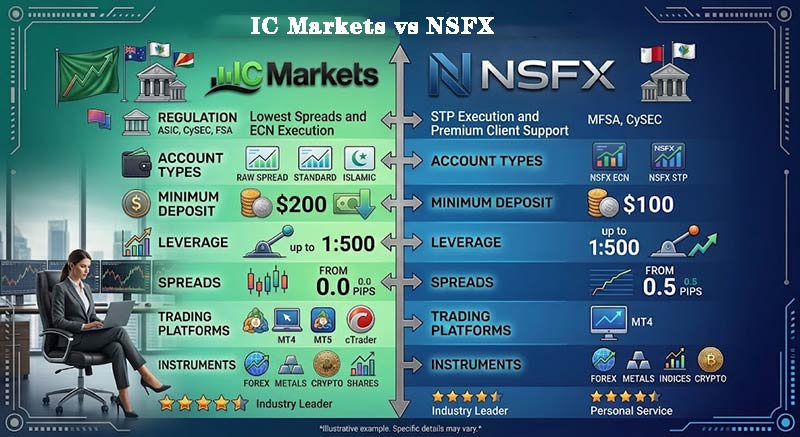
Quick Side-by-Side Comparison
| Feature | IC Markets | NSFX |
|---|---|---|
| Founded | 2007 | ~2010 |
| Regulation | ASIC, CySEC, FSA Seychelles (+ others) | MFSA (Malta) |
| Minimum Deposit | $200 | $300 (Fixed); higher for ECN/JForex |
| Spreads (EUR/USD typical) | 0.0 + commission (Raw) or ~0.6–0.8 (Standard) | Fixed ~3 pips or variable from ~0.4 + $8 RT |
| Commission (Raw/ECN) | $3.50/side (MT4/MT5), $3/side (cTrader) | $8 round-turn |
| Platforms | MT4, MT5, cTrader, TradingView | MT4, JForex |
| Max Leverage | Up to 1:500–1:1000+ (entity dependent) | Typically 1:50 |
| Instruments | 2,000+ | ~50–60 (mainly FX, metals, indices, energies) |
| Negative Balance Protection | Yes (most entities) | Yes |
Regulation & Safety
This is the first place I look, and it was a clear separator.
IC Markets runs under multiple licenses: ASIC in Australia, CySEC in Cyprus for EU clients, and FSA Seychelles for the global entity most international traders use. ASIC and CySEC are stricter. Client funds sit in segregated accounts. Negative balance protection applies on the main entities. The Seychelles entity is offshore, so protection is lighter there, but the brand has operated cleanly for nearly two decades and processes huge daily volume.
Head to the official site
NSFX holds an MFSA Category 3 Investment Services licence in Malta (IS/56519). It is MiFID-compliant and participates in the Maltese Investor Compensation Scheme (up to €20,000 for eligible clients). Funds are segregated and negative balance protection is offered. MFSA is a legitimate EU regulator, but it sits below ASIC or FCA in terms of perceived strictness and enforcement resources. Some older reviews mention passporting into other EU countries, yet the overall regulatory footprint is narrower than IC Markets’.
In practice I felt more comfortable scaling position size on IC Markets. The multi-jurisdiction setup and longer track record matter when markets get chaotic.
Account Types & Minimum Deposit
IC Markets keeps it simple. Standard account (spreads from around 0.6–0.8 pips, no commission) and Raw Spread accounts (from 0.0 pips plus commission). Minimum is $200 across the board. Islamic accounts are available. You can open both Standard and Raw and switch based on your volume.
NSFX offers Fixed Spread (MT4), ECN (MT4), and JForex accounts. Fixed starts at $300 with fixed spreads. ECN and JForex require higher deposits in many reports ($3,000 and $5,000 respectively). Leverage is capped lower, typically around 1:50 for retail clients under the MFSA regime.
The lower entry point and clearer account structure on IC Markets made it easier to start and test properly.
Spreads, Commissions & Trading Costs
This is where the difference becomes painful for active traders.
On IC Markets Raw Spread I regularly saw EUR/USD at 0.0–0.1 during London/New York overlap, plus $3.50 per side on MT4/MT5 ($7 round-turn) or $3 per side on cTrader. Standard account averaged under 1 pip most of the time. During high-impact news the spreads widened, but execution stayed usable and I rarely suffered major negative slippage on limit orders.
NSFX Fixed account sits around 3 pips on majors. ECN/JForex quotes variable spreads from roughly 0.4 on EUR/USD plus $8 round-turn commission. The all-in cost on the raw-style accounts is higher than IC Markets for the same volume. I ran identical scalping setups on both; the cost difference added up fast over a few hundred trades.
If you trade high frequency or larger size, IC Markets is simply cheaper in live conditions.
Head to the official site
Trading Platforms & Tools
IC Markets gives you proper choice: MT4, MT5, cTrader, and TradingView integration. cTrader’s depth of market and order types are excellent for discretionary work. MT5 and MT4 handle EAs without drama. Free VPS is available once you hit a reasonable monthly volume. Platform stability was solid during the months I tested — no random disconnects that killed trades.
NSFX sticks mainly to MT4 and JForex. JForex has its fans for algorithmic and depth features, but the overall ecosystem is thinner. No MT5, no native cTrader, limited advanced tools compared with IC Markets. For pure MT4 users this is fine. For anyone who likes platform flexibility it feels restricted.
Execution speed on IC Markets felt consistently tighter, especially around news. NSFX was acceptable on quieter days but showed more variance when volatility spiked.
Head to the official site
Deposit & Withdrawal Methods + Real Experience
Both accept cards, bank wires, and popular e-wallets (Skrill, Neteller, etc.). IC Markets processes most withdrawals within 24 hours on e-wallets and cards in my experience; bank wires take longer as expected. Broker-side fees are generally zero on standard methods. I never had a withdrawal delayed beyond the stated timeframe.
NSFX also supports similar methods. Processing times were usually 1 business day in the periods I tested, though some older feedback mentions occasional slower support responses on funding queries. Always check current fees, as third-party charges can apply on both.
Customer Support
IC Markets support is available 24/5 via live chat, email, and phone. Responses were quick and the agents usually understood trading questions without reading from a script. I had a couple of verification and platform queries sorted the same day.
NSFX offers live chat and email. Early interactions were fine, but later reports and my own follow-ups suggested slower or less consistent replies at times. Not a deal-breaker for occasional questions, but noticeable if you need fast answers during live sessions.
Education & Research Resources
Neither is a full education powerhouse. IC Markets provides market analysis, webinars, and economic calendars that are useful enough for intermediate traders. Research tools and third-party integrations (TradingView especially) help more than any in-house course.
NSFX has basic educational material and daily market commentary. It is thinner overall. If you are a complete beginner you will need external resources with either broker.
Asset Range
IC Markets offers a much wider selection: 60+ forex pairs plus indices, commodities, stock CFDs, crypto CFDs, bonds, and more — over 2,000 instruments in total depending on the entity. I could move between FX, gold, oil, and a few indices without opening multiple accounts.
NSFX focuses on forex, metals, energies, and indices. The list is shorter (around 50–60 instruments in most reports). Stock and crypto access is limited or absent under the main MFSA offering. For pure FX traders this may not matter. For multi-asset strategies IC Markets is clearly stronger.
Head to the official site
Pros and Cons
IC Markets Pros
- Tight raw spreads and competitive commissions
- Multiple high-quality platforms
- Strong multi-jurisdiction regulation and long track record
- Excellent for scalping, EAs, and high-volume trading
- Wide instrument range and solid execution
IC Markets Cons
- $200 minimum may still feel high for absolute beginners
- Offshore entity for many clients carries lighter compensation protection
- Education is average
Head to the official site
NSFX Pros
- MFSA regulation with EU-style investor compensation
- Fixed-spread option for predictable costs
- JForex available for those who prefer it
- Negative balance protection and segregated funds
NSFX Cons
- Higher all-in trading costs on ECN-style accounts
- Limited platforms and instrument range
- Lower maximum leverage
- Higher minimums on the better account types
- Support consistency has drawn mixed feedback
Who Each Broker Is Best For
Choose IC Markets if you are:
- A scalper or high-frequency trader
- Running EAs or algorithmic strategies
- Looking for the lowest real trading costs
- Trading multiple asset classes
- Comfortable with a multi-entity regulatory structure
Head to the official site
Choose NSFX if you are:
- Primarily an EU resident who prioritises MFSA oversight and the €20,000 compensation scheme
- Prefer fixed spreads and simpler cost calculation
- Trading mainly forex on MT4 or JForex with moderate volume
- Not focused on ultra-tight pricing or platform variety
Beginners can start on either, but the lower costs, better platforms, and broader tools on IC Markets make the learning process less expensive in real terms.
After trading both with real money, IC Markets is the stronger overall broker for most active traders The combination of tighter pricing, superior platform choice, faster and more consistent execution, and a deeper regulatory footprint outweighs NSFX’s MFSA licence and fixed-spread option.
Head to the official site
NSFX is not a scam and offers legitimate EU regulation with basic protections. For pure FX traders in certain regions who value the Maltese framework and do not mind higher costs or fewer tools, it can work. But when I compared live spreads, slippage during news, withdrawal reliability, and day-to-day usability, IC Markets pulled ahead clearly.
If your priority is regulation first and you are based in the EEA, verify the exact entity and protections available to you on both. If your priority is execution quality and trading costs — which decide most of my results — IC Markets is the better choice.
FAQ
Is IC Markets better than NSFX for scalping?
Yes. Lower all-in costs, tighter raw spreads, and platforms built for speed give IC Markets a clear edge for scalpers.
Which has better regulation — IC Markets or NSFX?
IC Markets holds stronger multi-jurisdiction licences including ASIC and CySEC. NSFX’s MFSA licence is solid EU regulation but narrower in scope and perceived strength.
What is the minimum deposit for IC Markets vs NSFX?
IC Markets requires $200. NSFX starts at $300 for the Fixed account and higher for ECN and JForex accounts.
Can I use MetaTrader with both brokers?
Yes. Both offer MT4. IC Markets also provides MT5 and cTrader.
Which broker has lower trading costs?
IC Markets. Raw accounts deliver lower average all-in costs than NSFX’s ECN-style pricing in live trading.
Is NSFX still active and reliable?
It remains MFSA-regulated. However, some traders have reported slower support responsiveness in recent periods. Always verify current licence status and test deposits/withdrawals yourself before committing significant capital.
Trade carefully. Past conditions do not guara

•Most Trusted Broker — Asia 2026
•Broker of the Year — LATAM 2026
These awards confirm our commitment to building a rewarding trading environment and helping you uncover your potential. Thank you for choosing to trade with an award-winning broker!
Why choose MetaTrader 5 with Top Forex Brokers?
•Blazing-fast execution & enhanced stability
•38 built-in technical indicators & 21 timeframes for precision trading
•Optimized for all devices—desktop, mobile & web
•Trade a wide range of assets: Stocks, Commodities, Forex & more!
Disclaimer: Trading forex and CFDs carries a high level of risk and may not be suitable for all investors. Ensure you understand the risks involved and consider your financial situation before trading.