

I spent several months trading live accounts with both IC Markets and FBS. Real money. Real positions. News events, quiet Asian sessions, and those frustrating high-impact releases. The choice between these two is one of the more common dilemmas I see traders face, especially once they move past pure beginner brokers.
IC Markets has the reputation for institutional-grade execution and raw pricing. FBS pulls people in with a $5 minimum, high leverage, and a more approachable feel. After testing both, the differences show up clearly in costs, platform options, regulation quality, and how the account behaves when the market gets messy.
Head to the IC Markets official site
Here’s the practical breakdown from someone who actually used both.
Quick Side-by-Side Comparison
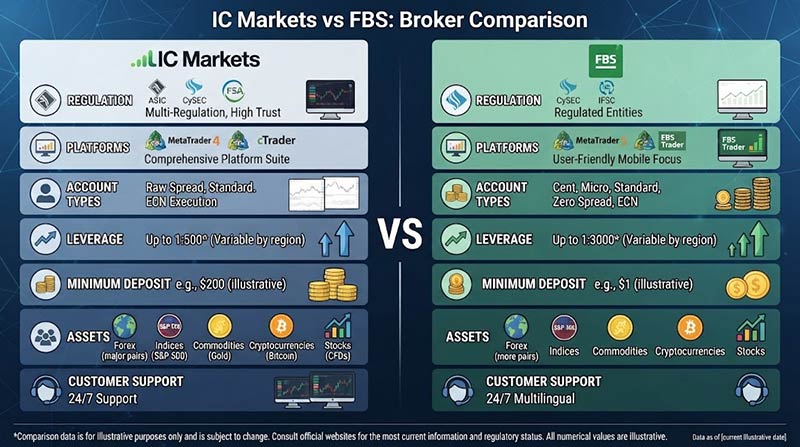
| Feature | IC Markets | FBS |
|---|---|---|
| Primary Regulation | ASIC, CySEC, FSA Seychelles | CySEC, ASIC (entities), IFSC Belize |
| Minimum Deposit | Usually $200 | $5 ($1 Cent) |
| EUR/USD Spreads | From 0.0 (Raw) + commission | From ~0.7–0.9 (Standard) |
| Commission (Raw/ECN) | $3.50/side MT / $3 cTrader | Varies; higher on Zero/ECN |
| Max Leverage | Up to 1:500 (higher offshore) | Up to 1:3000 |
| Platforms | MT4, MT5, cTrader, TradingView | MT4, MT5, FBS Trader app |
| Approx. Instruments | 2,000+ | ~500–600 |
| Best For | Scalpers, algos, serious volume | Low-capital, beginners, bonuses |
Numbers move, so always check the live site for your region and entity.
Head to the IC Markets official site
Regulation & Safety
This is the first place the two brokers diverge.
IC Markets runs a multi-entity structure. Australian clients sit under the ASIC licence (AFSL 335692). EU clients under CySEC. Many international clients end up with the FSA Seychelles entity (Raw Trading Ltd). The ASIC and CySEC oversight carry real weight — segregated funds, negative balance protection on the regulated entities, and proper reporting. The Seychelles side is lighter, which is standard for offshore retail access.
FBS also holds CySEC and has had ASIC involvement through certain entities, plus the Belize IFSC licence that covers a large part of its international business. The CySEC entity offers the stronger protection (including investor compensation up to €20,000). The Belize side is more typical offshore fare.
In practice I felt more comfortable leaving larger balances with IC Markets, especially once I moved past a few thousand dollars. Both keep client funds segregated, but the tier-1 licences at IC Markets give clearer recourse if something goes wrong. FBS is not a fly-by-night operation — it has been around since 2009 and serves a huge client base — but the regulatory mix is simply not as strong overall.
Head to the IC Markets official site
Account Types & Minimum Deposit
FBS wins the accessibility contest hands down. You can open a Cent account with $1 or a Standard with $5. That low barrier is genuine. I started one of my test accounts with a small amount just to check the process and was trading the same day.
IC Markets sits higher. Most accounts effectively require around $200. Some global pages show lower or zero minimums, but in practice $200 is the realistic starting point for proper conditions. Once funded, the account types are cleaner: Standard (markup, no commission) and Raw Spread (tight spreads + commission). No confusing maze of Cent, Micro, Zero, Ultra, etc.
If you are testing with very small capital or want to scale gradually without pressure, FBS is easier. If you already have a few hundred dollars and care more about pricing than the entry ticket, IC Markets is fine.
Spreads, Commissions & Trading Costs
This is where IC Markets pulls ahead for active traders.
On the Raw Spread account I consistently saw EUR/USD hovering around 0.0–0.1 during London/New York overlap, with the $3.50 per side commission on MetaTrader ($7 round turn). On cTrader the commission is slightly better at $3 per side. During quiet periods the all-in cost stayed competitive. On news it widened, of course, but the depth felt solid and fills were clean.
FBS Standard account spreads typically sat higher — often 0.7–1.0 on EUR/USD in normal conditions, sometimes more. Their Zero or ECN-style accounts tighten the spread but add commissions that can make the total cost higher than IC’s Raw for frequent traders. High leverage is available (up to 1:3000), which looks attractive until you calculate the real cost of the wider spreads on volume.
For a scalper or someone running an EA with decent frequency, IC Markets was noticeably cheaper over a month of trading. For a swing trader placing a few positions a week, the difference shrinks and FBS becomes more acceptable.
Trading Platforms & Tools
IC Markets has the clear platform advantage.
You get MetaTrader 4, MetaTrader 5, cTrader, and TradingView integration. cTrader is particularly strong — Level II depth, clean interface, and solid algorithmic tools. I ran most of my more active testing on cTrader and MT5 with IC Markets and never felt restricted. Free VPS is available once you hit certain volume thresholds.
FBS sticks mainly to MT4, MT5, and their own FBS Trader app. The app is decent for mobile monitoring and quick trades, and the MetaTrader platforms work fine. But you lose the cTrader option and the deeper TradingView connection that IC Markets offers. For pure MetaTrader users the difference is smaller. For anyone who likes order-book visibility or more modern charting, IC Markets feels like a step up.
Execution quality mattered more than the platform list. During NFP and CPI releases I saw tighter slippage and fewer awkward fills on IC Markets. FBS was acceptable in normal conditions but felt a bit more variable when volatility spiked.
Deposit & Withdrawal Methods + Real Experience
Both brokers support cards, bank transfers, and major e-wallets. Crypto is available on both in many regions.
My deposits hit both accounts quickly. Withdrawals told a clearer story. IC Markets processed e-wallet and card withdrawals within a few hours on most occasions, sometimes same day. Bank wires took the usual 1–3 business days. No fees from the broker side in my experience.
FBS was also fast on e-wallets (often under an hour once processed), but I had one card withdrawal that sat longer than expected and required a follow-up. Local payment methods can be strong depending on your country, which is useful for some traders. Overall I found IC Markets more consistent on the cash-out side, especially once the account had history.
Head to the IC Markets official site
Customer Support
Both offer 24/5 or 24/7 live chat. IC Markets support felt a bit more professional and faster on technical questions about platforms and execution. FBS support was friendly and helpful for account and funding issues, though response quality varied more by time of day and agent.
Neither is perfect at peak hours, but neither left me hanging for days either.
Education & Research Resources
FBS is stronger here for newer traders. They put more visible effort into educational content, webinars, and market analysis aimed at beginners and intermediate users. IC Markets is lighter on the education side. Their focus sits more on the trading environment itself — analysis tools exist (Trading Central, etc.), but you will not find the same volume of beginner-friendly courses.
If you still need structured learning, FBS has the edge. If you already know what you are doing, the difference is minor.
Asset Range
IC Markets offers a broader selection — over 2,000 instruments including a solid list of stock CFDs, indices, commodities, some bonds, and crypto. FBS covers the core forex pairs, metals, energies, indices, and a reasonable stock and crypto CFD list, but the total number is lower.
For pure forex trading the difference is small. Once you start looking at indices or individual stocks, IC Markets gives more choice.
Head to the IC Markets official site
Pros and Cons
IC Markets Pros
- Genuine raw spreads and transparent commissions
- Excellent multi-platform support (especially cTrader)
- Stronger overall regulatory profile
- Fast, consistent execution
- Suitable for scalping and algorithmic strategies
IC Markets Cons
- Higher minimum deposit
- Education is limited
- Offshore entity for many international clients
Head to the IC Markets official site
FBS Pros
- Extremely low minimum deposit
- High leverage available
- Decent education resources
- User-friendly for smaller accounts
- Frequent promotions and bonuses
FBS Cons
- Higher average trading costs for active traders
- Fewer platform options
- Regulatory setup is mixed (stronger on CySEC, lighter offshore)
- Execution quality not quite at the same level during volatility
Who Each Broker Is Best For
Choose IC Markets if you:
- Scalp or run EAs
- Trade high volume and care about every pip of cost
- Want cTrader or deeper platform choice
- Prefer stronger regulatory oversight
- Already have at least a few hundred dollars to fund properly
Choose FBS if you:
- Are starting with very small capital
- Want high leverage and simple account opening
- Value educational content and promotions
- Trade less frequently and prioritise accessibility
- Prefer a more beginner-oriented environment
Head to the IC Markets official site
After months of real-money testing, IC Markets is the better broker for most serious traders. The combination of raw pricing, platform choice, execution quality, and regulatory structure simply produces a cleaner, more professional trading environment. Costs are lower once you are active, and the account behaves more predictably when it matters.
FBS is not a bad broker. It serves a different purpose well — low entry, high leverage, and a softer onboarding curve. For someone testing the waters or running a small account, it can make sense. Once your capital and frequency increase, the higher spreads and narrower platform set start to cost more than the convenience is worth.
My personal recommendation is straightforward. If you can meet the higher minimum and you care about execution and costs, go with IC Markets. If you need the $5 entry and the educational support, start with FBS and plan to move later. The gap in quality is real, and it shows up in the statement over time.
Head to the IC Markets official site
FAQ
Is IC Markets better than FBS for scalping?
Yes. The raw spreads, commission structure, and execution speed give IC Markets a clear edge for scalpers and short-term strategies.
Which broker has lower trading costs?
IC Markets on the Raw Spread account, especially for frequent traders. FBS Standard looks cheaper on the surface but usually ends up higher once volume builds.
Can I start with a small deposit on both?
Only on FBS comfortably. IC Markets effectively needs around $200 for proper conditions in most cases.
Which has stronger regulation?
IC Markets, thanks to the combination of ASIC and CySEC entities alongside its offshore licence. FBS has CySEC protection for some clients but relies more heavily on its Belize licence for others.
Do both allow EAs and scalping?
Yes. Neither restricts algorithmic trading or scalping in normal conditions.
Which is better for beginners?
FBS, mainly because of the low minimum deposit and stronger educational resources. Just be aware that the trading costs are higher once you start trading more actively.

•Most Trusted Broker — Asia 2026
•Broker of the Year — LATAM 2026
These awards confirm our commitment to building a rewarding trading environment and helping you uncover your potential. Thank you for choosing to trade with an award-winning broker!
Why choose MetaTrader 5 with Top Forex Brokers?
•Blazing-fast execution & enhanced stability
•38 built-in technical indicators & 21 timeframes for precision trading
•Optimized for all devices—desktop, mobile & web
•Trade a wide range of assets: Stocks, Commodities, Forex & more!
Disclaimer: Trading forex and CFDs carries a high level of risk and may not be suitable for all investors. Ensure you understand the risks involved and consider your financial situation before trading.