

I spent several months trading real money on both XM and NSFX. Same strategy, same pairs, same news events. The goal was simple: see which one actually feels better day-to-day once the marketing pages stop mattering.
Choosing between these two is not straightforward. One makes it ridiculously easy to start and learn. The other sits under a proper European regulator but asks for more capital and delivers a narrower offering. After living with both platforms, the differences became obvious fast.
Head to the XM official site
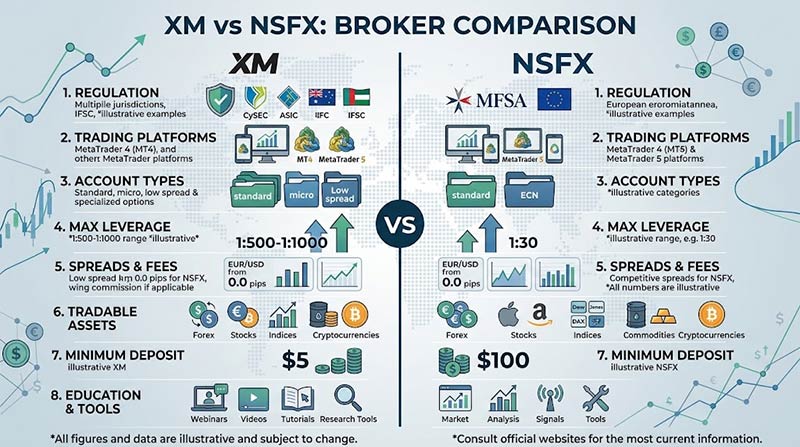
Quick Side-by-Side Comparison
| Feature | XM | NSFX |
|---|---|---|
| Regulation | Multi-entity (CySEC, ASIC, DFSA, FSCA, FSC offshore entities) | MFSA (Malta) Category 3 |
| Minimum Deposit | $5 | $300 (higher for ECN/JForex) |
| Max Leverage (retail) | Up to 1:1000 (non-EU) / 1:30 (EU) | Up to 1:50 / 1:30 |
| Spreads (EUR/USD typical) | From 0.8 pips (Ultra Low) / 1.6+ Standard | Fixed ~3 pips or variable from ~0.4 + commission |
| Platforms | MT4, MT5, XM App | MT4, JForex |
| Instruments | 1,000–1,400+ | ~50–80 |
| Education | Extensive (webinars, videos, academy) | Basic |
| Deposit Methods | Very wide | Limited (cards, wire, e-wallets) |
Regulation & Safety
This is the first place most serious traders look, and for good reason.
XM operates through multiple legal entities. Clients in certain regions get CySEC or ASIC protection. Most international clients end up under offshore licences (Belize, Seychelles, Mauritius). Funds are segregated and negative balance protection applies across the board. The multi-jurisdiction setup gives XM global reach, but the level of protection clearly depends on which entity holds your account.
Head to the XM official site
NSFX is regulated by the Malta Financial Services Authority (MFSA) under a Category 3 investment services licence. Malta falls under the EU MiFID framework. Client funds sit in segregated accounts, negative balance protection is in place, and eligible clients can access investor compensation of up to €20,000. For traders who specifically want European regulation without jumping through extra hoops, NSFX has a cleaner single-regulator story.
In practice I felt comfortable with both on the safety side. XM’s bigger footprint and longer track record (since 2009) gave me slightly more confidence when moving larger amounts. NSFX’s MFSA licence is solid, but the broker is smaller and less visible.
Account Types & Minimum Deposit
XM wins this category without contest.
You can open a Micro, Standard or Ultra Low account with just $5. That low barrier let me test strategies with real risk without committing serious capital. NSFX starts at $300 for the fixed-spread account and jumps to $3,000–$5,000 for the proper ECN and JForex accounts. That higher entry point immediately filters out beginners and small-account traders.
Head to the XM official site
Both offer Islamic (swap-free) accounts on request. XM’s account range simply feels more practical for most people starting out or scaling gradually.
Spreads, Commissions & Trading Costs
Real trading costs matter more than advertised “from” figures.
On XM’s Ultra Low account I regularly saw EUR/USD around 0.8–1.2 pips during London and New York sessions with no commission. Standard accounts sat closer to 1.6–2.0 pips. During high-impact news the spreads widened, as expected, but execution stayed acceptable. The Zero account (raw spreads + commission) is available in some regions and can work out cheaper for high-volume traders.
NSFX’s fixed-spread account locked major pairs around 3 pips. Predictable, but expensive if you trade often. The ECN accounts offered tighter variable spreads (I saw EUR/USD average around 0.4 pips) plus roughly $8 round-turn commission per lot. Once you add the commission, the all-in cost was competitive only on larger size. On smaller trades the fixed account felt costly and the ECN accounts required too much capital for my testing phase.
Overall XM delivered lower and more consistent costs for the way I trade.
Trading Platforms & Tools
Both give you MetaTrader 4. XM also offers MT5 and its own mobile app with clean charting. The XM app feels modern and I used it regularly for quick position checks.
NSFX adds JForex, which some advanced traders prefer for its depth-of-market and strategy tools. I spent time on both. MT4 on either broker felt identical. JForex has its fans, but I never found it essential. XM’s broader platform choice and smoother mobile experience gave it the edge for everyday use.
Execution quality during news was similar — occasional slippage on both, nothing dramatic.
Deposit & Withdrawal Methods + Real Experience
XM supports a long list of options: cards, bank wire, Skrill, Neteller, and many local methods depending on your country. Deposits usually appeared within minutes. My first few withdrawals (e-wallet and card) cleared in under 24 hours. Wire transfers took the usual 1–3 business days. No fees from XM on the methods I used.
NSFX offers the standard set — cards, bank transfer, Skrill, Neteller. Fewer local options. Deposits were fine. Withdrawals took a bit longer in my experience (often next business day for e-wallets). Nothing broken, just less convenient than XM’s wider network.
Customer Support
XM’s support is available 24/5 in many languages via live chat, email and phone. Responses were usually quick and the agents knew the platform. I never waited long.
NSFX support was responsive during European hours. Outside those times it felt thinner. Live chat worked, but the overall bandwidth is clearly smaller than XM’s.
Education & Research Resources
This is where the gap becomes obvious.
XM runs a proper education section: daily webinars in multiple languages, video courses, trading guides, economic calendar with analysis, and regular market commentary. As someone who still reviews setups and refreshes concepts, I used their materials regularly.
Head to the XM official site
NSFX offers some basic educational content and market reviews. It is functional but nowhere near the depth or consistency of XM’s offering. If you are still building your knowledge base, XM is clearly stronger.
Asset Range
XM lists well over 1,000 instruments — forex pairs, indices, commodities, stocks, and crypto CFDs (availability depends on entity). I could move between majors, gold, and a few indices without switching brokers.
NSFX focuses on forex, a handful of indices, and some commodities. The range is adequate for pure forex traders but feels limited once you want diversification.
Pros and Cons
XM Pros
- Extremely low $5 minimum deposit
- Strong multi-jurisdiction regulation and long operating history
- Excellent education resources
- Wide instrument selection and funding options
- Competitive spreads on Ultra Low accounts
XM Cons
- Protection level varies by entity (offshore for many international clients)
- Spreads on Standard accounts are not the tightest in the industry
- Inactivity fee after prolonged dormancy
Head to the XM official site
NSFX Pros
- Clear MFSA (EU) regulation with investor compensation scheme
- ECN-style accounts with tight variable spreads available
- JForex platform option
- Negative balance protection and segregated funds
NSFX Cons
- Higher minimum deposit ($300+)
- Limited instrument range
- Higher effective costs on fixed-spread accounts
- Narrower education and research offering
- Fewer deposit/withdrawal methods
Who Each Broker Is Best For
Choose XM if you are:
- A beginner or still refining your edge
- Starting with a small account
- Looking for strong educational support
- Wanting access to a broad range of markets and easy funding
- Comfortable with multi-entity regulation
Head to the XM official site
Choose NSFX if you are:
- Specifically prioritising an EU (MFSA) licence
- Trading larger size and can meet the higher deposit thresholds
- Preferring fixed spreads or the JForex environment
- Focused mainly on forex and a limited set of CFDs
After months of real-money trading on both, XM is the better overall broker for most traders in 2026.
The combination of a $5 entry point, solid (if multi-layered) regulation, far superior education, wider markets, and more convenient funding makes it the practical choice. NSFX’s MFSA regulation is respectable and the ECN accounts can be competitive for larger traders, but the higher minimum deposit, narrower product range, and lighter educational support limit its appeal.
If European regulation under a single clear licence is non-negotiable and you already have the capital, NSFX is a viable option. For almost everyone else — especially anyone still learning or trading smaller size — XM is the stronger pick.
I still keep an XM account active. The NSFX account has been mostly idle since the comparison period ended.
Head to the XM official site
FAQ
Which is better, XM or NSFX?
For most traders XM is better due to the low minimum deposit, education resources, instrument range and overall convenience. NSFX is preferable only if you specifically need its MFSA regulation and can meet the higher deposit.
Is NSFX regulated?
Yes. NSFX is regulated by the Malta Financial Services Authority (MFSA) under licence IS/56519.
What is the minimum deposit for XM vs NSFX?
XM: $5. NSFX: $300 for the basic fixed-spread account (higher for ECN and JForex).
Does XM or NSFX have tighter spreads?
XM’s Ultra Low account generally offers more competitive all-in costs for typical retail size. NSFX ECN accounts can be tight but come with commission and higher capital requirements.
Can beginners use both brokers?
XM is far more beginner-friendly because of the $5 minimum and extensive education. NSFX’s higher deposit and thinner learning resources make it less suitable for absolute beginners.
How do withdrawals compare between XM and NSFX?
Both process withdrawals reasonably quickly. XM offered more payment options and slightly faster turnaround in my experience.

•Most Trusted Broker — Asia 2026
•Broker of the Year — LATAM 2026
These awards confirm our commitment to building a rewarding trading environment and helping you uncover your potential. Thank you for choosing to trade with an award-winning broker!
Why choose MetaTrader 5 with Top Forex Brokers?
•Blazing-fast execution & enhanced stability
•38 built-in technical indicators & 21 timeframes for precision trading
•Optimized for all devices—desktop, mobile & web
•Trade a wide range of assets: Stocks, Commodities, Forex & more!
Disclaimer: Trading forex and CFDs carries a high level of risk and may not be suitable for all investors. Ensure you understand the risks involved and consider your financial situation before trading.