

I spent several months trading real money with both LQDFX and IC Markets in 2025 and into 2026. I wanted to settle the LQDFX vs IC Markets debate for myself — one offering high leverage and low barriers, the other delivering institutional-grade execution and proper regulation. The choice is not straightforward if you only look at spreads. Once you factor in safety, platforms, and actual live-trading experience, the picture becomes clearer.
Head to the IC Markets official site
Here’s my honest take after running both accounts side by side.
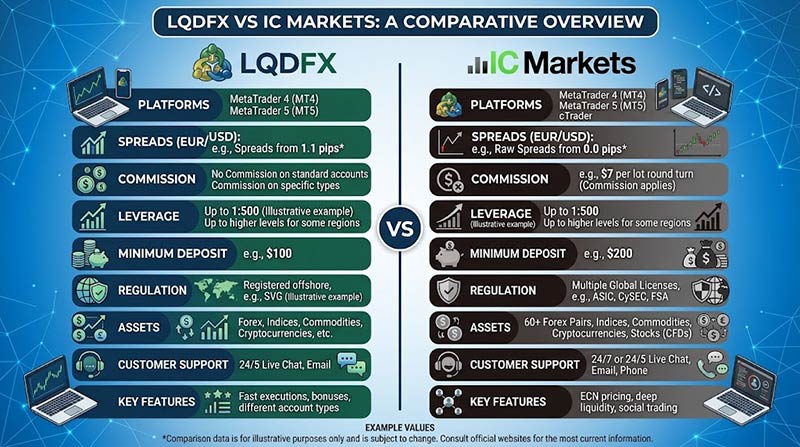
Quick Side-by-Side Comparison
| Feature | LQDFX | IC Markets (IC) |
|---|---|---|
| Regulation | Unregulated (offshore) | ASIC, CySEC, FSA Seychelles, others |
| Minimum Deposit | From $20 | $0–$200 (entity-dependent) |
| Spreads (EUR/USD typical) | From 0.1 pips (ECN) | From 0.0–0.1 pips (Raw) |
| Commission (Raw/ECN) | $3.50 / lot (approx.) | $3.50 / side MT4/5 ($7 round-turn) |
| Max Leverage | Up to 1:500 | Up to 1:500–1:1000 (entity-dependent) |
| Platforms | MT4 only | MT4, MT5, cTrader, TradingView |
| Instruments | Forex, indices, metals, crypto, some stocks | 2,000+ CFDs including extensive stocks |
| Deposit/Withdrawal Fees | Generally low / none claimed | None from broker on most methods |
| Best For | High-leverage seekers | Scalpers, algos, safety-focused traders |
Head to the IC Markets official site
Regulation & Safety
This is the biggest gap in the LQDFX vs IC Markets comparison.
IC Markets holds proper licences. The Australian entity is regulated by ASIC (AFSL 335692). The EU entity sits under CySEC. Most international clients trade through the Seychelles FSA entity, with additional licences in the Bahamas and Kenya. Client funds are segregated. Negative balance protection applies depending on the entity. After years of operation since 2007 and processing massive daily volume, the regulatory track record feels solid.
LQDFX is unregulated. It has operated from offshore jurisdictions (Marshall Islands, later Saint Lucia references, SVG company registration). Those places do not properly licence or supervise forex brokers. The UK FCA issued a public warning in 2022 that LQDFX was offering services without authorisation. It also appeared on the CFTC RED List. There is no compensation scheme and no meaningful oversight if something goes wrong with client funds.
I felt the difference every time I logged in. With IC Markets I slept better knowing the money sat under real regulators. With LQDFX I treated the account as higher risk capital only.
Account Types & Minimum Deposit
LQDFX makes it easy to start. Micro and Islamic accounts open from $20. Gold and ECN accounts need $500. VIP jumps to $25,000. Leverage reaches 1:500 on the Micro account. That low entry point is attractive if you want to test with small size.
IC Markets is more flexible on the global entity — some accounts show $0 minimum, while the ASIC entity traditionally requires around $200. Standard, Raw Spread (MT4/MT5), and Raw Spread cTrader accounts cover most needs. Higher-volume Raw Pro tiers exist for larger balances with lower commissions. Islamic accounts are available on request.
I opened a small LQDFX Micro account first because the barrier was almost nothing. For serious size I moved to IC Markets Raw Spread without hesitation.
Spreads, Commissions & Trading Costs
Both can be cheap if you pick the right account.
On LQDFX ECN I regularly saw EUR/USD around 0.1–0.3 pips plus roughly $3.50 per lot commission. Gold account sat closer to 0.7–1.0 pips with no commission. Spreads widened during news, which is normal, but I noticed more variability than I liked on quieter pairs.
IC Markets Raw Spread delivered consistently tighter pricing in my live trading. Average EUR/USD hovered near 0.1 pips with the $3.50 per side commission on MetaTrader ($7 round-turn). cTrader version was slightly cheaper on commission. Standard account starts around 0.8 pips with no commission. Execution stayed clean even during high-impact news. Slippage was minimal compared with what I experienced on the offshore account.
For scalping or high-frequency work, IC Markets felt cheaper overall once I factored in fill quality and consistency.
Head to the IC Markets official site
Trading Platforms & Tools
IC Markets wins this category clearly.
You get MT4, MT5, cTrader, and TradingView integration. cTrader’s depth of market and cAlgo environment suit serious algorithmic traders. Servers in the New York Equinix NY4 data centre deliver low latency. Free VPS options exist for eligible clients. The multi-platform setup let me switch tools depending on the strategy without changing brokers.
LQDFX sticks to MT4. It works fine and supports EAs, but the lack of MT5 or cTrader felt limiting after a few weeks. Charting and order management were adequate, yet nowhere near the depth IC Markets offers.
If platforms and execution quality matter to you, the LQDFX vs IC Markets choice becomes easy.
Deposit & Withdrawal Methods + Real Experience
Both accept cards, bank wires, and popular e-wallets. LQDFX also leans into crypto deposits, which some traders appreciate.
My LQDFX deposits cleared quickly. Withdrawals were mixed — some arrived within 24–48 hours, others took longer and required extra back-and-forth. I never lost funds, but the process lacked the predictability I prefer.
IC Markets deposits were instant on cards and e-wallets. Withdrawals processed the same or next business day in most cases (cut-off around Sydney time). Cards took a few days to hit the account; e-wallets were faster. No broker fees on the methods I used. The whole funding experience felt smoother and more professional.
Head to the IC Markets official site
Customer Support
LQDFX support is available 24/5 via live chat, email, and phone. Responses were usually fast on chat. Account managers reached out occasionally. Quality varied — sometimes helpful, sometimes generic.
IC Markets offers strong multi-channel support with good response times. I found the team more consistent when dealing with verification or withdrawal questions. Live chat and email handled most issues without drama.
Neither is perfect, but IC Markets felt more reliable under pressure.
Education & Research Resources
LQDFX provides basic video tutorials, e-books, and some market commentary. Useful for complete beginners, limited once you move past the basics.
IC Markets offers a broader set of tools, economic calendars, research notes, and platform-specific educational content. Combined with the stronger charting platforms, it supports more advanced analysis.
Asset Range
LQDFX covers major and minor forex pairs, indices, metals, energies, cryptocurrencies, and a selection of stocks. Enough for most retail strategies.
IC Markets goes further with over 2,000 instruments, including a large list of share CFDs, more indices, and deeper commodity coverage. If you trade beyond pure forex, IC Markets gives more room to diversify.
Pros and Cons
LQDFX Pros
- Very low minimum deposit
- High leverage up to 1:500
- Competitive raw spreads on ECN
- Crypto-friendly funding
- Simple MT4 setup
LQDFX Cons
- Completely unregulated
- Regulatory warnings on record
- Limited to MT4
- Less consistent execution and withdrawal experience
- Higher overall risk to capital
IC Markets Pros
- Strong multi-jurisdiction regulation
- Excellent raw spreads and execution
- Multiple professional platforms
- Deep liquidity and low latency
- Reliable deposits and withdrawals
- Broad instrument range
IC Markets Cons
- Higher effective minimum on some entities
- Leverage capped lower under certain licences
- No FCA UK entity (important for UK residents)
Head to the IC Markets official site
Who Each Broker Is Best For
Safety-focused traders and anyone running serious capital should choose IC Markets without question. Regulation and segregated funds matter more than a few extra pips of leverage.
Scalpers and algorithmic traders will prefer IC Markets for the platforms, NY4 servers, and consistent fills.
High-leverage seekers with very small accounts may still look at LQDFX because of the $20 entry and 1:500 leverage. Just understand you are accepting substantial counterparty risk.
Beginners testing the waters can open a tiny LQDFX Micro account if they treat it as pure risk capital, but most will outgrow it quickly and should move to a regulated broker.
After months of real trading on both, IC Markets is the better broker for the large majority of traders in 2026.
The regulation and fund safety gap is not something you can ignore. LQDFX can deliver tight spreads and high leverage, and some traders report smooth experiences. But when you compare actual execution quality, platform choice, withdrawal reliability, and the simple fact that one is properly regulated while the other is not, IC Markets pulls ahead.
If your priority is protecting capital and trading with professional tools, choose IC Markets. If you specifically need the highest leverage and the lowest possible deposit and are comfortable with offshore risk, LQDFX remains an option — just size it accordingly and never put money you cannot afford to lose.
The LQDFX vs IC Markets decision ultimately comes down to how much weight you place on safety versus raw accessibility. For me, safety won.
FAQ
Is LQDFX regulated?
No. LQDFX operates as an unregulated offshore broker and has received warnings from the FCA and appeared on the CFTC RED List.
Which is better for scalping — LQDFX or IC Markets?
IC Markets. Tighter consistent pricing, better platforms (especially cTrader), and superior execution infrastructure make it the stronger choice for scalpers.
What is the minimum deposit for LQDFX vs IC Markets?
LQDFX starts from $20 on Micro accounts. IC Markets ranges from $0 to around $200 depending on the entity and account type.
Can I trade with high leverage on both?
Yes. LQDFX offers up to 1:500. IC Markets offers high leverage on its offshore entity (up to 1:500 or higher in some cases) but lower under ASIC or CySEC.
Are withdrawals reliable on LQDFX and IC Markets?
IC Markets proved more consistent and predictable in my testing. LQDFX withdrawals worked but showed more variability in timing and process.
Should US traders consider either broker?
Neither is ideal for US residents. IC Markets does not accept US clients on its main entities. LQDFX is unregulated and has appeared on CFTC lists, making it unsuitable.

•Most Trusted Broker — Asia 2026
•Broker of the Year — LATAM 2026
These awards confirm our commitment to building a rewarding trading environment and helping you uncover your potential. Thank you for choosing to trade with an award-winning broker!
Why choose MetaTrader 5 with Top Forex Brokers?
•Blazing-fast execution & enhanced stability
•38 built-in technical indicators & 21 timeframes for precision trading
•Optimized for all devices—desktop, mobile & web
•Trade a wide range of assets: Stocks, Commodities, Forex & more!
Disclaimer: Trading forex and CFDs carries a high level of risk and may not be suitable for all investors. Ensure you understand the risks involved and consider your financial situation before trading.
Final reminder: This content is for educational purposes only and does not constitute financial advice. Trading forex, gold, and cryptocurrencies involves substantial risk of loss and is not suitable for every investor. Past performance is not indicative of future results. Always trade with money you can afford to lose and consider seeking independent financial advice.