

I’ve traded both Exness and Forex.com with real money for several months each. Not demo fluff — live accounts, news events, withdrawals, the works. The question of Exness vs Forex.com comes up constantly because they sit on opposite ends of the spectrum. One prioritizes extreme flexibility, ultra-low costs, and high leverage. The other prioritizes top-tier regulation, stability, and a more traditional institutional feel.
If you’re choosing between them in 2026, the decision almost always comes down to where you live, how much leverage you actually need, and whether tight spreads matter more to you than regulatory comfort.
Head to the EXNESS official site
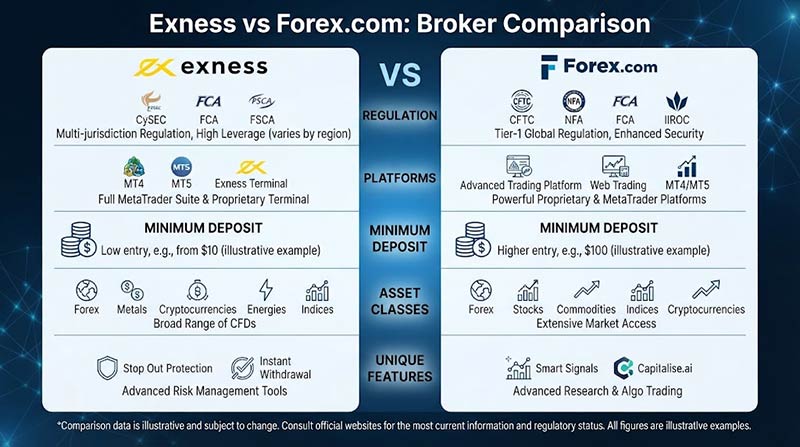
Quick Side-by-Side Comparison
| Feature | Exness | Forex.com |
|---|---|---|
| Founded | 2008 | 2001 (StoneX Group) |
| Regulation | Multi-entity (FSA Seychelles, FSCA, CMA Kenya + others). FCA/CySEC entities do not serve retail clients on the main site | CFTC/NFA (US), FCA, ASIC, CIRO + others |
| Minimum Deposit | From $1–$10 (method/region dependent) | $100 |
| Max Leverage | Up to 1:2000 / Unlimited (conditions apply) | 1:50 (US), 1:30 (UK/EU), higher on some international entities |
| EUR/USD Spread (typical) | Standard from ~0.2 pips; Raw/Zero from 0.0 | Standard ~0.8–1.2 pips; RAW from ~0.0–0.2 + commission |
| Commission (Raw-style) | Up to ~$3.50/side (Raw); lower on Zero | ~$5–$7/side |
| Platforms | MT4, MT5, Exness Terminal/App | Proprietary platform, TradingView, MT4, MT5 |
| US Clients | No | Yes |
| Withdrawal Speed (my experience) | Often minutes to a few hours | 1–3 business days |
Regulation & Safety
This is the biggest divide.
Forex.com is part of StoneX and holds serious Tier-1 licences. US clients trade under CFTC/NFA rules. UK and other regulated clients get FCA, ASIC, or equivalent protection, segregated funds, and proper compensation schemes where they apply. The compliance feel is strict and institutional. You know exactly who regulates you and what protections exist.
Exness runs a multi-entity model. Most retail traders (especially outside Europe) end up with the Seychelles FSA entity or regional ones like FSCA (South Africa) or CMA (Kenya). The FCA and CySEC entities exist but explicitly do not serve retail clients on the main Exness site. This structure lets them offer higher leverage and more flexible conditions, but it also means the regulatory safety net is thinner depending on which entity holds your account.
I felt more “protected” with Forex.com on paper. With Exness I felt the freedom more in day-to-day trading. Neither is a scam, but they are not the same risk profile. If strong traditional regulation is non-negotiable for you, Forex.com wins this category cleanly.
Head to the EXNESS official site
Account Types & Minimum Deposit
Exness makes it almost ridiculously easy to start. Standard and Standard Cent accounts often have no meaningful minimum beyond the payment method itself (sometimes as low as a few dollars). Pro, Raw Spread, and Zero accounts usually require more (region-dependent, often from a couple of hundred dollars). The Cent account is useful if you want to trade tiny sizes with real money.
Forex.com starts at $100. They offer Standard (spread-only) and RAW/commission accounts. Clean and simple, but less flexible for very small starting capital.
If you’re testing strategies with limited funds, Exness removes friction. Forex.com assumes you’re ready to put at least a modest amount to work.
Spreads, Commissions & Trading Costs
This is where Exness usually pulls ahead for active traders.
On Exness Standard I regularly saw EUR/USD in the 0.2–0.4 range during good liquidity. Raw Spread accounts go to 0.0 with a commission around $3.50 per side. Zero accounts can be even tighter on the major pairs. During news the spreads widen, but the base pricing is aggressive.
Forex.com Standard sits higher — often 0.8 to 1.2 on EUR/USD in my live trading. Their RAW account tightens the spread considerably but the commission ($5–$7 per side depending on region and account) adds up. For low-frequency traders the difference is manageable. For scalpers or high-volume traders, Exness is clearly cheaper in most of my sessions.
I also noticed Exness execution felt snappier during busy London–New York overlap. Forex.com was solid and reliable, just not as aggressive on price.
Trading Platforms & Tools
Both support MT4 and MT5. That covers most EA users and indicator traders.
Exness adds their own Terminal and mobile app. The app is clean and fast. I used it more than expected for quick position checks and withdrawals.
Forex.com offers a more polished proprietary platform plus native TradingView integration. The research and charting tools feel more institutional. If you like deep analysis tools, economic calendars, and a more traditional interface, Forex.com has the edge. If you just want MT4/MT5 plus a fast mobile experience, Exness is more than enough.
Deposit & Withdrawal Methods + Real Experience
Exness shines here for many regions. Local payment methods, cards, e-wallets, and crypto are widely available. My withdrawals often arrived in under an hour, sometimes minutes. That speed becomes addictive.
Forex.com is more conventional — bank wires, cards, and region-specific methods (ACH in the US). My withdrawals were reliable but took 1–3 business days. No drama, just slower.
Fees were low or zero on both when using preferred methods. Exness simply felt more flexible and faster in practice.
Customer Support
Both are solid. Exness offers 24/7 support in multiple languages and their live chat usually connected quickly. Forex.com is strong during market hours and professional, though I found response times a bit slower outside peak periods. Neither left me hanging on important issues.
Education & Research Resources
Forex.com is stronger. They provide more structured education, market analysis, and tools aimed at serious traders. Exness has the basics and some useful content, but it is not their main focus. If you are still learning or want regular research, Forex.com delivers more.
Asset Range
Both cover major and minor forex pairs, metals, indices, energies, and some crypto CFDs. Forex.com tends to have a broader stock CFD selection in some entities. Exness is competitive on forex and metals volume. Neither is limited in the core instruments most traders need.
Head to the EXNESS official site
Pros and Cons
Exness Pros
- Extremely low minimum deposit
- Competitive to aggressive spreads and low commissions
- High leverage options (including unlimited under conditions)
- Very fast withdrawals in my experience
- Flexible payment methods including local options and crypto
Exness Cons
- Multi-entity regulation is less straightforward than top-tier single regulators
- Not available to US clients
- Research and education are lighter
Forex.com Pros
- Strong multi-jurisdictional Tier-1 regulation (especially valuable for US and other strictly regulated clients)
- Solid proprietary platform + TradingView
- Reliable institutional-style service
- Better educational and research resources
Head to the EXNESS official site
Forex.com Cons
- Higher minimum deposit
- Spreads and overall costs generally higher than Exness
- Leverage capped by regulation (especially US and Europe)
- Withdrawals slower than Exness in practice
Who Each Broker Is Best For
Choose Exness if:
- You are outside the US and want maximum flexibility
- Low costs and tight spreads are your priority
- You like high (or unlimited) leverage and can manage the risk
- Fast withdrawals and low barriers to entry matter
- You mainly trade forex and metals on MT4/MT5
Choose Forex.com if:
- You are a US trader (this is often the deciding factor)
- Strong traditional regulation is non-negotiable
- You value research tools, TradingView integration, and a more polished platform experience
- You prefer a lower-leverage, more conservative environment
- You want the comfort of a long-established, publicly connected broker (StoneX)
Beginners who need hand-holding and education lean toward Forex.com. Cost-focused or high-volume traders outside the US usually prefer Exness.
Exness vs Forex.com
After trading both with real money, I do not see a universal winner. The better broker depends on your location and priorities.
For most non-US traders focused on costs, leverage flexibility, and withdrawal speed, Exness is the more attractive option in 2026. The pricing is better, the deposit barrier is lower, and the day-to-day experience feels more trader-friendly.
Head to the EXNESS official site
For US traders, or anyone who prioritises top-tier regulation and institutional-grade stability above all else, Forex.com is the clearer and safer choice. The extra cost and lower leverage are the trade-off for that regulatory strength.
I still keep accounts at both. When I want aggressive conditions and fast money movement, I use Exness. When I want the regulatory comfort and research tools, I lean on Forex.com. That dual approach has worked well for me.
Check the exact entity, leverage limits, and available payment methods for your country before funding either account. Conditions change by region, and the differences matter.
Head to the EXNESS official site
FAQ: Exness vs Forex.com
Which is better overall, Exness or Forex.com?
It depends on your location and what you value. Exness wins on costs and flexibility for most non-US traders. Forex.com wins on regulation and suitability for US clients.
Is Exness safer than Forex.com?
Forex.com generally has stronger traditional regulation (especially CFTC/NFA and FCA). Exness relies more on its multi-entity structure. Both segregate client funds, but the protective frameworks differ.
Can US traders use Exness?
No. US residents cannot open accounts with Exness. Forex.com is one of the established options available to them.
Which has tighter spreads?
Exness, particularly on Raw and Zero accounts. Forex.com RAW is competitive but usually carries a higher commission.
How fast are withdrawals on each?
In my experience Exness was significantly faster (often under an hour). Forex.com typically took 1–3 business days.
Does leverage matter more than regulation?
Only you can answer that. High leverage amplifies both gains and losses. Stronger regulation reduces certain risks but also limits how much leverage you can use. Be honest about your risk tolerance before choosing.

•Most Trusted Broker — Asia 2026
•Broker of the Year — LATAM 2026
These awards confirm our commitment to building a rewarding trading environment and helping you uncover your potential. Thank you for choosing to trade with an award-winning broker!
Why choose MetaTrader 5 with Top Forex Brokers?
•Blazing-fast execution & enhanced stability
•38 built-in technical indicators & 21 timeframes for precision trading
•Optimized for all devices—desktop, mobile & web
•Trade a wide range of assets: Stocks, Commodities, Forex & more!
Disclaimer: Trading forex and CFDs carries a high level of risk and may not be suitable for all investors. Ensure you understand the risks involved and consider your financial situation before trading.