

I spent several months trading live accounts with both XM and IFC Markets. Real money, real withdrawals, real news events. The choice between them is not as simple as looking at spreads or leverage. One feels solid and mainstream. The other offers something different that only a smaller group of traders will care about.
The dilemma is common. You want a broker that won’t mess with your funds, keeps costs reasonable, and actually works when the market moves. XM is the bigger, more established name with stronger regulatory coverage in many regions. IFC Markets has been around longer in some ways and stands out with its proprietary platform and synthetic instruments. After testing both, here’s what actually mattered.
Head to the XM official site
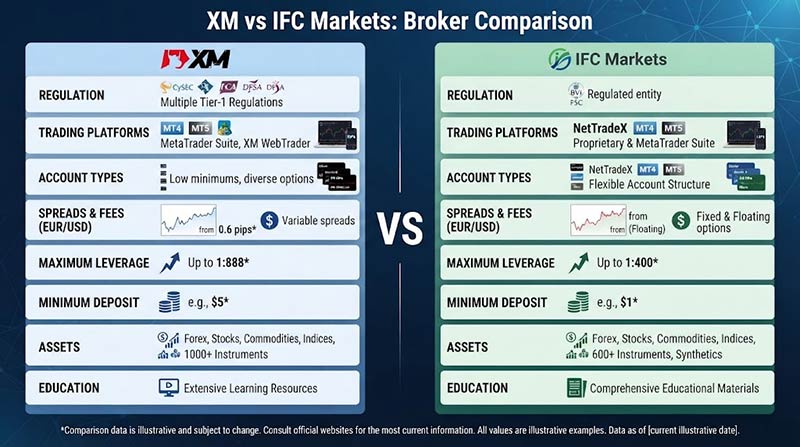
Quick Side-by-Side Comparison
| Feature | XM | IFC Markets |
|---|---|---|
| Founded | 2009 | 2006 |
| Main Regulation | CySEC, ASIC, DFSA, FSCA, FSC Belize | BVI FSC, LFSA Labuan, FSCA SA |
| Minimum Deposit | $5 | $1 |
| Max Leverage | Up to 1:1000 (entity dependent) | Up to 1:400 |
| Platforms | MT4, MT5, XM App | NetTradeX, MT4, MT5 |
| Spreads (EUR/USD typical) | From ~0.6–0.8 (Ultra Low) / higher Standard | From 0.4 floating / 1.8 fixed |
| Standout Feature | Education + multi-jurisdiction licenses | Synthetic instruments on NetTradeX |
| Withdrawal Experience | Generally fast (1–2 days for most methods) | Variable, sometimes slower |
Numbers change by entity and region. Always check the exact terms for your country.
Head to the XM official site
Regulation & Safety
This is the biggest difference.
XM operates through multiple entities. Clients in certain regions get CySEC (EU), ASIC (Australia), or DFSA (Dubai) oversight. Global clients often land under the Belize FSC entity. The multi-layered setup gives more regulatory weight and, in some cases, access to compensation schemes. Client funds are segregated. Negative balance protection is standard on the accounts I used.
IFC Markets is primarily regulated by the British Virgin Islands FSC (SIBA/L/14/1073) and has Labuan (LFSA) and South African FSCA coverage. These are real licenses, and the broker has been operating for years without major public collapses. However, they are not top-tier regulators in the same way CySEC or ASIC are. Investor compensation is weaker or absent depending on the entity. I never had problems with fund access, but the regulatory comfort level is clearly lower than XM’s better entities.
If regulation and fund safety sit at the top of your checklist, XM has the clearer advantage in most regions.
Account Types & Minimum Deposit
XM makes it easy to start. Standard and Ultra Low accounts open from $5. There are Islamic options and a Shares account for those who want real equities (higher minimum). The Ultra Low account became my main one because the spreads were tighter without a heavy commission structure on most pairs.
IFC Markets goes lower. You can open a beginner/micro-style account from $1. Standard accounts often sit at $1,000. They offer fixed-spread and floating-spread versions across NetTradeX, MT4, and MT5, plus Islamic accounts. The low entry point is genuine. I funded a small account just to test the platform without committing much capital.
For pure accessibility, IFC Markets wins on the absolute minimum. XM still feels more practical for most people because $5 gets you into a more complete setup.
Spreads, Commissions & Trading Costs
Live trading costs matter more than marketing numbers.
On XM Ultra Low I regularly saw EUR/USD spreads in the 0.6–1.0 range during London hours. Spreads widen during news, as expected. No commission on the Ultra Low account I used, so the spread is the full cost. During high-impact events the platform held up without excessive requotes on the pairs I traded.
IFC Markets offers floating spreads from around 0.4 pips on some accounts and fixed spreads from 1.8. Their ECN-style options add a small commission (around 0.005% of volume in some descriptions). In quiet markets the floating spreads looked competitive. During volatile periods the fixed-spread accounts felt more predictable, which some traders prefer. Overall costs were not dramatically cheaper or more expensive than XM on the majors I traded. The difference showed more on exotic pairs and certain CFDs.
Neither broker is the absolute cheapest in the industry, but both stay in a usable range for retail trading.
Head to the XM official site
Trading Platforms & Tools
This is where the brokers diverge most.
XM sticks to MetaTrader 4 and MetaTrader 5 plus their own XM App. Everything feels familiar. Charts load quickly, EAs work without drama, and the mobile experience is solid. I ran a few simple strategies and the execution was consistent. Nothing revolutionary, but nothing broken either.
IFC Markets gives you MT4 and MT5 as well, but the real difference is NetTradeX. This proprietary platform lets you create synthetic instruments using their GeWerk o Method. You can combine assets into custom pairs or portfolios that do not exist on standard platforms. For traders who like building their own instruments or running multi-asset ideas, this is a genuine differentiator. The interface takes some getting used to. It is not as polished as modern MetaTrader setups, but once you understand the synthetic tools it becomes useful.
If you live inside MetaTrader and never want to leave, XM is simpler. If you want to experiment with synthetic instruments, IFC Markets offers something XM does not.
Deposit & Withdrawal Methods + Real Experience
Both accept cards, bank transfers, and various e-wallets. Crypto options appear on some accounts.
My XM deposits landed quickly. Withdrawals to card or local methods usually cleared within one to two business days. One bank transfer took longer, but support tracked it without excuses. No surprise fees on the methods I used.
IFC Markets deposits were also straightforward. Withdrawals felt a bit more variable. Some e-wallet requests processed in a day. A bank transfer took noticeably longer and required an extra verification step. Nothing disappeared, but the process felt less polished than XM’s. Fees were generally transparent, though bank methods can carry intermediary costs on both brokers.
Speed and reliability favored XM in my experience.
Customer Support
XM support is available 24/5 in many languages. Live chat responses came within a few minutes during my tests. Answers were usually competent, though sometimes scripted on complex account questions.
IFC Markets also offers live chat and email. Response times were acceptable during market hours. Outside peak times the wait stretched longer. Multilingual support exists, but the depth felt thinner than XM’s larger operation.
Neither is perfect, but XM handled routine issues faster.
Education & Research Resources
XM invests heavily here. Webinars, video courses, market analysis, and a large educational library. Beginners get real value. Even intermediate traders can find useful economic calendar and research tools.
IFC Markets provides tutorials, some academy-style content, and platform guides. It is adequate, especially around NetTradeX features, but clearly secondary to XM’s broader offering.
Head to the XM official site
Asset Range
Both cover the core: forex majors and minors, metals, energies, indices, and some crypto CFDs.
XM has a solid stock CFD selection and a dedicated Shares account option in some regions. IFC Markets lists a wider variety of individual stocks, ETFs, and commodity CFDs in certain accounts, plus the synthetic instrument capability that expands the practical range further.
If you mainly trade forex and indices, both work. IFC Markets edges ahead for traders who want more stock and custom instrument exposure.
Pros and Cons
XM Pros
- Stronger multi-jurisdiction regulation in many cases
- Very low minimum deposit with practical account options
- Reliable MT4/MT5 experience and good mobile app
- Solid education resources
- Generally smoother withdrawals
XM Cons
- Spreads on standard accounts are not the tightest
- Offshore entity for many global clients carries the usual limitations
- Less unique platform features
Head to the XM official site
IFC Markets Pros
- Extremely low entry ($1 possible)
- NetTradeX and synthetic instruments are genuinely different
- Flexible fixed and floating spread options
- Decent instrument variety including stocks and ETFs
IFC Markets Cons
- Primarily offshore regulation (BVI etc.) with weaker protections
- Platform experience outside MetaTrader can feel dated
- Withdrawals less consistent in my testing
- Education and research lag behind XM
Who Each Broker Is Best For
Choose XM if:
- You prioritise regulation and fund safety
- You want a straightforward MetaTrader experience
- You value education and reliable support
- You are a beginner or intermediate trader starting with modest capital
- Smooth deposits and withdrawals matter
Choose IFC Markets if:
- You specifically want to use synthetic instruments or NetTradeX
- You need the absolute lowest possible starting deposit
- You are comfortable with offshore regulation
- You trade a mix of stocks, ETFs, and custom combinations
- Fixed spreads during news appeal to you
After months of live trading, XM is the safer and more practical choice for most people. The regulatory coverage, platform reliability, and overall operational smoothness outweigh the differences in spreads or unique features. I trusted the environment more and had fewer small frustrations.
IFC Markets is not a bad broker. The NetTradeX synthetic tools are interesting, and the low deposit is real. But the regulation gap is noticeable, and the overall experience felt less polished. I would only recommend it to traders who specifically need the proprietary platform features and accept the regulatory trade-off.
If your priority is reliability and a clean MetaTrader setup, go with XM. If synthetic instruments are a must-have and you are comfortable with BVI-style regulation, IFC Markets can work. For the majority of retail traders reading this in late 2026, XM is the better default.
Head to the XM official site
FAQ
Which is better overall, XM or IFC Markets?
XM for most traders because of stronger regulation options and smoother operations. IFC Markets only if you need NetTradeX and synthetic instruments.
Is IFC Markets safe to trade with?
It holds real licenses (BVI FSC and others) and has operated for years. Protection is weaker than top-tier regulators. Use only capital you can afford to risk.
Does XM offer tighter spreads than IFC Markets?
On Ultra Low accounts XM is competitive. IFC Markets can show tighter floating spreads at times, but total cost depends on the account and market conditions.
Can I use Expert Advisors on both?
Yes. Both support MT4 and MT5 fully. XM’s environment felt more consistent for automated strategies in my tests.
Which broker is better for beginners?
XM. Better education, clearer account structure, and stronger regulatory framing make the learning curve less stressful.
Are withdrawals reliable on both?
XM was more consistent for me. IFC Markets processed requests but with more variability and occasional extra steps.

•Most Trusted Broker — Asia 2026
•Broker of the Year — LATAM 2026
These awards confirm our commitment to building a rewarding trading environment and helping you uncover your potential. Thank you for choosing to trade with an award-winning broker!
Why choose MetaTrader 5 with Top Forex Brokers?
•Blazing-fast execution & enhanced stability
•38 built-in technical indicators & 21 timeframes for precision trading
•Optimized for all devices—desktop, mobile & web
•Trade a wide range of assets: Stocks, Commodities, Forex & more!
Disclaimer: Trading forex and CFDs carries a high level of risk and may not be suitable for all investors. Ensure you understand the risks involved and consider your financial situation before trading.