

I’ve traded both IFC Markets and XTB with real money for several months each. Not demo fluff — live accounts, actual deposits, live news events, and real withdrawals. The choice between them isn’t theoretical for me. It came down to what I actually needed day to day: regulation I could trust, platforms that didn’t fight me, real costs, and whether I wanted actual stocks or the ability to build synthetic instruments.
If you’re stuck on the same decision in 2026, this is the comparison I wish I had before funding either account.
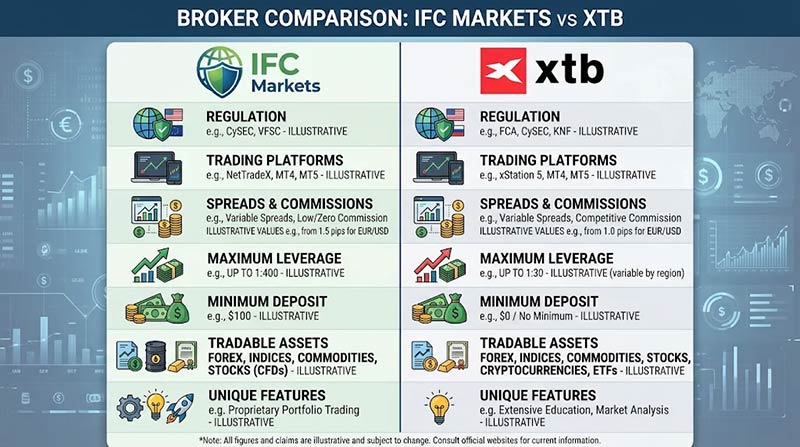
Quick Side-by-Side Comparison
| Feature | XTB | IFC Markets |
|---|---|---|
| Regulation | FCA, CySEC, KNF (Poland), DFSA + others | Mainly BVI FSC, Labuan FSA, FSCA intermediary |
| Minimum Deposit | $0 | $1 |
| Typical EUR/USD Spread | ~0.8–1.1 pips (spread-only) | Fixed from 1.8 / floating from ~0.4 + ECN options |
| Platforms | xStation 5 (proprietary) | NetTradeX, MT4, MT5 |
| Max Leverage (retail) | 1:30 (EU/UK) / higher offshore | Up to 1:400 |
| Standout Feature | Real stocks & ETFs (commission-free tiers) | Synthetic / Personal Composite Instruments (PCI) |
| Instruments | 2,000–10,000+ depending on entity | 650+ + unlimited custom synthetics |
| Withdrawal Experience | Generally smooth, some small-fee thresholds | Variable; fees on several methods, 1–5 days typical |
Regulation & Safety
This is the biggest gap.
XTB is a publicly listed company on the Warsaw Stock Exchange. Retail clients in the UK go under FCA (FRN 522157). EU clients usually sit under CySEC. There’s also KNF in Poland and DFSA in Dubai. Client money is segregated and negative balance protection applies under the stronger regimes. That doesn’t mean zero problems ever (they took a notable KNF fine in 2026 related to past sales practices), but the regulatory backbone is solid.
IFC Markets runs primarily under the British Virgin Islands FSC (SIBA/L/14/1073) and Labuan FSA, with an FSCA intermediary entity in South Africa. Older references to a CySEC licence appear outdated or revoked in current independent checks. Offshore regulation is common in the industry, but the protections and complaint pathways are weaker than FCA or CySEC. Funds are segregated and they carry professional indemnity insurance, yet the overall safety net is thinner.
If capital protection and regulatory recourse matter more than leverage or exotic instruments, XTB is clearly ahead.
Account Types & Minimum Deposit
XTB keeps it simple: basically a Standard account with no minimum deposit, plus Islamic and Professional options where eligible. You can open and fund with whatever amount feels comfortable.
IFC Markets offers more variety. Beginner/Micro accounts start at $1. Standard accounts often require $1,000. There are fixed-spread, floating, and ECN-style options across NetTradeX, MT4 and MT5, plus Islamic accounts. The low entry point is genuine — useful if you’re testing with small size — but the account structure can feel fragmented at first.
Spreads, Commissions & Trading Costs
On majors, XTB’s all-in cost is competitive for a commission-free model. Live EUR/USD typically sat in the 0.8–1.1 pip range for me during London/New York overlap. No separate commission on forex or most CFDs. Real stocks and ETFs have commission-free tiers up to monthly volume limits, which is excellent if you mix investing with trading.
IFC Markets gives you choices. Fixed spreads start around 1.8 pips on classic accounts — wide by modern standards. Floating accounts and the newer Pro/ECN options tighten things considerably (floating from roughly 0.4, raw from 0.0 plus commission). During quiet periods the floating accounts were usable. During high-impact news the spreads still widened, which is normal, but the fixed accounts felt expensive for anything beyond occasional trading.
Overall I paid less on average at XTB for straightforward forex and index work. IFC can be cheaper on specific ECN setups if you size up and stay disciplined about account type.
Trading Platforms & Tools
xStation 5 is XTB’s proprietary platform and it’s polished. Clean interface, solid charting, economic calendar built in, and seamless switching between CFD trading and real stock/ETF investing. Mobile apps are strong. The downside is clear: no MetaTrader for most retail clients. If your strategy lives inside MT4/MT5 EAs or custom indicators, you’re locked out.
IFC Markets gives you NetTradeX plus full MT4 and MT5. NetTradeX is the differentiator. It supports Personal Composite Instruments (PCI) via their GeWorko method — you can build and trade synthetic instruments that combine currencies, stocks, indices, commodities, etc. into custom baskets or cross rates. This is genuinely unique in the retail space. I spent weeks building and testing synthetic pairs that simply don’t exist elsewhere. MT4/MT5 support is solid if you prefer the familiar environment.
Platform feel is subjective. xStation feels more modern and investment-oriented. NetTradeX feels more analytical and experimental once you dig into the synthetic tools.
Deposit & Withdrawal Methods + Real Experience
Both accept cards, bank wires and various e-wallets. IFC Markets has broader crypto and alternative payment options, which helps in certain regions.
My XTB withdrawals were straightforward. Most cleared within 1–2 business days. Small withdrawals can attract fees depending on the entity and amount, but larger ones were free in my experience.
IFC Markets processed requests same day in most cases, but actual arrival times varied. Crypto and some e-wallets were faster. Bank wires took longer and carried fees (often $20-ish plus intermediary costs). A couple of smaller withdrawals felt slower than expected and required follow-up. Not a deal-breaker, but less consistent than XTB.
Customer Support
Both offer live chat and email. XTB’s responses were usually faster and more structured in my experience, especially on account and funding questions. IFC Markets support was competent once connected, and they handle multiple languages well, but response times fluctuated more.
Education & Research
XTB is stronger here. Market analysis, educational content, webinars and platform-integrated research are more consistent and practical. IFC Markets has materials and some analysis, but it doesn’t match XTB’s depth or presentation.
Asset Range
XTB wins on breadth and quality of real stocks and ETFs. Thousands of instruments, and the ability to actually own shares and ETFs (not just CFDs) is a major plus for longer-term positioning.
IFC Markets has a more limited standard list but compensates with the synthetic instrument capability. If your edge involves custom baskets, correlation plays or unique cross-asset expressions, NetTradeX is the only practical retail option I’ve used that delivers it cleanly.
Pros and Cons
XTB Pros
- Strong multi-jurisdiction regulation and public company transparency
- Zero minimum deposit
- Excellent real stocks and ETFs with low or zero commissions on volume tiers
- Polished, reliable xStation platform
- Generally smoother withdrawals and support
XTB Cons
- No MetaTrader for most retail clients
- Retail leverage capped under EU/UK rules
- Spreads are average rather than industry-leading on pure forex
IFC Markets Pros
- $1 minimum and high leverage available
- Unique synthetic / PCI instruments on NetTradeX
- Full MT4 and MT5 support
- Flexible account types and payment methods (including crypto)
IFC Markets Cons
- Primarily offshore regulation
- Fixed-spread accounts are relatively expensive
- Withdrawal fees and consistency lag behind top-tier brokers
- Overall instrument range (excluding synthetics) is narrower
Who Each Broker Is Best For
Choose XTB if you:
- Prioritise regulation and fund safety
- Want real stocks and ETFs alongside CFDs
- Prefer a modern proprietary platform over MetaTrader
- Trade or invest with a medium-to-long-term mindset
- Value smoother operational experience (funding, withdrawals, support)
Choose IFC Markets if you:
- Need MetaTrader for EAs or custom indicators
- Want to experiment with synthetic instruments and custom baskets
- Are starting with very small capital
- Prefer higher leverage and more flexible payment options
- Are comfortable with offshore regulation in exchange for the above features
After months on both, I keep the larger portion of my capital at XTB. The regulatory difference is not cosmetic. Public listing, FCA/CySEC oversight and cleaner operational experience matter when real money is involved. The stock and ETF offering is also genuinely useful rather than just marketing.
I still keep a smaller active account at IFC Markets specifically for the NetTradeX synthetic tools and occasional MT5 testing. Those features are hard to find elsewhere at retail level.
If regulation, reliability and a clean multi-asset experience rank highest for you, XTB is the better broker in 2026. If your edge depends on MetaTrader or building custom synthetic instruments, IFC Markets justifies the trade-offs — just size the account accordingly and treat it as the more specialised tool.
FAQ: IFC Markets vs XTB
Which is safer, IFC Markets or XTB?
XTB. Stronger regulators (FCA, CySEC, KNF) and public company status give clearer protections and transparency.
Does XTB offer MetaTrader?
Not for most retail clients in 2026. xStation 5 is the primary platform.
Can I trade real stocks at both?
XTB offers real stocks and ETFs with competitive commission structures. IFC Markets focuses more on CFDs and synthetics.
What is the main advantage of IFC Markets?
The ability to create and trade Personal Composite Instruments (synthetics) on NetTradeX, plus full MT4/MT5 access and a $1 minimum.
Are withdrawals reliable at both?
XTB has been more consistent in my experience. IFC Markets works but can involve fees and slightly longer or more variable processing depending on the method.
Which has tighter spreads?
Depends on account type. XTB’s standard spread-only pricing is competitive and transparent. IFC Markets can be tighter on its floating/ECN accounts but wider on classic fixed accounts.

•Most Trusted Broker — Asia 2026
•Broker of the Year — LATAM 2026
These awards confirm our commitment to building a rewarding trading environment and helping you uncover your potential. Thank you for choosing to trade with an award-winning broker!
Why choose MetaTrader 5 with Top Forex Brokers?
•Blazing-fast execution & enhanced stability
•38 built-in technical indicators & 21 timeframes for precision trading
•Optimized for all devices—desktop, mobile & web
•Trade a wide range of assets: Stocks, Commodities, Forex & more!
Final reminder: This content is for educational purposes only and does not constitute financial advice. Trading forex, gold, and cryptocurrencies involves substantial risk of loss and is not suitable for every investor. Past performance is not indicative of future results. Always trade with money you can afford to lose and consider seeking independent financial advice.