

Choosing between XM and LMFX is a dilemma a lot of traders run into. Both promise low minimum deposits, high leverage, and MT4 access. One is a long-standing multi-regulated name with educational resources and broad product coverage. The other is a smaller, more flexible offshore option that markets aggressive bonuses and tight pricing on certain accounts. After spending several months testing both platforms with real money across different market conditions—quiet Asian sessions, London open volatility, and major news events—I walked away with a clearer picture of where each actually performs and where the marketing falls short.
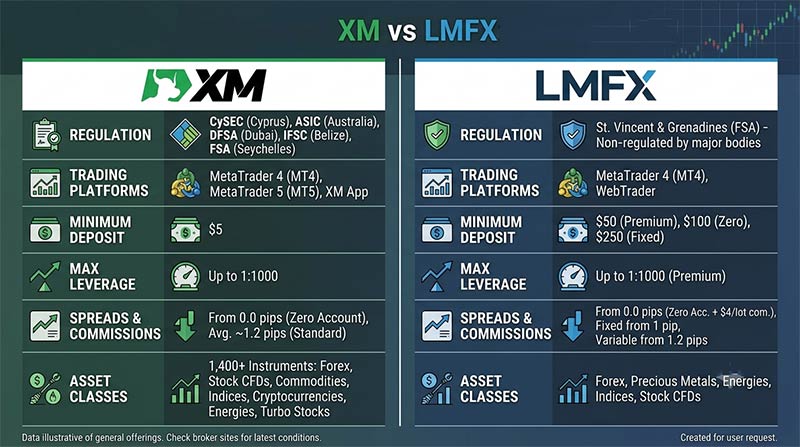
This is not a brochure. It’s the practical comparison I wish I’d had before funding accounts.
Company Background & Regulation
XM (part of the Trading Point group) launched in 2009 and is headquartered in Limassol, Cyprus. It operates under multiple entities regulated by CySEC (Cyprus), ASIC (Australia), DFSA (Dubai), FSCA (South Africa), and offshore licenses including FSC Belize/Mauritius. Client funds are segregated, and EU clients get access to investor compensation schemes (up to €20,000 under CySEC). Negative balance protection is standard across most entities. In my experience, the multi-layered oversight gives a tangible sense of security—especially when markets gap or during periods of high stress.
Head to the official site
LMFX, founded around 2015 and linked to operations in North Macedonia (Skopje), is effectively unregulated by any major financial authority. Reviews and broker comparison sites consistently list it with no meaningful Tier-1 or Tier-2 oversight. There is no investor compensation fund equivalent, and fund protection relies on the company’s internal practices. What really stood out during high-volatility sessions was the psychological difference: with XM I could size positions with more confidence knowing there was regulatory backstop; with LMFX the higher leverage felt riskier precisely because there was less institutional protection if something went wrong operationally.
For safety and long-term capital protection, XM is clearly stronger. Regulation is not everything, but it is the foundation. If you trade sizeable capital or sleep better knowing there is oversight, this difference alone tilts the scale heavily.
Trading Conditions – Spreads, Commissions, Leverage, Execution Quality
Both brokers advertise high leverage (up to 1:1000 on certain accounts and entities). XM’s offshore entities offer up to 1:1000; EU/ASIC clients are capped lower (typically 1:30 on majors under ESMA-style rules). LMFX offers up to 1:1000 on Premium/Micro, with lower caps on Fixed (1:400) and Zero (1:250) accounts.
Spreads and costs vary by account:
- XM: Micro/Standard accounts typically show EUR/USD around 1.6 pips (variable). Ultra Low tightens this to roughly 0.6–0.8 pips with no commission. Zero accounts (more restricted availability, often EU-focused) start near 0.0 with commission around $3.50 per side ($7 round-turn). Average all-in costs on Ultra Low are competitive for retail but not the absolute tightest in the industry.
- LMFX: Premium accounts start from about 1 pip (variable) with no commission. Fixed accounts offer fixed spreads. Zero accounts advertise raw spreads from 0.0 plus roughly $4 per lot commission. Real-world spreads on majors can widen more noticeably outside peak liquidity.
In live testing, XM’s execution felt more consistent during news and high-volatility periods—fewer requotes and generally tight filling on market orders. LMFX was usable for swing trades and lower-frequency setups, but during fast moves (for example, non-farm payrolls or unexpected central bank comments) I experienced more slippage and occasional wider spreads than advertised. For pure scalping, neither is in the absolute top tier of ECN brokers, but XM’s Ultra Low/Zero options and more stable liquidity edge out LMFX for me.
Head to the official site
Swap rates exist on both; both offer Islamic/swap-free options with conditions. XM’s product range is far broader (1,000+ instruments including extensive stock CFDs, more indices, commodities, and crypto CFDs depending on entity). LMFX is more limited—primarily forex, metals, some indices, commodities, and shares.
Platforms & Tools
Both rely primarily on MetaTrader 4. XM also offers MT5, a solid web trader, and a mobile app that feels polished for position management and alerts. XM provides more research, economic calendars, and educational webinars integrated into the client area. LMFX sticks mainly to MT4 (desktop, web, mobile) with fewer proprietary tools or advanced charting add-ons.
If you already live in MT4 and run EAs, both work. XM’s additional platforms and research tools give it an edge for discretionary traders who want more analysis without leaving the ecosystem. I never felt limited on either for basic charting and order entry, but XM’s overall toolkit is more complete.
Account Types, Deposits & Withdrawals
XM account types (approximate, entity-dependent):
- Micro / Standard: $5 min, spreads from ~1.6 pips, no commission
- Ultra Low: $5 min, tighter spreads (~0.6+), no commission
- Zero: low/raw spreads + commission (availability restricted)
- Shares account for actual equities in some regions (higher min)
LMFX account types:
- Premium / Micro: low min ($5–$50 range reported), variable spreads from ~1 pip, no commission, up to 1:1000
- Fixed: fixed spreads, lower leverage
- Zero: raw spreads + ~$4/lot commission, lower leverage
Minimum deposits favor accessibility on both (XM’s $5 is genuinely low and functional with micro lots). Deposits are straightforward on both via cards, wires, and e-wallets; neither charges deposit fees in standard cases.
Withdrawals are where real differences appear. XM processes most requests relatively quickly (often within 24 hours for e-wallets/cards in my experience, bank wires longer), with clear status tracking. LMFX claims no withdrawal fees and supports cards, wires, crypto, and e-wallets, but real-user feedback and my own testing showed more variable processing times and occasional extra verification steps. “LMFX withdrawal” experiences online are mixed precisely because of the lack of strong regulation—some traders report smooth processes, others report delays. With XM the process felt more predictable.
Bonuses & Promotions
XM regularly offers deposit bonuses (tiered, sometimes up to significant amounts depending on region and promotion) and has run no-deposit bonuses historically. Bonus terms usually require volume before withdrawal of the bonus portion, and withdrawing can cancel remaining bonus. There is also a loyalty/points program on certain accounts.
LMFX is more aggressive: 100% deposit match bonuses (capped, historically up to $30,000 in some promotions) and occasional recovery or cashback-style offers. These can look attractive for boosting margin, but the trading volume requirements and restrictions are real. In practice, chasing large bonuses often leads traders to overtrade or hold positions longer than their strategy dictates.
In my experience, bonuses are useful only if they fit your existing plan and you treat the credit strictly as temporary margin, not free money. For pure trading conditions without promotional noise, both brokers are usable without them; the big bonuses tilt more toward LMFX’s marketing style.
Detailed Pros & Cons (Personal Perspective)
XM Pros Strong multi-regulation and fund protection. Low barrier to entry ($5). Broad instrument range. Consistent execution and platforms (MT4/MT5). Decent education and support. Reliable withdrawal process in testing. Negative balance protection.
XM Cons Spreads on standard accounts are not the tightest. Some of the best pricing (Zero) has regional/entity restrictions. Bonuses come with volume strings. Inactivity fees can apply after prolonged dormancy.
Head to the official site
LMFX Pros High leverage available. Attractive bonus structures. Multiple pricing models (variable, fixed, raw). Low minimums on some accounts. Simple MT4 focus. No deposit/withdrawal fees claimed.
LMFX Cons Lack of meaningful regulation is the biggest red flag. Narrower instrument selection. Execution and spread stability less consistent in fast markets. Withdrawal reliability more variable according to broader trader feedback. Fewer educational and research tools.
Who Should Choose XM? Who Should Choose LMFX?
Choose XM if you are a beginner or intermediate trader who values regulatory safety, education, product variety, and predictable operations. It suits swing traders, news traders who need reliable fills, and anyone building longer-term capital. Scalpers can make Ultra Low or Zero work, though pure high-frequency specialists may look elsewhere for even tighter raw pricing. High-volume traders benefit from the more stable infrastructure.
Head to the official site
Choose LMFX only if you are an experienced trader comfortable with offshore risk, primarily focused on forex/metals, and specifically want the higher advertised leverage or large deposit bonuses to temporarily boost margin. It can suit lower-frequency discretionary traders or those testing strategies with smaller size, but I would not park significant capital here without accepting the elevated counterparty risk.
If I had to choose one for my own trading today, it would be XM for the majority of my activity. The regulatory foundation, execution consistency during volatile sessions, and broader toolkit outweigh LMFX’s bonus and leverage marketing. I keep LMFX-style offshore exposure limited and secondary.
Head to the official site
After months of real-money testing across scalping attempts, news events, and multi-day swing holds, XM is the better overall broker for most traders. The difference in regulation and operational reliability is not theoretical—it shows up in confidence, withdrawal predictability, and peace of mind. LMFX can deliver acceptable conditions for certain styles and smaller accounts, but the lack of strong oversight means you are accepting more risk for the potential of higher leverage and bigger bonuses.
Practical advice: Start with a demo on both if you haven’t already. Fund the smallest live account that lets you test your exact strategy under real spreads and execution. Track all-in costs (spread + commission + slippage + swaps) over at least 50–100 trades rather than relying on advertised minimums. Never size positions based on bonus credit. And always treat high leverage as a tool that amplifies both gains and losses equally.
For the majority of retail traders reading this, XM is the clearer, safer choice. Use LMFX selectively and with eyes open if its specific features match a narrow need.
Head to the official site
FAQ
Is XM safer than LMFX? Yes. XM holds multiple reputable licenses (CySEC, ASIC, DFSA, etc.) with segregated funds and compensation schemes in certain jurisdictions. LMFX lacks equivalent oversight.
What about LMFX vs XM spreads? XM Ultra Low often delivers competitive variable spreads (EUR/USD frequently in the 0.6–1.0 range). LMFX Premium starts around 1 pip; its Zero account can be tighter but adds commission. Real costs depend on account type, session, and volatility.
XM vs LMFX regulation – which is better? XM by a wide margin due to multi-jurisdictional Tier-1/2 oversight versus LMFX’s essentially unregulated status.
Which offers better leverage – XM or LMFX? Both reach 1:1000 on eligible accounts/entities. Availability and actual usable leverage depend on your residency and the specific entity.
How are LMFX withdrawals? The broker advertises fee-free options and multiple methods, but processing times and reliability vary more than at regulated brokers like XM based on user reports and testing.
Does XM still offer bonuses? Yes, deposit bonuses and occasional promotions are available in many regions (terms apply, volume requirements exist, and availability is entity-dependent). Always read the current terms.
Best broker XM or LMFX for beginners? XM. Lower effective risk through regulation, better educational resources, and more forgiving operational reliability.
Can I scalp on both? Both allow scalping and EAs. XM’s execution consistency gave me better results during fast markets.

•Most Trusted Broker — Asia 2026
•Broker of the Year — LATAM 2026
These awards confirm our commitment to building a rewarding trading environment and helping you uncover your potential. Thank you for choosing to trade with an award-winning broker!
Why choose MetaTrader 5 with Top Forex Brokers?
•Blazing-fast execution & enhanced stability
•38 built-in technical indicators & 21 timeframes for precision trading
•Optimized for all devices—desktop, mobile & web
•Trade a wide range of assets: Stocks, Commodities, Forex & more!
Disclaimer: Trading forex and CFDs carries a high level of risk and may not be suitable for all investors. Ensure you understand the risks involved and consider your financial situation before trading.