

After spending several months testing both platforms with real money, I kept coming back to the same question that hits almost every active forex trader at some point: Exness or LQDFX? Both promise tight spreads, high leverage, and MetaTrader access. Both claim to be trader-friendly. Yet once you actually fund accounts, trade through volatile sessions, and try to get your money out, the differences become impossible to ignore.
I’ve scalped EURUSD during London open, held gold through NFP, and swung GBP pairs over multi-day moves on both. What follows is my unfiltered take after living with the platforms—not a brochure, just what actually mattered when my own capital was on the line.
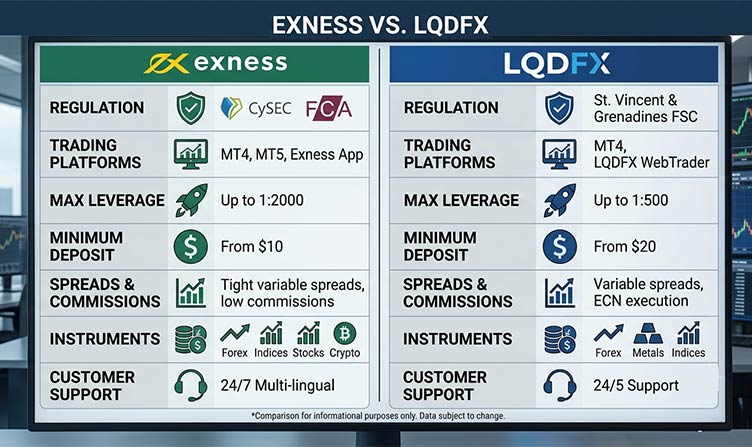
Company Background & Regulation
Exness started in 2008 and has grown into one of the larger volume brokers in the retail space. It operates through multiple entities with licenses from the Financial Services Authority of Seychelles (FSA), Cyprus Securities and Exchange Commission (CySEC), Financial Sector Conduct Authority of South Africa (FSCA), Financial Services Commission of the British Virgin Islands and Mauritius, Central Bank of Curaçao and Sint Maarten, Capital Markets Authority of Kenya, and others. The higher-tier licenses (FCA and CySEC entities) are more restricted for retail clients in certain regions, so most traders end up under the offshore entities that still carry real oversight and segregated client funds. Negative balance protection is standard.
Head to the official site
LQDFX launched around 2015 and has always operated as an offshore broker, typically linked to Saint Lucia or Marshall Islands registrations. It has never held a meaningful license from a top-tier regulator. Multiple warnings have appeared over the years from the FCA and other authorities regarding unauthorized activity. Client funds are said to be segregated, but without independent regulatory audits or compensation schemes, that claim carries limited weight.
In my experience, regulation is not abstract paperwork. During a period of extreme market stress I watched how brokers handled withdrawals and margin calls. Exness processed everything smoothly under its regulatory framework. With LQDFX the lack of oversight always sat in the back of my mind. If something goes wrong—delayed withdrawals, disputed trades, or worse—you have far fewer avenues for recourse. For anyone treating this as more than pure speculation money, that difference is decisive.
Trading Conditions – Spreads, Commissions, Leverage, Execution Quality
This is where the day-to-day reality of trading shows up.
Spreads and commissions Exness offers several account types. On Standard accounts you get spreads from around 0.2–0.8 pips on majors with no commission. Pro accounts tighten that further. Raw Spread accounts start from 0.0 pips plus roughly $3.50 per side per lot. Zero accounts aim for zero spreads on the most liquid instruments for large parts of the day with a lower variable commission. During quiet Asian sessions I regularly saw EURUSD under 0.3 pips on Raw/Zero. During high-volatility news the spreads widened, but execution stayed consistent.
LQDFX Micro accounts typically run around 1 pip on EURUSD with no commission. Gold accounts sit closer to 0.7 pips. ECN accounts advertise from 0.1 pips plus about $3.50 per lot. In live trading the ECN spreads were competitive in calm markets, but I noticed more frequent widening and occasional slippage during news releases compared with Exness.
Leverage Exness can offer up to unlimited leverage on qualifying accounts (subject to equity, instrument, and regional rules). Most of the time I traded with 1:500–1:2000 ranges depending on the pair and my equity. Stop-out is often set at 0%, which is aggressive but useful for certain strategies.
LQDFX offers up to 1:500 on Micro accounts and lower (1:300 or 1:100) on higher tiers. It is still high by regulated standards, but not in the same league as Exness’s flexible unlimited option.
Execution quality What really stood out during high-volatility sessions was Exness’s consistency. Scalping the open or trading the NFP spike, I got fills close to the expected price with minimal requotes on market-execution accounts. LQDFX felt acceptable in normal conditions but showed more variable fills and occasional delays when liquidity thinned. For pure scalping or news trading, Exness pulled ahead. For slower swing trading the difference was smaller.
Platforms & Tools
Both support MetaTrader 4. Exness also offers MetaTrader 5 and its own Exness Terminal (web and mobile). The Terminal is clean, fast, and integrates account management, economic calendar, and one-click trading without feeling bloated. Mobile apps on both platforms work fine for monitoring, but Exness’s ecosystem feels more polished when switching between devices.
LQDFX is primarily an MT4 shop. It does the job for classic charting, EAs, and indicators, but lacks the extra native tools Exness provides. If you live inside MT4 and never leave it, either works. If you value modern account dashboards, faster mobile experience, and multi-platform options, Exness is clearly stronger.
Account Types, Deposits & Withdrawals
Exness
- Standard and Standard Cent: very low or no practical minimum deposit
- Pro, Raw Spread, Zero: higher thresholds in some regions (often starting around a few hundred dollars)
- Funding methods are extensive: cards, e-wallets, local transfers, crypto
- Withdrawals are the standout feature. Instant or near-instant processing on many methods is common. I routinely had funds in my account within minutes. This is one of the main reasons I kept returning to Exness for active trading.
Head to the official site
LQDFX
- Micro and Islamic: $20 minimum
- Gold and ECN: $500
- VIP: $25,000
- Similar payment methods including crypto
- Withdrawals typically take 1–3 business days. In my testing they were processed, but never with the same speed or reliability I experienced on Exness. Any delay feels longer when you know the broker is unregulated.
The difference in withdrawal speed and certainty is not minor. When you need capital for another opportunity or simply want peace of mind, Exness’s instant withdrawal capability is a genuine operational advantage.
Detailed Pros & Cons
Exness – Personal Perspective Pros:
- Strong multi-jurisdiction regulation and fund segregation
- Extremely competitive spreads and flexible account types
- Unlimited leverage option under conditions
- Near-instant withdrawals that actually work
- Solid MT4/MT5 + proprietary terminal
- Transparent execution during volatile periods
Cons:
- Higher minimums on professional accounts in some regions
- No big deposit bonuses (they focus on trading conditions instead)
- Leverage can be restricted by equity or region
Head to the official site
LQDFX – Personal Perspective Pros:
- Low entry barrier on Micro accounts
- Competitive ECN spreads when markets are calm
- Straightforward MT4 setup
- High leverage available
Cons:
- No meaningful regulation and history of regulatory warnings
- Slower and less predictable withdrawals
- Narrower platform choice
- Greater counterparty risk that never fully leaves your mind
Who Should Choose Exness? Who Should Choose LQDFX?
Choose Exness if you are:
- A beginner who wants a safer environment while learning
- A scalper or news trader who needs reliable fills and tight costs
- A high-volume or professional trader who values execution quality and fast capital movement
- Anyone who prioritizes regulation and the ability to withdraw quickly without drama
Head to the official site
LQDFX might still appeal only to traders who:
- Are comfortable with full offshore risk
- Trade small size on Micro accounts and mainly use MT4
- Prioritize the absolute lowest advertised entry barrier over everything else
Even then, I would size positions carefully and never leave large balances sitting there.
If I had to choose one for my own trading today, it is Exness without hesitation. The combination of regulation, execution consistency, and especially the speed and reliability of withdrawals creates a better overall experience. LQDFX can look attractive on paper with its low minimums and ECN pricing, but the lack of real oversight and the slower capital movement make it a higher-risk choice that I no longer find worth the trade-off.
For most traders reading this—whether you scalp, swing, or sit somewhere in between—Exness is the clearer, more trustworthy option. Test both with small amounts if you insist, but put the majority of your serious capital where the infrastructure and regulatory framework actually support the activity.
Practical advice: always verify the exact entity and terms available in your country, start with a demo or micro size, and treat leverage as a tool rather than a goal. Markets will always find ways to humble you; choose the broker that does not add unnecessary risk on top.
Head to the official site
FAQ
Is Exness safer than LQDFX? Yes. Exness holds multiple regulatory licenses and maintains segregated funds under those frameworks. LQDFX operates without top-tier regulation.
Which has tighter spreads – Exness or LQDFX? On professional accounts both can be very competitive. Exness Raw/Zero and LQDFX ECN both reach near-zero raw spreads. In live volatile conditions I found Exness more consistent.
What is the minimum deposit for Exness vs LQDFX? Exness allows very low or no practical minimum on Standard accounts. LQDFX starts at $20 on Micro.
How fast are withdrawals on Exness? Often instant or within minutes on supported methods. This is one of its strongest practical advantages.
Can I use high leverage on both? Yes. Exness can go to unlimited under conditions. LQDFX typically caps at 1:500 on its lowest-tier accounts.
Is LQDFX good for beginners? Only if the trader fully accepts the unregulated risk. Most beginners are better served by a regulated broker such as Exness.
Do both support MetaTrader? Yes. Both offer MT4. Exness also provides MT5 and its own terminal.
Which is better for scalping? Exness, primarily because of execution quality and withdrawal speed when you need to move capital quickly.

•Most Trusted Broker — Asia 2026
•Broker of the Year — LATAM 2026
These awards confirm our commitment to building a rewarding trading environment and helping you uncover your potential. Thank you for choosing to trade with an award-winning broker!
Why choose MetaTrader 5 with Top Forex Brokers?
•Blazing-fast execution & enhanced stability
•38 built-in technical indicators & 21 timeframes for precision trading
•Optimized for all devices—desktop, mobile & web
•Trade a wide range of assets: Stocks, Commodities, Forex & more!
Disclaimer: Trading forex and CFDs carries a high level of risk and may not be suitable for all investors. Ensure you understand the risks involved and consider your financial situation before trading.