

I’ve spent several months trading real money on both XM and FXPrimus. Not demo accounts or a few test trades—actual positions through news events, quiet Asian sessions, and full London opens. The question of XM vs FXPrimus comes up constantly because both have been around since 2009, both push high leverage, and both market themselves as accessible for everyday traders. The choice isn’t always obvious until you’ve felt the difference in spreads during volatility, waited on a withdrawal, or tried to get a straight answer from support at 2 a.m.
Here’s what actually stood out after living with both.
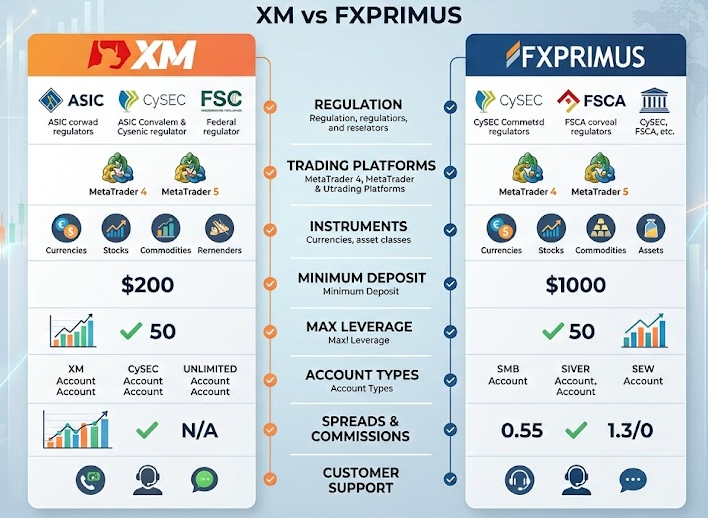
Quick Side-by-Side Comparison
| Feature | XM | FXPrimus |
|---|---|---|
| Regulation | CySEC, ASIC, FSCA, DFSA, FSC (multi) | CySEC + VFSC |
| Minimum Deposit | $5 | $15 (Classic); higher for Pro/Zero |
| Max Leverage | Up to 1:1000 | Up to 1:2000 (Classic) |
| Spreads (EUR/USD typical) | Ultra Low ~0.8–1.1 pips; Zero raw + commission | Classic ~1.5 pips; Pro ~0.3 + commission |
| Platforms | MT4, MT5 | MT4, MT5, WebTrader |
| Instruments | 1,400+ | ~1,000 or fewer |
| Deposit/Withdrawal Fees | Mostly $0 (XM side) | Mostly $0 (broker side) |
| Customer Support | 24/7 | 24/5 |
| Education | Strong (webinars, videos, research) | Solid but lighter |
Regulation & Safety
This is the first place I look, and the difference is clear. XM operates through multiple entities with licenses from CySEC (EU), ASIC (Australia), FSCA (South Africa), DFSA (Dubai), and offshore options like FSC Belize or similar. The protection level depends on which entity you land under based on your residence, but the overall structure feels more robust. Negative balance protection is standard, funds are segregated, and the multi-jurisdiction setup gives more layers of oversight.
FXPrimus runs Primus Global Ltd under CySEC (license 261/14) and Primus Markets INTL Ltd under VFSC in Vanuatu. CySEC clients get the usual EU protections including the Investor Compensation Fund up to €20,000. The VFSC entity is the one many international traders end up on, and it is lighter-touch. Both brokers segregate funds and offer negative balance protection. I never had a safety scare with either, but XM’s broader regulatory footprint made me sleep better when markets got messy.
Head to the XM official site
Account Types & Minimum Deposit
XM wins on accessibility. You can open Micro, Standard, or Ultra Low accounts with just $5. Micro lets you trade tiny sizes (1,000-unit lots), which is perfect when you’re testing a new strategy without stress. Ultra Low keeps spreads tighter with no commission. Zero account (raw spreads + $3.50 per side) is available in some regions and suits active traders.
FXPrimus starts at $15 for the Primus CLASSIC account (spread-only, no commission, leverage up to 1:2000). Primus PRO needs around $500 and adds tighter spreads with commissions ($8–$10 per lot depending on platform). Primus ZERO requires $1,000 for raw 0.0 spreads plus $5 commission. They also have a Synthetics account focused on those instruments. The higher entry points on the better-priced accounts felt like a barrier when I wanted to scale gradually.
Head to the XM official site
Spreads, Commissions & Trading Costs
In live trading, costs matter more than the marketing numbers. On XM’s Ultra Low I consistently saw EUR/USD around 0.8–1.1 pips during liquid hours with no commission. Standard sat wider, closer to 1.6–2.0. The Zero account (where available) delivered raw spreads but the round-turn commission adds up if you’re scalping heavily.
FXPrimus CLASSIC ran wider—often 1.5 pips or more on majors in my experience. PRO tightened things nicely (around 0.3 advertised, higher in practice sometimes) but the commission made the all-in cost comparable or slightly higher than XM Ultra Low for my volume. During major news, both widened, though XM felt a touch more consistent in execution. Neither is the absolute cheapest raw-spread broker out there, but XM’s commission-free tighter accounts were more practical for the way I trade.
Head to the XM official site
Trading Platforms & Tools
Both give you solid MetaTrader 4 and MetaTrader 5. Execution on both was fast enough for my needs—rarely any meaningful slippage on majors outside news. XM’s platforms felt familiar and stable. FXPrimus also offers WebTrader and, according to some older or regional info, has supported cTrader in the past; current official focus appears to stay on MT4/MT5/WebTrader. If you specifically need cTrader depth of market or its interface, double-check availability for your account type and region, as it is not as central as it once was for some traders.
I ran EAs on both without drama. Charting tools, one-click trading, and mobile apps are standard and reliable on both.
Head to the XM official site
Deposit & Withdrawal Methods + Real Experience
Both support cards, bank wires, e-wallets (Skrill, Neteller, etc.), and crypto in many regions. XM deposits hit almost instantly on cards and e-wallets. Withdrawals were processed within 24 hours on their side; e-wallets often arrived the same day, cards took a few business days. XM charges $0 on most methods from their side (small exception possible on very small bank wires).
FXPrimus was similar—instant or near-instant deposits on electronic methods, withdrawals processed within a business day on their end. I had one e-wallet withdrawal that landed cleanly the same day and a bank transfer that took the expected few days. No broker-side fees in my experience, though third-party charges can appear. Neither gave me serious headaches, but XM’s process felt slightly smoother and more automatic.
Customer Support
XM’s 24/7 live chat and multilingual support answered quickly in my tests. I got clear answers on account questions and one withdrawal status check without long waits. FXPrimus runs 24/5. Responses were professional when I reached them, but the limited hours meant waiting if something came up over a weekend. For most traders this is fine; if you trade odd hours or need constant access, XM has the edge.
Head to the XM official site
Education & Research Resources
XM invests heavily here. Live webinars, video libraries, market analysis, and educational content are plentiful and useful for newer traders. I actually used some of their sessions while testing strategies. FXPrimus offers blogs, basic resources, and some educational material, but it is lighter. If you’re still building your knowledge base, XM is noticeably stronger.
Asset Range
XM offers a much wider selection—over 1,400 instruments including more forex pairs, a large stock CFD list, indices, commodities, and some crypto CFDs (availability varies by entity). FXPrimus covers the majors and a solid range of indices, metals, energies, and other CFDs, but the overall menu is smaller. If you like jumping between different markets or trading a broader basket of stocks and indices, XM gives more options.
Head to the XM official site
Pros and Cons
XM Pros
- Very low $5 minimum deposit
- Strong multi-regulator structure
- Competitive commission-free spreads on Ultra Low
- Excellent education and 24/7 support
- Huge instrument range
XM Cons
- Standard account spreads can feel average
- Platform limited to MT4/MT5 (no cTrader focus)
- Some features or leverage capped depending on entity
Head to the XM official site
FXPrimus Pros
- High leverage available on Classic (up to 1:2000)
- Raw-spread options with competitive commissions on higher accounts
- Decent platform choice and execution
- Negative balance protection and segregated funds
FXPrimus Cons
- Higher minimums for the tighter-priced accounts
- Lighter regulatory stack outside CySEC
- Fewer instruments and less education depth
- Support not fully 24/7
Head to the XM official site
Who Each Broker Is Best For
Beginners who want safety, education, and the ability to start tiny should lean XM. The $5 entry, Micro account, strong educational library, and broader regulation make the learning curve less painful.
High-leverage seekers who are comfortable with the VFSC entity and want the potential 1:2000 on a low-deposit Classic account may prefer FXPrimus. Just size positions carefully—high leverage cuts both ways.
Active day traders or scalpers will probably find XM’s Ultra Low or Zero accounts more cost-effective day-to-day. If you specifically want cTrader and it is available in your region with FXPrimus, that could tip the scale, but verify current platform access first.
Traders who value a wider choice of stocks, indices, and overall instrument variety will get more from XM.
Head to the XM official site
XM vs FXPrimus
After months of real trading on both, XM is the stronger overall choice for most people. The combination of lower barrier to entry, more robust regulatory coverage across entities, better education, wider markets, and consistently practical trading costs edged it ahead. FXPrimus is a legitimate broker with competitive conditions on its higher-tier accounts and higher leverage options, but it feels like the secondary choice unless you specifically need something XM does not emphasize (such as certain leverage levels or platform nuances in your region).
Your priorities decide it. If regulation depth, low starting capital, and learning resources matter most, go XM. If maximum leverage on a simple account and you are fine with the regulatory mix, FXPrimus can work. Either way, start small, verify the exact entity and conditions for your country, and test withdrawals early. That’s what I did, and it saved me from surprises later.
Head to the XM official site
FAQ: XM vs FXPrimus
Which is better overall, XM or FXPrimus?
XM for most traders due to regulation breadth, lower minimums, education, and instrument range. FXPrimus can suit high-leverage preferences on its Classic account.
Is XM safer than FXPrimus?
XM’s multi-jurisdiction licenses (including stronger ones like ASIC and CySEC) generally provide a more layered safety profile. Both offer segregated funds and negative balance protection.
What is the minimum deposit for XM vs FXPrimus?
XM starts at $5. FXPrimus starts at $15 for Classic, with higher requirements for PRO and ZERO accounts.
Does FXPrimus offer tighter spreads than XM?
On its PRO and ZERO accounts the raw spreads can be competitive, but after commissions the all-in cost is often similar to or higher than XM’s Ultra Low for typical volume. Classic spreads run wider.
Can I use cTrader with either broker?
XM is MT4/MT5 focused. FXPrimus has offered cTrader in some contexts historically; confirm current availability for your account and region as official emphasis is on MT4, MT5, and WebTrader.
How fast are withdrawals on XM vs FXPrimus?
Both process requests within about one business day on their side. E-wallets are typically fastest (often same day). My personal withdrawals were reliable on both, with XM feeling slightly more streamlined.

•Most Trusted Broker — Asia 2026
•Broker of the Year — LATAM 2026
These awards confirm our commitment to building a rewarding trading environment and helping you uncover your potential. Thank you for choosing to trade with an award-winning broker!
Why choose MetaTrader 5 with Top Forex Brokers?
•Blazing-fast execution & enhanced stability
•38 built-in technical indicators & 21 timeframes for precision trading
•Optimized for all devices—desktop, mobile & web
•Trade a wide range of assets: Stocks, Commodities, Forex & more!
Disclaimer: Trading forex and CFDs carries a high level of risk and may not be suitable for all investors. Ensure you understand the risks involved and consider your financial situation before trading.