

I spent several months trading real money on both IC Markets and FXGiants. Same strategies, same pairs, same news events. The question kept coming up from traders I know: which one actually delivers when real capital is on the line?
Both brokers look solid on paper. One has a stronger regulatory footprint and deeper liquidity. The other gives you fixed-spread options and a lower entry barrier. After living with the platforms, the spreads, the withdrawals, and the support, the differences became clear.
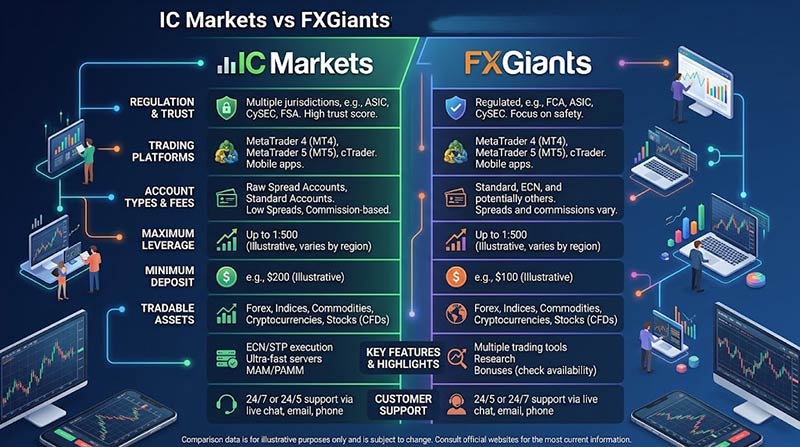
Here’s the side-by-side that mattered most while I was testing.
Quick Comparison Table
| Feature | IC Markets | FXGiants |
|---|---|---|
| Regulation | ASIC, CySEC, FSA Seychelles | Mainly BVI FSC (group has FCA/CySEC) |
| Min Deposit | $200 | $100 (varies by account) |
| Platforms | MT4, MT5, cTrader, TradingView | Primarily MT4 |
| Spreads (EUR/USD Raw) | From 0.0 + commission | From 0.0 + commission or fixed |
| Commission (Raw) | $3.50/side MT4/5 ($3 cTrader) | Around $3.75–$9/side depending on account |
| Max Leverage | Up to 1:500–1:1000 (entity dependent) | Up to 1:1000 |
| Instruments | 2,000+ | 300+ |
| Execution | Excellent, low latency | Solid on MT4, more variable |
Regulation & Safety
This is the first place I look, and it’s also where the gap is widest.
IC Markets runs under ASIC (Australia – Tier-1), CySEC (Cyprus), and FSA Seychelles. ASIC and CySEC bring proper client-fund segregation, negative balance protection, and real oversight. Most international clients land under the Seychelles entity these days, but the Australian parent and CySEC licence still give the brand weight. I never had a moment of worry about fund safety.
Head to the IC Markets official site
FXGiants operates primarily through Notesco (BVI) Limited under the British Virgin Islands FSC. The wider Notesco group holds an FCA licence (UK) and other licences, but the global website most traders use sits under BVI regulation. That is lighter-touch. Negative balance protection exists, and funds are segregated, yet the compensation schemes and dispute resolution are not at the same level as ASIC or CySEC. A few national regulators have issued warnings about the offshore entity over the years. I traded comfortably, but I kept position sizes more conservative here than I did at IC Markets.
If regulation and fund safety rank high for you, IC Markets is the clearer choice in 2026.
Account Types & Minimum Deposit
IC Markets keeps it simple. Standard (commission-free, spreads from around 0.8 pips), Raw Spread on MT4/MT5 ($3.50 per side), and Raw Spread on cTrader ($3.00 per side). Minimum deposit sits at $200 across the board. Islamic accounts are available. No confusing tiers.
FXGiants offers six live account types: Live Floating, Live Fixed, Live Zero Fixed Spread, plus three STP/ECN variants (No Commission, Zero Spread, Absolute Zero). Minimum starts at $100 on many accounts, though some ECN-style accounts ask for more. The fixed-spread options stand out. If you hate seeing spreads blow out during news, the fixed accounts can feel more predictable.
I preferred IC Markets’ cleaner structure. Fewer decisions, less chance of picking the “wrong” account.
Spreads, Commissions & Trading Costs
This is where real money talks.
On IC Markets Raw accounts I regularly saw EUR/USD sitting at 0.0–0.1 pips during London and New York sessions. Add the $7 round-turn commission and all-in costs stayed among the lowest I’ve paid. During high-impact news the spreads widened, but execution stayed tight and slippage was minimal. Scalping and EA trading felt smooth.
FXGiants can match the zero-spread headline on its Zero Fixed and STP/ECN Zero accounts, but commissions are often higher ($3.75–$9 per side depending on the account). Floating accounts start wider (around 1.0–1.7 pips). The fixed-spread accounts deliver what they promise — the spread does not jump — yet the overall cost of trading was usually higher than IC Markets for the volume I was putting through.
Over three months of active trading, my average cost per lot was noticeably lower at IC Markets. That difference compounds fast.
Head to the IC Markets official site
Trading Platforms & Tools
IC Markets wins this category hands down. You get full MetaTrader 4, MetaTrader 5, cTrader, and TradingView integration. Servers sit in Equinix NY4 and LD5. Latency is excellent. EAs run without drama. Depth of Market and advanced order types on cTrader make a real difference for order-flow traders.
FXGiants sticks mainly to MetaTrader 4. It is stable and familiar, and they claim high execution rates with limited requotes on STP/ECN accounts. For pure MT4 users it works fine. If you want MT5, cTrader, or better charting tools, you will feel limited.
I ran the same EA on both. On IC Markets it executed cleaner and with less interference. On FXGiants it was acceptable but not in the same league.
Head to the IC Markets official site
Deposit & Withdrawal Methods + Real Experience
Both brokers offer cards, bank wire, and popular e-wallets. IC Markets also supports more regional options and crypto on certain entities. Neither charges internal deposit or withdrawal fees on most methods (your bank or payment provider may still take a cut).
My experience: IC Markets processed e-wallet withdrawals same day or next business day consistently. Card refunds took a few days. Bank wires were slower, as expected. FXGiants was similar for e-wallets, though I hit one delay that required a support ticket to clear. Nothing dramatic, but IC Markets felt more polished and predictable.
Head to the IC Markets official site
Customer Support
IC Markets support is available 24/7 via live chat, email, and phone in multiple languages. Responses were usually fast and competent. When I had a minor verification question, it was sorted the same day.
FXGiants runs 24/5 multilingual support. Live chat worked, but response quality varied. One withdrawal query took longer than I liked. Not a deal-breaker, yet IC Markets felt more professional overall.
Education & Research Resources
Neither broker is an education powerhouse. IC Markets provides market analysis, webinars, and economic calendar tools. Research is functional rather than deep. FXGiants has basic educational material and market updates, but nothing that will transform a beginner into a consistent trader. If education is a priority, look elsewhere or supplement with third-party resources.
Asset Range
IC Markets offers over 2,000 instruments — forex, indices, commodities, stocks, crypto CFDs, and more. FXGiants sits around 300 instruments across forex, metals, indices, commodities, futures, and shares. For pure forex and majors, both cover the bases. If you want broader diversification, IC Markets is stronger.
Head to the IC Markets official site
Pros and Cons
IC Markets Pros
- Stronger multi-jurisdiction regulation
- Extremely competitive raw spreads and total costs
- Multiple professional platforms (MT4, MT5, cTrader)
- Excellent execution quality for scalpers and algos
- Wide instrument range
IC Markets Cons
- $200 minimum deposit
- No fixed-spread accounts
- Education and research are average
Head to the IC Markets official site
FXGiants Pros
- Lower minimum deposit
- Fixed-spread account options
- Multiple account types for different styles
- High leverage available
- Familiar MT4 environment
FXGiants Cons
- Primarily offshore (BVI) regulation for most clients
- Higher overall trading costs on many accounts
- Limited to mainly MT4
- Narrower instrument selection
Who Each Broker Is Best For
Scalpers and high-frequency traders: IC Markets. The raw pricing and low-latency servers make a measurable difference.
Algo and EA traders: IC Markets again. Better platform choice and more reliable execution.
Fixed-spread seekers or traders who hate news-time spread spikes: FXGiants has a genuine edge here with its fixed and zero-fixed accounts.
High-leverage users who want a low barrier to entry: FXGiants (up to 1:1000 and $100 min on many accounts).
Traders prioritising regulation and long-term safety: IC Markets.
Beginners testing the waters: FXGiants’ lower deposit can feel less intimidating, though I still prefer the cleaner environment at IC Markets once you are past the first few hundred dollars.
Head to the IC Markets official site
After months of real-money trading, IC Markets is the better broker for most active traders in 2026. The combination of stronger regulation, tighter real costs, superior platform options, and consistently better execution edges out FXGiants.
FXGiants is not a bad broker. The fixed-spread accounts and lower minimum deposit give it a niche. If those features matter more to you than regulatory strength and multi-platform flexibility, it can work. For me, the extra cost and lighter regulation were not worth the trade-off.
I keep my main accounts at IC Markets. That is the honest recommendation after testing both with real capital.
FAQ: IC Markets vs FXGiants
Which is better overall — IC Markets or FXGiants?
IC Markets for most traders, especially those focused on costs, execution, and regulation.
Does FXGiants offer fixed spreads?
Yes. Several account types provide fixed or zero-fixed spreads, which is one of its clearer advantages.
Is IC Markets safer than FXGiants?
Generally yes. ASIC and CySEC licences provide stronger oversight than the primary BVI regulation used by FXGiants for global clients.
Can I scalp on both brokers?
Yes. IC Markets is better suited because of tighter spreads and faster, more consistent execution.
What is the minimum deposit for each?
IC Markets requires $200. FXGiants starts at $100 on many accounts.
Which broker has better platforms?
IC Markets — MT4, MT5, and cTrader versus primarily MT4 at FXGiants.

•Most Trusted Broker — Asia 2026
•Broker of the Year — LATAM 2026
These awards confirm our commitment to building a rewarding trading environment and helping you uncover your potential. Thank you for choosing to trade with an award-winning broker!
Why choose MetaTrader 5 with Top Forex Brokers?
•Blazing-fast execution & enhanced stability
•38 built-in technical indicators & 21 timeframes for precision trading
•Optimized for all devices—desktop, mobile & web
•Trade a wide range of assets: Stocks, Commodities, Forex & more!
Disclaimer: Trading forex and CFDs carries a high level of risk and may not be suitable for all investors. Ensure you understand the risks involved and consider your financial situation before trading.