

After spending several months testing both platforms with real money, I kept coming back to the same dilemma almost every serious trader faces at some point: do you go with the established, tightly regulated ECN player that charges a bit more to get started, or the high-leverage, low-barrier offshore option that looks attractive on paper? IC Markets vs LMFX is exactly that choice.
I funded live accounts at both, ran scalping sessions during London open, traded NFP and FOMC releases, held swing positions for days, and paid close attention to execution quality, spreads under pressure, and how quickly money actually left the account when I requested withdrawals. What follows is not a brochure summary. It is the practical comparison I wish I had before depositing.
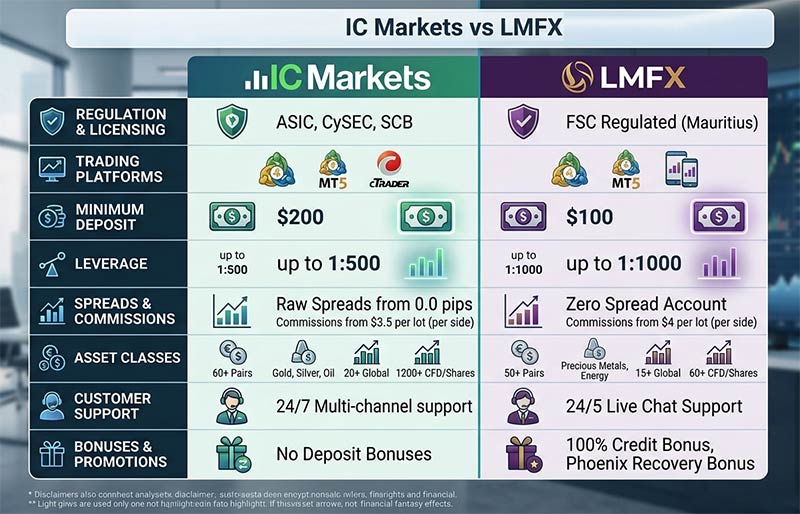
Company Background & Regulation
IC Markets started in Sydney in 2007. It has grown into one of the larger true ECN brokers by volume. Regulation sits at the core of its offering: ASIC in Australia (AFSL 335692), CySEC in Cyprus, and additional entities under the FSA in Seychelles and SCB in the Bahamas. Client funds are segregated. Negative balance protection applies on the regulated entities. For EU clients there is Investor Compensation Fund coverage up to €20,000. That layered structure gives me genuine comfort when markets go chaotic.
Head to the official site
LMFX launched around 2015 and is based in North Macedonia. It operates without licences from any major financial authority. Multiple independent reviews and regulatory databases list it as unregulated. There is no investor compensation scheme, no mandatory external audits of the kind ASIC or CySEC require, and limited formal recourse if something goes wrong. In my experience, that single fact changes how large a position I am willing to hold overnight.
When I weighed IC Markets vs LMFX regulation, the difference was not subtle. One broker answers to Tier-1 supervisors and publishes clear fund-segregation practices. The other does not. For any capital I cannot afford to lose, that gap matters more than a few tenths of a pip.
Trading Conditions – Spreads, Commissions, Leverage, Execution Quality
This is where the real trading cost comparison lives.
IC Markets Raw Spread accounts (MT4/MT5) show average EUR/USD spreads around 0.0–0.1 pips most of the time, with a transparent commission of $3.50 per side ($7 round turn) on a standard lot. On cTrader the commission drops to $3.00 per side. Standard accounts sit around 0.6–1.0 pips with no commission. During high-volatility sessions the raw spreads stayed remarkably stable. I watched EUR/USD hold near zero even while NFP numbers hit the wire. Slippage was minimal and almost always positive or neutral on market orders.
LMFX offers three main structures. Premium accounts start around 1 pip on majors with no commission. Zero accounts advertise 0-pip spreads plus roughly $4 per side ($8 round turn). Fixed-spread accounts exist for those who hate variability. In quieter markets the Zero account looked competitive on paper. Once volatility rose, spreads widened more noticeably than on IC Markets, and occasional requotes or delayed fills appeared during news.
Leverage is the other big divergence. IC Markets offers up to 1:500 on its international (Seychelles) entity and the usual 1:30 retail limits under ASIC/CySEC rules. LMFX goes to 1:1000 on its Premium accounts. Higher leverage is seductive for small accounts, but it also amplifies every execution hiccup and every emotional decision. I used the higher leverage on LMFX for a short period of aggressive scalping and quickly realised I preferred the more measured risk environment at IC Markets.
Execution quality tilted clearly toward IC Markets. Their servers sit in Equinix data centres; average reported latency stays under 40 ms for many locations. Orders filled cleanly even when I was hammering the order book around major news. LMFX on MT4 felt adequate for normal conditions but showed more variance when liquidity thinned.
For pure cost on high-volume ECN-style trading, IC Markets raw spread remains hard to beat once you factor in reliability under stress. That is why the phrase “IC Markets raw spread” keeps appearing in serious trader discussions.
Platforms & Tools
IC Markets gives you MetaTrader 4, MetaTrader 5, and cTrader, plus TradingView integration on some setups. cTrader’s depth-of-market and algorithmic environment is excellent for discretionary and systematic traders who want Level II visibility. VPS options and copy-trading integrations (ZuluTrade, Myfxbook) are available.
LMFX sticks to MetaTrader 4 across desktop, web, and mobile. It works, EAs run, and the interface is familiar. But the absence of MT5 and especially cTrader limits the toolkit. If your strategy relies on advanced charting, multi-timeframe analysis, or sophisticated order types, the difference becomes obvious after a few weeks.
I ran the same EA on both platforms. On IC Markets the fills tracked the back-test more closely. On LMFX I saw more divergence during busy periods.
Account Types, Deposits & Withdrawals
IC Markets keeps it straightforward: Standard (commission-free), Raw Spread on MT4/MT5, and Raw Spread on cTrader. Minimum deposit is $200 across the board. Islamic accounts are available. Deposits via card, bank transfer, and several e-wallets are usually free from the broker side. Withdrawals are processed quickly—often same day for e-wallets, a few days for cards and wires. In my tests, funds arrived without drama and without unexpected fees from the broker.
LMFX is more fragmented. Premium, Micro, Fixed, and Zero accounts each carry different minimums (as low as $5–$50), leverage caps, and cost structures. The low entry point is attractive for absolute beginners or very small test accounts. Withdrawals are advertised as same-day processing with no broker fees. In practice I experienced mixed results: some e-wallet withdrawals landed fast, while bank wires took longer and required more back-and-forth on verification than I encountered at IC Markets. The keyword “LMFX withdrawal” often surfaces in forums precisely because experiences vary more widely than with tightly regulated brokers.
Detailed Pros & Cons
IC Markets – Pros (from my live trading)
- Genuine Tier-1 regulation and fund protection
- Excellent raw spreads and consistent execution
- Full suite of professional platforms including cTrader
- Transparent pricing and reliable withdrawals
- Deep liquidity that holds up during news
IC Markets – Cons
- $200 minimum can feel high for brand-new traders
- Retail leverage capped at 1:30 on regulated entities
- No extravagant bonuses or ultra-high leverage marketing
Head to the official site
LMFX – Pros
- Very low minimum deposit
- Leverage up to 1:1000
- Simple MT4 offering and competitive Zero-account pricing in calm markets
- Accepts a broader range of countries in some cases
LMFX – Cons
- No major regulatory oversight
- Spreads and execution quality less consistent under volatility
- Limited platform choice
- Higher perceived counterparty risk
Who Should Choose IC Markets? Who Should Choose LMFX?
Scalpers, news traders, and high-volume ECN traders will almost always prefer IC Markets. The combination of raw spreads, low latency, and stable fills during the sessions that matter most is simply better. Swing traders who leave positions open for days or weeks also benefit from the regulatory safety net.
Beginners testing the waters with very small capital or traders who prioritise maximum leverage above everything else may find LMFX more accessible on paper. I would still urge extreme caution and only risk money you can afford to lose completely.
If you trade algorithmic strategies or need cTrader’s order-book tools, IC Markets is the clear choice. If you only ever use basic MT4 charts and want the absolute lowest deposit, LMFX enters the conversation—but the regulation gap remains.
After months of real-money comparison, if I had to choose one for my own trading today it would be IC Markets without hesitation. The regulation, execution quality, platform depth, and consistency of the IC Markets raw spread environment outweigh the higher minimum deposit and more conservative leverage. LMFX can work for short-term experimentation or traders who fully understand and accept the risks of an unregulated offshore broker, but it does not match IC Markets on the factors that protect capital and preserve edge over the long run.
Practical advice: open a demo at both if you are still undecided, then fund the smallest live account you are comfortable with and trade your actual strategy for a few weeks. Watch the fills on news days and test a withdrawal. Numbers on a comparison table matter less than what happens when real money is on the line.
For further reading on related brokers, see our in-depth IC Markets review and other ECN broker comparisons on brokersss.com.
Head to the official site
FAQ
Is IC Markets better regulated than LMFX? Yes. IC Markets holds ASIC and CySEC licences among others. LMFX is widely described as unregulated by major authorities.
What are the typical spreads in an IC Markets vs LMFX review? IC Markets Raw Spread averages near 0.0–0.1 pips on EUR/USD plus $7 round-turn commission. LMFX Premium starts around 1 pip; Zero accounts advertise 0 pips plus higher commission.
Which broker offers better leverage – IC Markets or LMFX? LMFX reaches 1:1000. IC Markets tops out at 1:500 on its international entity (and lower on regulated retail accounts).
How fast are LMFX withdrawals compared with IC Markets? Both claim same-day processing for many methods. In practice IC Markets felt more consistent and required less follow-up in my tests.
Is IC Markets or LMFX better for scalping? IC Markets. Execution stability and raw-spread reliability during high-volume periods give it a clear edge.
Can beginners start with either broker? LMFX has the lower deposit threshold. I still recommend IC Markets for anyone who plans to grow an account, because the regulatory and execution foundations are stronger.
Do both brokers allow EAs and news trading? Yes. IC Markets handles both more cleanly in live conditions from my experience.
Which is the best broker – IC Markets or LMFX – for most traders? For the majority of serious retail and professional traders, IC Markets is the stronger overall choice.

•Most Trusted Broker — Asia 2026
•Broker of the Year — LATAM 2026
These awards confirm our commitment to building a rewarding trading environment and helping you uncover your potential. Thank you for choosing to trade with an award-winning broker!
Why choose MetaTrader 5 with Top Forex Brokers?
•Blazing-fast execution & enhanced stability
•38 built-in technical indicators & 21 timeframes for precision trading
•Optimized for all devices—desktop, mobile & web
•Trade a wide range of assets: Stocks, Commodities, Forex & more!
Disclaimer: Trading forex and CFDs carries a high level of risk and may not be suitable for all investors. Ensure you understand the risks involved and consider your financial situation before trading.