

After spending several months testing both platforms with real money, I can tell you the “XM vs FreshForex” decision is one that trips up a lot of traders. Both brokers market themselves as accessible, high-leverage options with low minimum deposits and plenty of bonuses. On the surface they look similar. Dig a little deeper—especially once you start placing real trades during news spikes or quiet Asian sessions—and the differences become obvious.
I’ve scalped EUR/USD on both, held swing positions through volatile non-farm payrolls weeks, and even run a small news-trading experiment. What really stood out during high-volatility sessions was how each broker handled execution, spreads, and, most importantly, the safety of my capital. This isn’t a brochure comparison. It’s the kind of side-by-side I wish someone had handed me years ago.
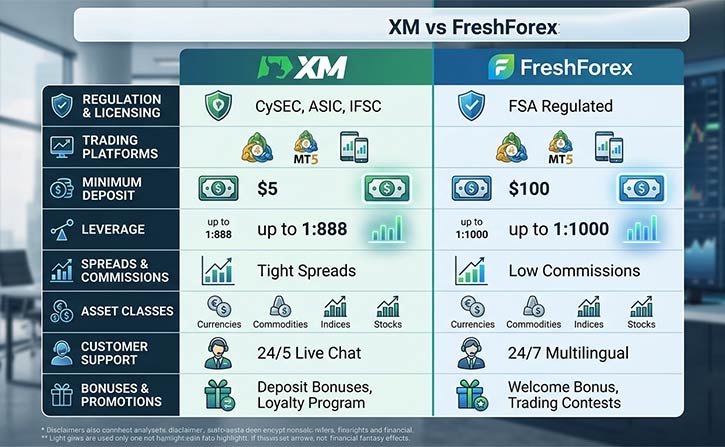
Company Background & Regulation
XM launched in 2009 and has grown into a multi-entity group serving millions of clients. It holds licenses from CySEC (Cyprus), ASIC (Australia), DFSA (Dubai), and offshore entities such as IFSC Belize and FSC. That mix matters. Retail clients in many regions get negative balance protection, segregated funds, and, under the CySEC entity, access to the Investor Compensation Fund up to €20,000. In my experience, the multi-layered regulation gives a genuine sense of security you don’t always find with pure offshore brokers.
FreshForex has been around longer—founded around 2003–2004—and operates primarily under registration in Saint Vincent and the Grenadines (SVGFSA / Riston Capital Ltd). Some sources mention older Russian or Belize references, but the core oversight remains offshore Tier-3 style regulation. Client funds are said to be segregated, yet there is no equivalent of a strong compensation scheme or rigorous capital requirements. When I compared the two side by side, the XM vs FreshForex regulation gap was the first thing that made me cautious with larger balances at FreshForex.
For pure safety of funds, XM is clearly ahead. That doesn’t mean FreshForex is a scam—plenty of traders use it without drama—but the regulatory cushion is thinner.
Head to the official site
Trading Conditions – Spreads, Commissions, Leverage, Execution Quality
This is where the rubber meets the road.
Spreads and commissions On XM’s Standard and Micro accounts, EUR/USD typically sits around 1.6 pips with no commission. Their Ultra Low / KIWAMI-style accounts tighten that to roughly 0.6–0.8 pips commission-free, while the Zero account offers raw spreads from 0.0 with a round-turn commission (often around $7 per standard lot). During my testing, the Zero account felt competitive for scalping once volume justified the commission.
FreshForex offers three main paths: Classic (fixed spreads starting around 2 pips, no commission), Market Pro (floating from about 0.9 pips), and ECN (raw spreads from 0.0 with commission starting around 0.003% or roughly $3–$10 round turn depending on the pair). On quiet days the ECN looked attractive. During high-volatility sessions, however, I noticed more widening on FreshForex than on XM’s tighter accounts.
Leverage FreshForex pushes up to 1:2000 on some accounts. XM tops out at 1:1000 on its offshore entities (1:30 under CySEC/ASIC for retail). Higher leverage is a double-edged sword. For small accounts it can feel exciting; in practice I found myself using far less on both brokers once I respected risk.
Execution Both use market execution on MT4/MT5 with no requotes in normal conditions. XM felt slightly more consistent during NFP and FOMC releases in my logs. Slippage existed on both, but XM’s average was tighter on the pairs I trade most.
Here’s a quick side-by-side snapshot under realistic market conditions:
| Feature | XM | FreshForex |
|---|---|---|
| Typical EUR/USD Spread | 0.6–1.6 pips (account dependent) | 0.0–2.0+ pips (account dependent) |
| Commission | $0 or ~$7 RT on Zero | $0 or ~$3–10 RT on ECN |
| Max Leverage | 1:1000 (offshore) | 1:2000 |
| Min Deposit | $5 | $10–$25 |
| Regulation | CySEC, ASIC, DFSA, IFSC etc. | SVG / offshore |
| Platforms | MT4, MT5, XM App | MT4, MT5 |
| Account Types | Micro, Standard, Ultra Low, Zero | Classic, Market Pro, ECN |
| Withdrawal Speed | Often same-day to 1–2 business days | Varies; can be slower with bonuses |
| Bonuses | Welcome + deposit match + loyalty | Aggressive deposit bonuses (up to 300%) |
(Exact spreads fluctuate—always check live conditions.)
Platforms & Tools
Both brokers rely on MetaTrader 4 and MetaTrader 5. XM adds its own mobile app and web trader, plus TradingView integration in some setups. FreshForex sticks closer to pure MT4/MT5 with web versions. In my daily use, XM’s mobile app felt smoother for quick position checks and one-tap order placement. Charting tools, indicators, and Expert Advisors work the same on both since they share the MetaTrader backbone. If you live and breathe custom EAs or multi-timeframe analysis, either platform will do the job. XM simply feels a bit more polished around the edges.
Account Types, Deposits & Withdrawals
XM’s $5 minimum is genuinely low. You can open Micro (1,000-unit lots) or Standard and still manage risk properly. FreshForex’s official minimum sits around $10–$25 depending on the source and account, though they sometimes advertise lower. Both support a wide range of funding methods—cards, e-wallets, bank wires, and local options in many regions.
What really mattered to me was the FreshForex withdrawal experience. On clean accounts without active bonuses, withdrawals processed, but any bonus attachment usually came with volume requirements that delayed or complicated access to funds. XM withdrawals, in my experience, were more straightforward—often processed within a day or two once verification was complete, with fewer strings attached on non-bonus balances. Negative balance protection is present on both under their respective entities, but XM’s multi-regulator setup gave me more confidence when I left overnight positions open.
Bonuses & Promotions
This is where FreshForex often looks flashier on paper. Large deposit match bonuses (sometimes advertised up to 100–300%) and occasional no-deposit offers appear regularly. The catch is almost always high turnover requirements before you can withdraw profits or even the bonus itself. In my testing, those requirements made the “free money” feel more like a trading volume commitment than a genuine boost.
XM’s bonus structure is more measured—welcome credits, deposit matches (historically up to several thousand dollars in total), and a loyalty points program that converts into trading credit. The XM bonus terms felt clearer and less restrictive in practice. If you treat bonuses as extra margin rather than free cash, both can be useful. Just read the fine print carefully; I’ve seen too many traders get stuck chasing turnover instead of trading their actual strategy.
Head to the official site
Detailed Pros & Cons
XM Pros (from my perspective)
- Stronger multi-jurisdictional regulation and fund protection
- Reliable execution and tighter average spreads on competitive accounts
- Excellent educational content and research for newer traders
- Smooth deposits and withdrawals in most cases
- Very low $5 entry point with micro-lot flexibility
XM Cons
- Standard spreads are not the tightest in the industry
- Leverage capped lower than pure offshore rivals
- Bonus eligibility can vary by entity and region
Head to the official site
FreshForex Pros
- Higher maximum leverage
- Aggressive bonus offers that can turbo-charge small accounts (if you meet the terms)
- ECN option with raw spreads for volume traders
- Long operating history
FreshForex Cons
- Weaker regulatory oversight
- Spreads can widen more noticeably in volatile conditions
- Bonus-related withdrawal restrictions are common complaints
- Overall client protection is thinner
Who Should Choose XM? Who Should Choose FreshForex?
Choose XM if:
- You are a beginner or intermediate trader who values education and safety
- You trade primarily during London/New York sessions and want consistent execution
- Capital protection and straightforward withdrawals matter more than maximum leverage
- You prefer a broker with proven multi-regulator credentials
Head to the official site
Choose FreshForex if:
- You are an experienced trader comfortable with offshore risk
- You specifically want 1:2000 leverage and are disciplined enough to use it carefully
- You plan to trade high volume on the ECN account and can handle potential bonus volume requirements
- You are starting with a very small account and want the highest possible gearing
Scalpers and news traders will probably lean toward XM’s tighter, more consistent pricing. Swing traders who hold for days or weeks may find the difference smaller, provided they accept the regulatory trade-off.
If I had to choose one for my own trading today, it would be XM. The combination of stronger regulation, more predictable execution, cleaner withdrawal process, and solid educational support outweighs FreshForex’s higher leverage and flashier bonuses for the way I trade. FreshForex can work for a specific type of high-risk, high-leverage trader who understands the trade-offs and stays away from aggressive bonus traps. For the majority of retail traders asking “best broker XM or FreshForex,” XM is the safer, more complete package.
Practical advice: open demo accounts on both, test the exact pairs and times you trade, and only deposit what you can afford to lose. Always verify the legal entity you are signing up under—regulation is not uniform across every brand entity. And treat every bonus as a potential restriction until you fully understand the terms.
Whether you pick XM or FreshForex, the real edge still comes from your risk management and strategy, not the broker logo on the platform.
FAQ
1. Which broker is safer – XM or FreshForex? XM, thanks to its multi-regulator licenses (CySEC, ASIC, etc.) versus FreshForex’s primarily offshore SVG registration.
2. Who has tighter spreads in the XM vs FreshForex review? It depends on the account. XM’s Ultra Low/Zero accounts and FreshForex’s ECN can both deliver tight pricing; real-world averages often favor XM during volatility.
3. Can I get high leverage on both? Yes. FreshForex offers up to 1:2000; XM up to 1:1000 on offshore entities.
4. How fast are FreshForex withdrawals? They vary. Clean accounts without active bonuses are usually reasonable; bonus-linked accounts often face volume requirements that slow things down.
5. Does XM still offer a bonus? Yes—welcome and deposit bonuses plus a loyalty program are typically available (terms and availability depend on region and entity).
6. Which is better for beginners? XM. Lower barrier to entry, stronger education, and better overall safety net.
7. Are both brokers suitable for scalping? Yes, both allow it. XM’s execution consistency felt slightly better in my tests.
8. Should I use bonuses on either broker? Only if you fully understand and can meet the turnover requirements. Otherwise they can restrict access to your own funds.

•Most Trusted Broker — Asia 2026
•Broker of the Year — LATAM 2026
These awards confirm our commitment to building a rewarding trading environment and helping you uncover your potential. Thank you for choosing to trade with an award-winning broker!
Why choose MetaTrader 5 with Top Forex Brokers?
•Blazing-fast execution & enhanced stability
•38 built-in technical indicators & 21 timeframes for precision trading
•Optimized for all devices—desktop, mobile & web
•Trade a wide range of assets: Stocks, Commodities, Forex & more!
Disclaimer: Trading forex and CFDs carries a high level of risk and may not be suitable for all investors. Ensure you understand the risks involved and consider your financial situation before trading.