

After spending several months testing both platforms with real money, I kept coming back to the same question that so many of us face: Markets.com vs Exness — which one actually delivers when the market gets messy? I’ve scalped during London open, held swing positions through NFP, and watched order books thin out in the Asian session. Both brokers can handle the basics, but the differences in spreads, withdrawal speed, and day-to-day reliability became impossible to ignore.
If you’re reading this, you’re probably stuck in the same dilemma. One broker feels more polished and multi-asset focused. The other feels like it was built by people who actually trade high volume every day. Let’s break it down the way I experienced it — no brochure language, just the reality of putting real capital at risk.
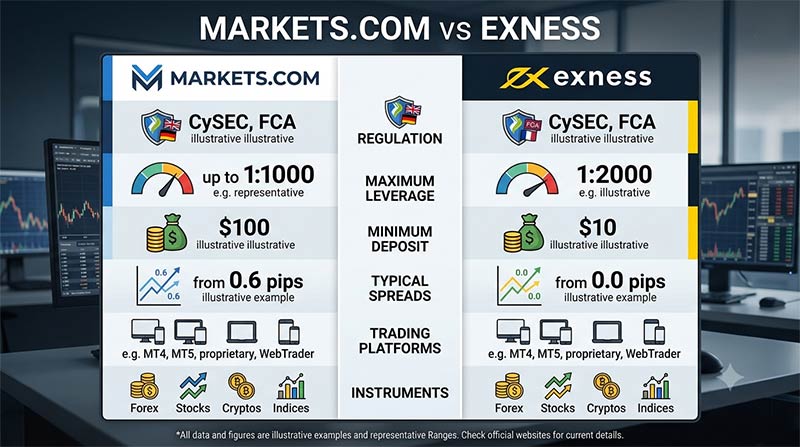
Company Background & Regulation
Both companies started in 2008, so they’ve survived the same crises. Markets.com is part of the Finalto group and holds licenses from CySEC (Safecap Investments Ltd), FCA, ASIC, and FSCA. That multi-jurisdiction setup gives it solid credibility, especially for traders who want the comfort of EU or UK-level oversight and compensation schemes (ICF up to €20,000 or FSCS up to £85,000 depending on the entity). Client funds are segregated, and negative balance protection is standard under the stricter regimes.
Exness also carries Tier-1 licenses — FCA and CySEC — alongside FSCA, FSA Seychelles, and several others. In practice, many retail clients outside the EU/UK end up under the offshore entities, which allow higher leverage but offer lighter compensation protection. What stood out to me during testing is that Exness is extremely transparent about which entity you’re under. They publish clear details and undergo regular audits (including by Deloitte). Both brokers segregate client funds. Neither has the kind of regulatory red flags that make me walk away.
Head to the official site
In my experience, Markets.com edges it slightly on pure regulatory comfort for EU/UK traders. Exness feels more flexible for international clients who value higher leverage and operational speed over the strictest possible compensation scheme. If fund protection is your absolute top priority and you qualify for the CySEC or FCA entity, Markets.com has a small advantage. For everyone else, the difference is smaller than the marketing suggests.
Trading Conditions – Spreads, Commissions, Leverage, Execution Quality
This is where the rubber meets the road. I spent weeks logging every major pair fill during both quiet and volatile sessions.
Spreads and commissions Markets.com runs a mostly spread-only model. EUR/USD typically floated around 0.6–1.2 pips on the standard account in my tests. Some regions offer a Raw-style account with tighter spreads plus commission, but the default experience is commission-free with the cost baked into the spread. It’s clean and simple.
Exness is more flexible. On the Standard account, spreads start from roughly 0.2–0.3 pips and average closer to 0.8–1.0 pips in normal conditions. The Raw Spread and Zero accounts deliver true 0.0 pips on majors most of the time, with commissions around $3.50 per side per lot on Raw or much lower on Zero. For a scalper or high-volume trader, the all-in cost on Exness Raw is usually lower. During high-volatility sessions — think NFP or FOMC — Exness spreads widened less aggressively than I expected, while Markets.com felt a bit stickier.
Leverage Markets.com caps retail clients under CySEC/FCA/ASIC at the usual 1:30. Professional or offshore clients can reach 1:300 or higher depending on the entity. Exness is famous for going further. Under the right conditions and entities, you can access 1:2000 or even unlimited leverage (subject to equity and volume requirements). That flexibility is powerful, but it is also dangerous. In my own trading I rarely push past 1:100 these days, yet knowing the option exists changes how you size positions.
Execution quality Both use market execution on most accounts. What really stood out during high-volatility sessions was Exness’s consistency. Slippage was minimal on my Raw account, and I rarely saw requotes. Markets.com was solid on the proprietary platform but felt a touch slower on MT4 during news spikes. Neither is perfect — no broker is — but Exness handled the chaos better in my live tests.
If cost and speed under pressure matter most to you, Exness currently wins the Exness vs Markets.com spreads comparison for active traders.
Platforms & Tools
Markets.com gives you three solid options: their own web and mobile platform, MT4, and MT5. The proprietary platform is clean, modern, and beginner-friendly, with decent charting and research tools built in. MT4 and MT5 work as expected for EAs and indicators.
Head to the official site
Exness goes further. You get full MT4 and MT5, plus the Exness Terminal (browser-based with TradingView charts) and the Exness Trade mobile app. The TradingView integration on the Terminal is genuinely useful — I found myself preferring it over pure MT5 for discretionary analysis. Copy trading and social features are also available. For pure platform flexibility, Exness has the edge. Markets.com’s proprietary platform feels more polished for multi-asset browsing, but Exness is stronger if you live inside MetaTrader or want modern charting without leaving the broker’s ecosystem.
Account Types, Deposits & Withdrawals
Markets.com typically requires a $100 minimum deposit. Account types are relatively straightforward (standard commission-free, some raw options, and micro in certain regions). Deposits are free and reasonably fast. Withdrawals are also free from the broker’s side, but processing usually takes 1–5 business days depending on the method. In my tests, card and e-wallet withdrawals were reliable but never “instant.”
Exness is in a different league here. Standard and Cent accounts can start from as little as $1–$10 (sometimes effectively zero depending on payment method). Pro, Raw, and Zero accounts usually need around $200. The real standout is withdrawal speed. Exness processes the vast majority of requests in seconds to under a minute — the famous “instant withdrawal.” I tested this repeatedly with different methods and the money hit my wallet almost every time within moments. That alone changed how I manage risk. Knowing I can pull capital out in seconds removes a layer of psychological friction.
For anyone who values capital mobility, Exness instant withdrawal is a genuine advantage that Markets.com simply does not match right now.
Detailed Pros & Cons
Markets.com Pros
- Strong multi-regulator coverage (CySEC, FCA, ASIC, FSCA)
- Excellent instrument range — thousands of stocks, ETFs, indices, and more
- Clean proprietary platform that feels modern
- Straightforward commission-free pricing for many traders
Markets.com Cons
- Higher average spreads for active forex traders
- Slower withdrawals compared with top competitors
- Leverage more restricted under major regulators
- Less competitive for pure scalpers
Head to the official site
Exness Pros
- Extremely tight spreads on Raw/Zero accounts
- Near-instant withdrawals that actually work
- Very low or zero minimum deposit
- High leverage options and flexible account types
- Strong MT4/MT5 + TradingView ecosystem
Exness Cons
- Offshore entities for many clients mean lighter compensation protection
- Instrument range is solid for forex/metals/crypto but thinner on individual stocks and ETFs compared with Markets.com
- The unlimited leverage feature can tempt people into dangerous position sizing
Head to the official site
Who Should Choose Markets.com? Who Should Choose Exness?
Choose Markets.com if:
- You want a broader multi-asset selection (especially stocks and ETFs)
- You value the stricter regulatory entities and compensation schemes
- You prefer a clean, modern proprietary platform and are not ultra-high volume
- You’re more of a swing or position trader who doesn’t live on spreads
Choose Exness if:
- You scalp, day trade, or trade high volume and care deeply about all-in costs
- Instant access to your money matters
- You want the lowest possible entry barrier and maximum leverage flexibility
- You live in MT4/MT5 or like TradingView charts inside the broker terminal
Head to the official site
Beginners who want simplicity and multi-asset choice may lean Markets.com. Scalpers, news traders, and high-volume forex traders will almost always be happier with Exness in my experience.
After months of real-money testing, if I had to choose one for my own trading today it would be Exness. The combination of tighter spreads on the professional accounts, genuinely instant withdrawals, and reliable execution during volatility outweighs the slightly stronger regulatory packaging of Markets.com for the way I trade.
That does not mean Markets.com is bad. It is a solid, well-regulated broker with a wider instrument list and a polished platform. For many swing traders or multi-asset investors it remains an excellent choice. But for pure forex and CFD trading efficiency, Exness currently delivers more of what active traders actually need day to day.
Head to the official site
Practical advice: open demo accounts with both. Fund small live accounts if you can. Test the exact pairs and times you trade. Spreads and execution are personal — what felt better for me may feel different for you. And always treat leverage with respect, no matter which broker you pick.
FAQ
1. Which is better overall — Markets.com or Exness? For most active forex traders, Exness currently offers better costs and withdrawal speed. Markets.com is stronger on regulation comfort and asset variety.
2. How do Exness vs Markets.com spreads compare? Exness Raw/Zero accounts deliver tighter all-in costs for high-volume traders. Markets.com standard spreads are competitive for occasional trading but usually wider for scalpers.
3. Is Markets.com or Exness better regulated? Both hold strong licenses. Markets.com’s CySEC/FCA/ASIC setup feels slightly more conservative for EU/UK clients. Exness also has FCA and CySEC but routes many clients through flexible offshore entities.
4. Does Exness really offer instant withdrawals? Yes. In my repeated tests, most requests were processed in seconds. Markets.com is reliable but slower (typically 1–5 days).
5. What is the minimum deposit for each? Markets.com is generally $100. Exness Standard accounts can start from $1–$10 depending on method and region.
6. Which broker is better for beginners? Markets.com’s proprietary platform and broader educational feel may be gentler. Exness is also beginner-friendly once you understand the account types, and the low deposit helps.
7. Can I use MT4 and MT5 on both? Yes. Both support full MT4 and MT5. Exness adds its own Terminal with TradingView charts.
8. Who wins for high leverage? Exness, by a clear margin, especially outside the strictest regulatory regimes.

•Most Trusted Broker — Asia 2026
•Broker of the Year — LATAM 2026
These awards confirm our commitment to building a rewarding trading environment and helping you uncover your potential. Thank you for choosing to trade with an award-winning broker!
Why choose MetaTrader 5 with Top Forex Brokers?
•Blazing-fast execution & enhanced stability
•38 built-in technical indicators & 21 timeframes for precision trading
•Optimized for all devices—desktop, mobile & web
•Trade a wide range of assets: Stocks, Commodities, Forex & more!
Disclaimer: Trading forex and CFDs carries a high level of risk and may not be suitable for all investors. Ensure you understand the risks involved and consider your financial situation before trading.