

After spending several months testing both platforms with real money across different market conditions, I still get asked the same question almost weekly: “Pepperstone vs Exness — which one should I actually use?”
It’s a fair dilemma. Both brokers have built solid reputations, attract serious volume, and appear in countless “best broker” lists. Yet once you dig past the marketing, the experience feels very different depending on how you trade.
I’ve run scalping sessions on both, held swing positions through news events, tested the Pepperstone Razor account against Exness raw-spread setups, and withdrawn real funds more times than I care to count. This Pepperstone vs Exness review is the unfiltered version of what I found.
Company Background & Regulation
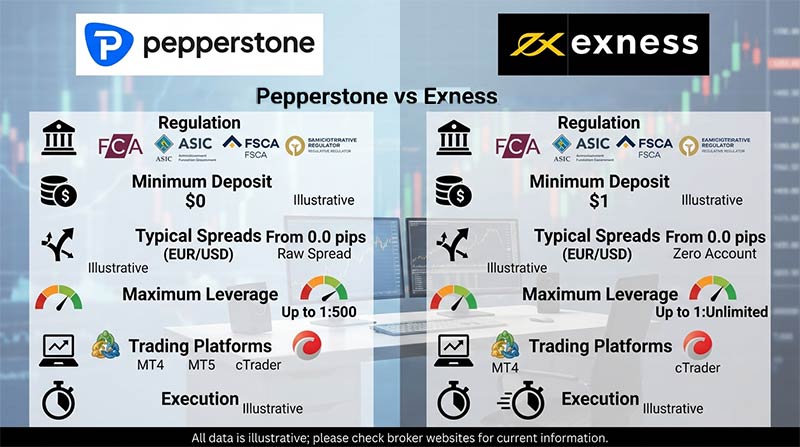
Pepperstone started in Melbourne in 2010. From the beginning it positioned itself as a no-nonsense ECN-style broker for active traders. The group now holds licences from ASIC (Australia), the FCA (UK), CySEC (Cyprus), BaFin (Germany), the DFSA (Dubai), the SCB (Bahamas), and the CMA (Kenya). Retail clients in many jurisdictions are onboarded under genuine Tier-1 entities, with segregated funds and, where applicable, compensation schemes such as the FSCS in the UK.
Head to the official site
Exness was founded in 2008 and is headquartered in Limassol, Cyprus. It has grown into one of the highest-volume retail forex brokers in the world. It also holds FCA and CySEC licences, plus FSCA (South Africa), FSA Seychelles, FSC Mauritius, FSC BVI and others. The important nuance is that the FCA and CySEC entities have largely been restricted to professional clients for years. Most retail traders outside a few jurisdictions end up with the offshore entities.
Head to the official site
In my experience, Pepperstone vs Exness regulation is one of the clearest differences. With Pepperstone I felt more comfortable knowing my account sat under ASIC or FCA-level oversight. With Exness the trading conditions are often more aggressive, but the regulatory safety net is thinner for the average retail account. Both segregate client funds, both offer negative balance protection in most cases, yet the depth of Tier-1 coverage leans toward Pepperstone.
Trading Conditions – Spreads, Commissions, Leverage, Execution Quality
This is where the rubber meets the road.
Pepperstone Razor account has been my go-to for high-volume work. Raw spreads on EUR/USD regularly sit between 0.0 and 0.1 pips during London and New York overlap, with a commission of roughly $7 round-turn per standard lot on MetaTrader. All-in costs typically land around 0.7–0.8 pips on majors when conditions are normal. Standard account spreads hover around 1.0–1.2 pips with no commission.
Exness is competitive here too. On its Raw Spread and Zero accounts you can see 0.0 pips, and the commission structure is similar or sometimes slightly lower depending on the pair and account. Standard and Pro accounts run commission-free with spreads that start from around 0.1–0.2 pips on majors in quieter periods. Exness vs Pepperstone spreads can look almost identical on a quiet Tuesday morning.
What really stood out during high-volatility sessions was the behaviour of the spreads and the fill quality. On NFP and major central-bank days I saw Pepperstone’s Razor account keep spreads more stable and fills cleaner. Exness was still fast, but I experienced more occasional widening and the occasional requote on certain pairs when the market was moving hard.
Leverage is another clear divider. Pepperstone offers up to 1:500 (or 1:200 on some entities) for eligible clients, dropping to the usual 1:30 for retail under stricter regulators. Exness is famous for “unlimited” leverage on smaller accounts that meet certain conditions, and 1:2000 is commonly available. If you like running larger position sizes relative to equity, Exness wins on pure leverage. I personally prefer the more controlled leverage environment at Pepperstone for risk management, but I understand why many traders in emerging markets gravitate toward Exness.
Execution quality on both is solid for retail. Pepperstone feels slightly more institutional in its ECN-style routing. Exness is extremely fast on its own infrastructure and handles huge volume without obvious issues.
Platforms & Tools
Pepperstone gives you MT4, MT5, cTrader and native TradingView integration. That combination is hard to beat if you like switching between charting styles or running advanced order types on cTrader. The TradingView connection is clean and works well with the Razor account.
Exness sticks mainly to MT4, MT5 and its own Exness Terminal plus mobile app. The proprietary terminal is smooth and modern, and many traders prefer it for its simplicity. You won’t get cTrader or the same depth of TradingView integration, though.
If your strategy lives inside TradingView or you rely on cTrader’s depth-of-market and advanced pending orders, Pepperstone is the clearer choice. If you just want fast MetaTrader and a clean proprietary interface, Exness is perfectly capable.
Account Types, Deposits & Withdrawals
Pepperstone keeps it simple: Standard and Razor. Minimum deposit is effectively $0, though most people fund with at least a couple of hundred dollars to make leverage practical.
Exness offers Standard, Standard Cent, Pro, Raw Spread and Zero. Minimum deposits start as low as $1–$10 on the basic accounts and rise to around $200 for the professional ones. The Cent account is useful for absolute beginners who want to trade tiny sizes.
Deposits are straightforward at both. The real difference shows up on withdrawals. Exness has built a reputation for near-instant processing on e-wallets and many local methods. I have requested withdrawals late at night and seen the funds arrive in under ten minutes more than once. Pepperstone is reliable and usually processes within the same day or next business day, but it does not match the speed of Exness instant withdrawal on most payment rails.
For traders who move money in and out frequently, that speed advantage at Exness is meaningful.
Detailed Pros & Cons
Pepperstone Pros
- Strong multi-jurisdiction Tier-1 regulation for retail clients
- Excellent Razor account pricing and consistent execution
- Full suite of platforms including cTrader and TradingView
- Transparent commission structure
- Solid customer support in my experience
Pepperstone Cons
- Leverage is more conservative than Exness
- Withdrawals are fast but not usually “instant”
- Fewer account types and no true cent account
Head to the official site
Exness Pros
- Extremely competitive spreads and low entry barriers
- Instant or near-instant withdrawals on many methods
- High and even unlimited leverage options
- High trading volume and liquidity
- Wide range of account types including Cent
Exness Cons
- Most retail accounts sit under offshore regulation
- Platform choice is more limited
- Spreads can widen more noticeably in extreme volatility
- Customer support quality has been more variable in my testing
Head to the official site
Who Should Choose Pepperstone? Who Should Choose Exness?
Choose Pepperstone if you are:
- A scalper or high-frequency trader who lives on the Razor account
- Someone who values Tier-1 regulation and fund protection
- A trader who wants cTrader or seamless TradingView
- Running larger size or algorithmic strategies that need consistent fills
Head to the official site
Choose Exness if you are:
- Starting with a small account and want low minimum deposits
- Trading from a region where local payment methods and instant withdrawals matter
- Comfortable with higher leverage and offshore regulation
- Looking for the absolute lowest all-in costs on certain account types
Head to the official site
Beginners often find Exness more approachable because of the Cent account and low deposit. Experienced ECN-style traders and those who prioritise regulatory strength usually lean toward Pepperstone.
After months of real-money testing, if I had to choose one for my own trading today it would be Pepperstone. The combination of genuine Tier-1 regulation, the quality of the Razor account, and the platform flexibility edges it ahead for the way I trade.
That does not mean Exness is a bad broker. Far from it. For many traders — especially those prioritising withdrawal speed, high leverage, or starting with limited capital — Exness remains an excellent choice. The best broker Pepperstone or Exness decision ultimately depends on your location, account size, strategy and risk tolerance.
Head to the official site
Practical advice: open demo accounts on both, then fund small live accounts and test the exact pairs and times you actually trade. Spreads and execution can look different on a quiet demo than they do during a real London open or a major data release. Check which legal entity you will be onboarded under, and confirm the payment methods available in your country.
Both brokers are legitimate operators in 2026. The difference is in the details that matter to your specific style.
For deeper individual reviews, see our full Pepperstone review on brokersss.com and Exness review on brokersss.com. You may also find our comparisons of Pepperstone vs IC Markets and Exness vs XM useful.
FAQ
1. Which is better overall in the Pepperstone vs Exness comparison? Pepperstone edges ahead for most active traders who value regulation and platform choice. Exness wins on withdrawal speed and leverage flexibility.
2. How do Exness vs Pepperstone spreads compare on the best accounts? Both can deliver near-zero raw spreads. Pepperstone Razor plus commission and Exness Raw/Zero accounts are usually very close on majors in normal conditions.
3. Is Pepperstone safer than Exness from a regulation standpoint? Pepperstone offers broader Tier-1 coverage for retail clients. Exness has strong licences but routes most retail flow through offshore entities.
4. What is the maximum leverage at each broker? Pepperstone typically up to 1:500 (lower under strict regulators). Exness offers up to 1:2000 or unlimited under specific conditions on eligible accounts.
5. Does Exness really offer instant withdrawal? Yes, on many e-wallet and local methods the processing on Exness’s side is often under a minute. Final arrival time still depends on the payment provider.
6. Can I use TradingView with both brokers? Pepperstone has strong native TradingView integration, especially with the Razor account. Exness support is more limited.
7. Which broker is better for scalping? Pepperstone Razor account generally provides more consistent fills and tighter effective costs during high-frequency sessions in my testing.
8. Are both brokers suitable for beginners? Exness is often more beginner-friendly thanks to low deposits and Cent accounts. Pepperstone is straightforward once you understand the Standard vs Razor difference.

•Most Trusted Broker — Asia 2026
•Broker of the Year — LATAM 2026
These awards confirm our commitment to building a rewarding trading environment and helping you uncover your potential. Thank you for choosing to trade with an award-winning broker!
Why choose MetaTrader 5 with Top Forex Brokers?
•Blazing-fast execution & enhanced stability
•38 built-in technical indicators & 21 timeframes for precision trading
•Optimized for all devices—desktop, mobile & web
•Trade a wide range of assets: Stocks, Commodities, Forex & more!
Disclaimer: Trading forex and CFDs carries a high level of risk and may not be suitable for all investors. Ensure you understand the risks involved and consider your financial situation before trading.