

After spending several months testing both platforms with real money, I’ve seen the same dilemma play out dozens of times in trading communities. You’re ready to commit capital, you’ve narrowed it down to two long-standing names, and now you’re stuck. One promises institutional-grade raw spreads and rock-solid regulation. The other waves a $1 minimum deposit, high leverage, and a pile of bonuses. Which one actually holds up when the market starts moving?
I traded both side by side through quiet Asian sessions, London open chaos, and a couple of high-impact news events. What follows is not a polished brochure. It’s what I actually experienced as a working trader who cares about execution quality, fund safety, and how much of my edge survives the broker’s cut.
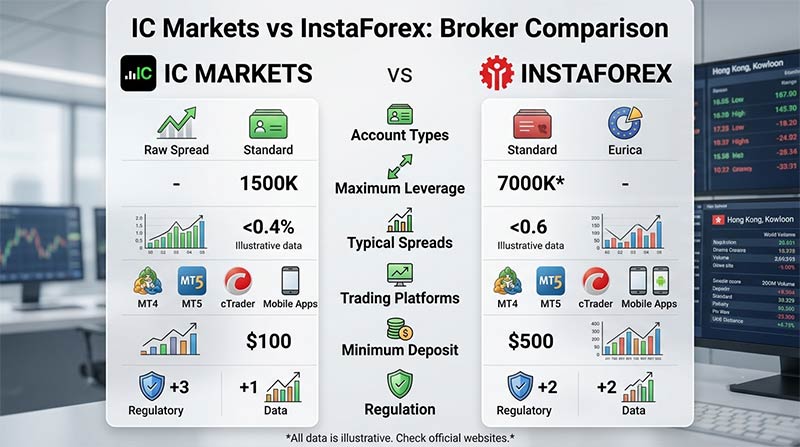
Company Background & Regulation
Both brokers launched in 2007, so neither is a new kid on the block. That is where the similarities largely end.
IC Markets started in Sydney and still carries its Australian roots proudly. It operates under ASIC (AFSL 335692), CySEC in the EU, and an FSA Seychelles entity for international clients. The ASIC and CySEC licences are the ones that matter most. Client funds are segregated, negative balance protection applies in the regulated entities, and the Australian dispute resolution system is available to eligible clients. In my experience, that regulatory stack simply feels safer when you’re holding larger positions overnight.
Head to the official site
InstaForex runs a more fragmented structure. There is a CySEC-regulated EU entity that offers proper MiFID protections and Investor Compensation Fund coverage up to €20,000. Outside Europe, many clients are onboarded through British Virgin Islands or Saint Vincent entities. Those offshore licences provide basic legal existence but little in the way of meaningful investor protection or compensation schemes. I have no horror stories from my own InstaForex account, but I never felt as comfortable leaving serious size there as I did with IC Markets.
If safety of funds is near the top of your list — and it should be — IC Markets holds a clear edge on the IC Markets vs InstaForex regulation comparison.
Trading Conditions – Spreads, Commissions, Leverage & Execution
This is where the gap becomes obvious for anyone who actually trades size or frequency.
IC Markets’ Raw Spread account is the reason so many scalpers and EA users stick with them. During my testing, EUR/USD hovered around 0.0–0.1 pips for long stretches of the London session. You pay a transparent commission of $3.50 per side on MT4/MT5 ($7 round turn) or $3.00 per side on cTrader. The all-in cost stays competitive even when you factor in the commission. Standard accounts run roughly 0.6–1.0 pips with no commission for those who prefer simplicity.
InstaForex spreads are a different animal. On the popular Standard accounts you will commonly see fixed spreads around 3 pips on majors. There are zero-spread and ECN-style options, but they come with higher minimum deposits or percentage-based commissions that can add up quickly. During quiet periods the difference is annoying. During high-volatility sessions the difference becomes expensive.
What really stood out during high-volatility sessions was IC Markets’ execution. Slippage was minimal and mostly positive or neutral on market orders. InstaForex showed more requotes and occasional wider fills, especially around news. For pure ECN-style trading, IC Markets raw spread accounts feel closer to what institutional desks actually use.
Leverage is where InstaForex looks more aggressive on paper. Both brokers can offer up to 1:1000 through their offshore entities. Retail clients under ASIC or CySEC are capped at 1:30 on majors, as expected. In practice I rarely push past 1:50–1:100 anyway; the extra leverage on InstaForex feels more like a marketing number than a practical advantage for most serious strategies.
Minimum deposit also tells a story. IC Markets asks for $200. InstaForex lets you start with $1. That low barrier is genuinely useful for pure beginners who want to feel the market with almost no capital. Once you move beyond micro-lots, the $200 threshold at IC Markets stops mattering.
Platforms & Tools
Both brokers give you MetaTrader 4 and MetaTrader 5. That covers the vast majority of retail needs, including Expert Advisors and custom indicators.
IC Markets adds cTrader and TradingView integration. The cTrader version of their Raw Spread account carries the slightly lower commission and a cleaner interface that many professional scalpers prefer. Depth of market, one-click trading, and advanced order types are excellent. I found myself using cTrader more than I expected once I got comfortable with it.
InstaForex offers its own web trader and mobile apps alongside MT4/MT5. The proprietary tools are functional but not particularly innovative. They do push copy trading, PAMM accounts, and frequent trading contests harder than IC Markets. If social trading or bonus-driven contests appeal to you, InstaForex is more active in that space.
For pure execution quality and professional tools, I preferred the IC Markets environment.
Account Types, Deposits & Withdrawals
IC Markets keeps things relatively clean: Standard (spread-only), Raw Spread on MT4/MT5, and Raw Spread on cTrader. Islamic accounts are available. The $200 minimum applies across the board.
InstaForex has a wider menu — Standard, Eurica (zero-spread with commission), Cent accounts, ECN, and various VIP tiers. The $1 entry point and cent accounts make it easy for absolute beginners or traders who want to test strategies with tiny risk.
Deposits are straightforward at both. Cards, bank wires, and popular e-wallets work. Crypto is available at both in many regions.
Withdrawals are where personal experience diverged. My IC Markets withdrawals (e-wallets and cards) were processed inside 24 hours on the broker side and arrived quickly. Bank wires took the usual few business days. InstaForex withdrawals worked, but I noticed more fees depending on the method and slightly longer internal processing on a couple of occasions. Some traders report friction if they try to withdraw large amounts or switch methods. InstaForex withdrawal speed is acceptable for most people, yet it never felt as frictionless as IC Markets.
Detailed Pros & Cons
IC Markets Pros (from my testing)
- Genuine raw spreads that stay tight even when the market is moving
- True ECN execution with low latency
- Strong tier-1 regulation (ASIC + CySEC)
- Excellent platform choice including cTrader
- Fast, reliable withdrawals in my experience
- No nonsense approach to trading conditions
IC Markets Cons
- $200 minimum is higher than some competitors
- Fewer flashy bonuses and contests
- Customer support is professional but not the most chatty
Head to the official site
InstaForex Pros
- Extremely low $1 minimum deposit and cent accounts
- High leverage available
- Broad instrument list and active promotions
- Copy trading and PAMM options
- Multiple account types for different styles
InstaForex Cons
- Wider spreads on the accounts most beginners use
- Weaker overall regulatory protection for non-EU clients
- Execution quality and slippage less consistent in my tests
- Withdrawal fees and processing can feel less seamless
Who Should Choose IC Markets? Who Should Choose InstaForex?
Choose IC Markets if you are:
- A scalper or high-frequency trader who lives and dies by tight spreads and clean execution
- An EA or algorithmic trader who needs reliable low-latency fills
- A swing or position trader who values strong regulation and fund safety
- Anyone running serious size and wants the lowest all-in trading costs
- Looking for the best broker between IC Markets or InstaForex for professional-grade conditions
Head to the official site
Choose InstaForex if you are:
- A complete beginner who wants to start with $50 or less
- Interested in copy trading, PAMM, or frequent contests and bonuses
- Trading very small size where the $1 minimum and cent accounts matter
- Comfortable with higher spreads in exchange for lower entry barriers and higher advertised leverage
For pure ECN trading and long-term cost efficiency, IC Markets wins for me. For absolute accessibility and social/promotional features, InstaForex still has a place.
If I had to choose one for my own trading today, it would be IC Markets without hesitation. The combination of raw spreads, reliable execution, and stronger regulatory oversight simply compounds better over hundreds of trades. The cost difference on a scalping or news-trading strategy is real money. The peace of mind from ASIC/CySEC oversight is also real.
That said, InstaForex is not a scam or a pure marketing shell. It works for many traders, especially those just starting out or who prioritise low barriers and promotional extras. Just go in with eyes open about the spread costs and the regulatory differences.
Practical advice: open demo accounts on both, test the same strategy for a couple of weeks, then fund a small live account on the one that actually feels better under your fingers. Do not let marketing copy or a $1 minimum override the data from your own trading journal.
For more detailed single-broker deep dives, check the IC Markets review and InstaForex review pages on brokersss.com, along with comparisons against other low-spread brokers such as Pepperstone or FP Markets.
FAQ
Which is better overall — IC Markets or InstaForex? For most active traders focused on costs and safety, IC Markets is the stronger choice based on regulation, spreads, and execution quality.
How do IC Markets vs InstaForex spreads compare? IC Markets Raw accounts routinely show near-zero spreads plus a fixed commission. InstaForex Standard accounts are typically wider (around 3 pips fixed on many majors).
Is IC Markets safer than InstaForex? Yes in most cases. ASIC and CySEC regulation provide stronger client protections than the offshore entities commonly used by InstaForex outside the EU.
What leverage can I get on each? Both offer up to 1:1000 on certain entities. Retail clients under major regulators are limited to 1:30 on major forex pairs.
How fast are InstaForex withdrawals? Usually 1–3 business days depending on method. Some e-wallets and crypto can be faster, but fees often apply.
Does IC Markets have a true raw spread account? Yes. The Raw Spread accounts on MT4, MT5 and cTrader start from 0.0 pips with transparent commissions.
Can beginners start with either broker? InstaForex is easier for absolute beginners because of the $1 minimum and cent accounts. IC Markets is still accessible once you can deposit $200.
Which is better for scalping? IC Markets. The combination of tight raw spreads and consistent execution makes a measurable difference.

•Most Trusted Broker — Asia 2026
•Broker of the Year — LATAM 2026
These awards confirm our commitment to building a rewarding trading environment and helping you uncover your potential. Thank you for choosing to trade with an award-winning broker!
Why choose MetaTrader 5 with Top Forex Brokers?
•Blazing-fast execution & enhanced stability
•38 built-in technical indicators & 21 timeframes for precision trading
•Optimized for all devices—desktop, mobile & web
•Trade a wide range of assets: Stocks, Commodities, Forex & more!
Disclaimer: Trading forex and CFDs carries a high level of risk and may not be suitable for all investors. Ensure you understand the risks involved and consider your financial situation before trading.