

After spending several months testing both platforms with real money, I kept running into the same question from fellow traders: “Should I stick with Exness or give FXPrimus a proper shot?” It’s a common dilemma. Both brokers have been around for over 15 years, both offer high leverage and MetaTrader platforms, and both market themselves as trader-friendly. Yet the day-to-day experience can feel quite different once you’re actually placing trades, managing risk, and trying to pull profits out.
I’m not here to push one brand. I’ve scalped London opens on both, sat through NFP releases on both, and swung positions for days on both. What follows is my honest, hard-earned take on the Exness vs FXPrimus matchup — regulation, real spreads, execution under pressure, withdrawal speed, and which type of trader each broker actually suits.
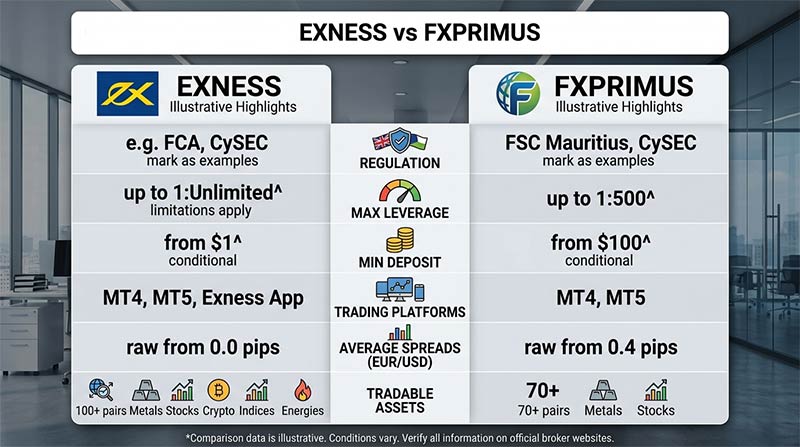
Company Background & Regulation
Exness launched in 2008 and has grown into one of the higher-volume retail brokers out there. FXPrimus followed a year later in 2009. Both have survived multiple market cycles, which already puts them ahead of the here-today-gone-tomorrow shops.
On regulation, Exness carries more licenses across different jurisdictions. The group includes entities regulated by the Seychelles FSA (the one most international retail clients land under), CySEC in Cyprus, the UK FCA (mainly institutional these days), South Africa’s FSCA, plus a few others such as Mauritius FSC and Kenya’s CMA. Client funds are segregated, and negative balance protection is standard.
Head to the official site
FXPrimus operates primarily under Primus Markets INTL Ltd (VFSC Vanuatu license 14595) for the high-leverage international offering, and Primus Global Ltd under CySEC (license 261/14) for European clients. They also talk about segregated accounts and negative balance protection. The CySEC entity is solid, but the bulk of the high-leverage marketing points to the Vanuatu side.
In my experience, both keep client money separate from company funds. Neither has had major public fund-protection scandals during the time I’ve used them. That said, Exness’s broader regulatory footprint and public financial reporting give me a slightly higher comfort level when I’m parking larger balances. If regulation is your absolute top priority and you can accept lower leverage, the CySEC route at either broker is preferable. For pure offshore high-leverage trading, both are in the same ballpark — just know what entity you’re actually registered under.
(For more on how different regulators stack up, check our broader regulation guides on brokersss.com.)
Trading Conditions – Spreads, Commissions, Leverage, Execution Quality
This is where the rubber meets the road.
Spreads and commissions On Exness Standard accounts I typically saw EUR/USD floating around 0.6–1.2 pips during liquid hours, with no commission. Raw Spread and Zero accounts start from 0.0 and add a commission (roughly $3.50 per side on Raw in my testing, sometimes lower on Zero depending on volume).
FXPrimus Classic sits wider — usually 1.4–1.8 pips on EUR/USD with zero commission. Their Pro account tightens that to around 0.3 pips plus commission ($8–10 round turn depending on platform), and the Zero account aims for 0.0 plus a higher commission.
For a pure scalper or high-volume day trader, the FXPrimus vs Exness spreads comparison usually favors Exness once you factor in total cost per lot. On quieter Asian sessions the gap narrows, but during London–New York overlap Exness consistently felt cheaper for me.
Leverage Both advertise up to 1:2000. Exness can go effectively unlimited on smaller equity Standard accounts under certain conditions (equity under roughly $1,000 and trading volume requirements met). FXPrimus Classic starts at 1:2000 but automatically scales leverage down as equity grows — 1:1000 above $2,500, 1:500 above $5,000, and so on. Pro accounts top out lower (around 1:500).
If you like to run high leverage on a modest account, both deliver. Just remember higher leverage cuts both ways; I’ve seen accounts vaporize in minutes on both platforms during flash moves.
Execution quality What really stood out during high-volatility sessions was Exness’s consistency. During the March 2026 non-farm payroll release I was running the same strategy on both. Exness filled my market orders with minimal slippage most of the time. FXPrimus was acceptable on the majors but showed more occasional widening and a couple of delayed fills when liquidity thinned. Neither is perfect — no retail broker is during genuine chaos — but Exness felt a notch cleaner for news trading and aggressive scalping.
Both allow hedging and scalping with no obvious restrictions in my testing.
Head to the official site
Platforms & Tools
Both give you MetaTrader 4 and MetaTrader 5. That covers 90 % of what most retail traders need — Expert Advisors, custom indicators, one-click trading, the works.
Exness also offers its own Exness Terminal (web-based) and a clean mobile app. The Terminal is surprisingly usable for quick analysis and order management when I don’t want to fire up full MT5. FXPrimus sticks mainly to MT4/MT5 plus a WebTrader. No proprietary platform that stood out to me.
Copy trading and social features exist on both, though Exness’s implementation felt more polished in daily use. If you’re deep into automated strategies, both support EAs without drama. For pure charting power, MT5 on either is fine; the edge goes to whoever’s server is geographically closer to you.
Account Types, Deposits & Withdrawals
Account types Exness: Standard, Standard Cent, Pro, Raw Spread, Zero. Cent accounts are handy for testing new systems with tiny risk. FXPrimus: Classic (entry-level), Pro, Zero. Straightforward tiering.
Minimum deposit Exness is more flexible — you can often start with the equivalent of $10 or even less depending on payment method and region. FXPrimus Classic sits around $15. Not a huge difference for most, but every dollar counts when you’re starting out.
Deposits Both accept cards, bank wires, e-wallets, and crypto in many regions. Exness feels slightly faster on local payment methods in Asia and Africa from what I’ve seen.
Withdrawals — the real differentiator This is where Exness earns its reputation. Exness instant withdrawal is not marketing fluff in my experience. E-wallet and many local methods often hit my account in under a minute, 24/7. Even on weekends I’ve pulled profits without waiting for Monday. Bank wires take longer, of course, but the broker side is usually processed almost immediately.
FXPrimus withdrawals are reliable but not instant in the same way. Most of my requests cleared within a few hours to one business day. That’s still better than many brokers, yet once you’ve tasted true instant processing it’s hard to go back. If cash-flow speed matters — and for active traders it often does — Exness wins this category cleanly.
(For deeper dives into payment methods and regional differences, see our individual broker funding guides on brokersss.com.)
Detailed Side-by-Side Comparison Table
| Feature | Exness | FXPrimus |
|---|---|---|
| Founded | 2008 | 2009 |
| Main Regulation | FSA Seychelles, CySEC, FSCA, others | VFSC Vanuatu, CySEC |
| Min Deposit | From ~$10 (varies) | From $15 (Classic) |
| Max Leverage | Up to 1:2000 / Unlimited (conditions) | Up to 1:2000 (scales with equity) |
| EUR/USD Spreads (typical) | Standard ~0.6–1.2; Raw from 0.0 | Classic ~1.5; Pro ~0.3; Zero from 0.0 |
| Commission (Raw/Zero) | ~$3.50/side (Raw) | Higher on Zero/Pro |
| Platforms | MT4, MT5, Exness Terminal, App | MT4, MT5, WebTrader |
| Account Types | Standard, Cent, Pro, Raw, Zero | Classic, Pro, Zero |
| Withdrawal Speed | Often instant (e-wallets/local) | Hours to 1 business day |
| Execution Quality | Strong under volatility | Good, occasional wider spreads |
| Negative Balance Protection | Yes | Yes |
Pros & Cons – Personal Perspective
Exness Pros
- Genuine instant withdrawals on many methods
- Tighter overall trading costs for active styles
- Flexible low starting deposits and cent accounts
- Multiple platforms including a usable proprietary terminal
- Broader regulatory coverage
Exness Cons
- Retail clients usually under offshore entities rather than FCA/CySEC
- Customer support can feel stretched during peak hours
- Unlimited leverage requires meeting conditions
Head to the official site
FXPrimus Pros
- Solid CySEC option for those who want it
- Clean Classic account for simpler commission-free trading
- Reliable MT4/MT5 offering
- Competitive high leverage on smaller accounts
FXPrimus Cons
- Wider spreads on the entry-level account
- Withdrawals are fast but not truly instant
- Fewer platform options beyond MetaTrader
- Leverage drops as equity grows
Who Should Choose Exness? Who Should Choose FXPrimus?
Choose Exness if you are:
- A scalper or high-frequency day trader who watches every pip of cost
- Someone who values Exness instant withdrawal for quick profit-taking or risk management
- A beginner who wants to start small with cent accounts and low deposits
- A news trader who needs reliable fills when volatility spikes
- An active trader running higher volume where commission + tight spreads beats wider pure spreads
Head to the official site
Choose FXPrimus if you are:
- A swing trader or lower-frequency trader who prefers the simplicity of a Classic account
- Someone who specifically wants the CySEC entity and is fine with lower leverage
- A trader who likes a straightforward tiered structure without too many account choices
- Comfortable with slightly slower (but still reasonable) withdrawals
High-volume professional traders will usually lean Exness for the cost edge. Pure beginners who just want a simple commission-free experience might feel more comfortable starting on FXPrimus Classic before graduating.
If I had to choose one for my own trading today, it would be Exness. The combination of tighter effective spreads on the accounts I actually use, consistently strong execution during news, and those near-instant withdrawals tips the scale. After months of real-money testing, the operational smoothness simply feels higher.
That does not make FXPrimus a bad broker. It remains a legitimate, long-standing option with decent conditions, especially if you prefer their Classic setup or specifically need the CySEC route. For many casual or swing traders the differences may not matter much day to day.
Practical advice: open demo accounts on both, test the same strategy for two weeks, then fund a small live account on each and try a real withdrawal. Numbers on a comparison page never fully capture how a broker feels when your money is on the line. Also verify exactly which legal entity your account falls under — that determines your actual protections and leverage limits.
Whatever you pick, size positions so a single bad day doesn’t end your career. The broker is only the vehicle; risk management is still the driver.
For more detailed individual reviews, payment method breakdowns, and other broker comparisons, explore the full library on brokersss.com.
Head to the official site
FAQ
1. Which is better overall in the Exness vs FXPrimus review? For most active traders I’ve spoken with and from my own testing, Exness edges ahead on costs, execution consistency, and withdrawal speed. FXPrimus remains a solid alternative depending on your style and preferred regulation.
2. How do FXPrimus vs Exness spreads compare in real trading? Exness Raw/Zero accounts generally deliver lower total cost per lot for frequent traders. FXPrimus Classic is wider but commission-free; their Pro and Zero narrow the gap.
3. Is Exness or FXPrimus better regulated? Exness holds more licenses across more jurisdictions. Both offer CySEC options. Always check which entity your specific account sits under.
4. What about Exness vs FXPrimus leverage? Both reach 1:2000 on smaller accounts. Exness can go unlimited under conditions; FXPrimus scales leverage down as equity rises.
5. How fast is FXPrimus withdrawal compared with Exness? Exness processes many withdrawals in seconds to under a minute. FXPrimus is typically hours to one business day — still respectable, just not instant.
6. Can beginners start with either broker? Yes. Both have low minimum deposits. Exness cent accounts make risk control especially easy for absolute beginners.
7. Do both support MT4 and MT5? Yes. Exness also offers its own Terminal and mobile app as extras.
8. Which is the best broker — Exness or FXPrimus — for scalping? Exness, primarily due to tighter spreads on professional accounts and more consistent fills during fast markets.

•Most Trusted Broker — Asia 2026
•Broker of the Year — LATAM 2026
These awards confirm our commitment to building a rewarding trading environment and helping you uncover your potential. Thank you for choosing to trade with an award-winning broker!
Why choose MetaTrader 5 with Top Forex Brokers?
•Blazing-fast execution & enhanced stability
•38 built-in technical indicators & 21 timeframes for precision trading
•Optimized for all devices—desktop, mobile & web
•Trade a wide range of assets: Stocks, Commodities, Forex & more!
Disclaimer: Trading forex and CFDs carries a high level of risk and may not be suitable for all investors. Ensure you understand the risks involved and consider your financial situation before trading.