

After spending several months testing both platforms with real money across different market conditions, I kept coming back to the same question a lot of traders face: should I stick with the more established, multi-regulated option or go for the higher-leverage, feature-heavy alternative? XM and RoboForex both launched in 2009, both serve a global client base, and both offer MT4/MT5. Yet the differences in how they handle regulation, costs, execution, and extras are large enough that the “right” choice depends heavily on your style, risk tolerance, and location.
I deposited real funds into both, ran scalping sessions during London open, held swing positions through news events, tested copy trading where available, and processed multiple withdrawals. What follows is my unfiltered take after that hands-on work.
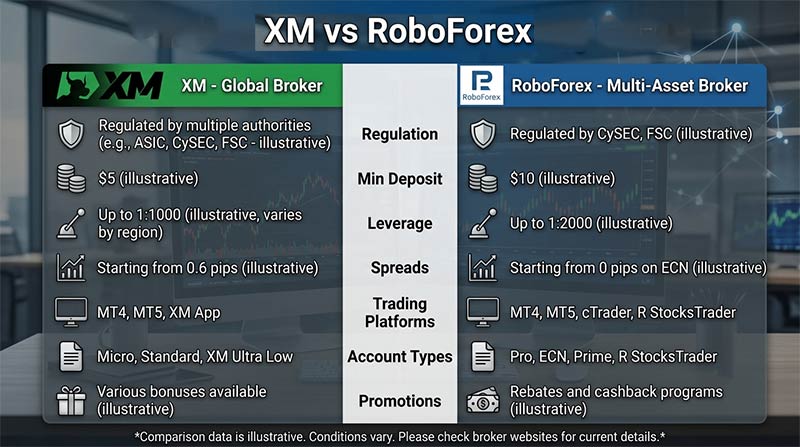
Company Background & Regulation
Safety is non-negotiable for me. I will not keep serious size with a broker whose regulatory setup feels thin.
XM operates under several entities. The strongest are CySEC (Cyprus, Licence 120/10) and ASIC (Australia). EU retail clients get Investor Compensation Fund protection up to €20,000, mandatory negative balance protection, and segregated client funds at tier-1 banks. Many international clients (Asia, Latin America, much of Africa) end up under the FSC Belize entity, which offers higher leverage and bonuses but weaker formal compensation. Even there, XM maintains segregated accounts and applies negative balance protection as policy. The multi-licence structure and longer track record with larger regulators give me more comfort when markets get chaotic.
Head to the official site
RoboForex is primarily regulated by the FSC of Belize. It is also a Category A member of the Financial Commission, which provides an external dispute-resolution mechanism and compensation of up to €20,000 per case. Some sources mention a Mauritius licence as well. Client funds are segregated and negative balance protection is offered, but the overall regulatory framework sits at a lower tier than XM’s CySEC/ASIC coverage. In my experience the broker has been reliable on payouts, yet I size positions more conservatively here because the safety net is thinner.
Bottom line on safety: XM edges ahead for most traders who prioritise regulatory depth. RoboForex is acceptable for experienced traders who understand the trade-off and keep risk tight.
Trading Conditions – Spreads, Commissions, Leverage, Execution Quality
This is where the real differences show up in daily P&L.
Spreads and commissions On XM’s Ultra Low account I consistently saw EUR/USD around 0.6–0.9 pips during normal liquidity, with no commission. The Zero account (mainly for certain regions) can print from 0.0 with roughly $3.50 per side commission. Standard/Micro sits wider, around 1.6 pips.
RoboForex Pro account starts around 1.3 pips with no commission. The ECN and Prime accounts deliver raw spreads from 0.0–0.2 pips on majors plus commission (roughly $2–4 round-turn depending on the exact account). For pure scalping volume, RoboForex’s raw accounts often worked out cheaper once I calculated total cost per lot. What really stood out during high-volatility sessions was that RoboForex’s ECN feed held tighter for longer when news hit, while XM’s Ultra Low still widened but remained usable.
Leverage XM offers up to 1:1000 on its offshore entity (1:30 for EU/Australian retail). RoboForex goes to 1:2000 on Pro accounts. Higher leverage is a double-edged sword. I used the extra gear on RoboForex for small-account news trades, but I also watched margin calls arrive faster when I got the direction wrong. Most of my swing trading stayed at more moderate levels on both platforms.
Execution Both brokers handled market and limit orders cleanly in normal conditions. During NFP and CPI releases I experienced occasional slippage on both, though RoboForex’s ECN account felt a fraction more consistent on the fills I tracked. Neither broker banned scalping or hedging in my testing.
Platforms & Tools
XM keeps it simple and reliable: MetaTrader 4, MetaTrader 5, and their own mobile app. Everything loads fast, EAs work without drama, and the mobile experience is clean. They also integrate Trading Central analysis tools.
RoboForex gives you more choice: MT4, MT5, cTrader, and their proprietary R StocksTrader platform. The extra platforms matter if you trade a lot of stocks or ETFs or prefer cTrader’s depth-of-market view and charting. R StocksTrader opens access to thousands of shares and ETFs that XM simply does not offer in the same depth. For pure forex and index work I was happy on either; for multi-asset trading RoboForex pulled ahead.
Account Types, Deposits & Withdrawals
Minimum deposits XM: $5. RoboForex: $10. Both are beginner-friendly.
Account range XM: Micro, Standard, Ultra Low, Zero, Shares, and Islamic variants. RoboForex: Pro, ProCent (excellent for testing strategies with tiny size), ECN, Prime, R StocksTrader, and Islamic options.
Deposits and withdrawals Both support cards, e-wallets (Skrill, Neteller, etc.), bank wires, and various local methods. Deposits were instant or near-instant on both.
Withdrawals were the area I watched closely. XM typically processed within 24 hours for e-wallets and cards in my experience; bank wires took longer. RoboForex was competitive and often reimbursed fees on a limited number of withdrawals per month. I never had a rejected or significantly delayed withdrawal on either platform, which is more than I can say for some other brokers I’ve tested. RoboForex withdrawal speed was reliable enough that I stopped worrying about it after the first few cycles.
Bonuses, Promotions & Copy Trading Features
XM is more aggressive with deposit bonuses and its loyalty points programme (XMP). In regions where bonuses are allowed you can get meaningful credit that helps cushion early losses, though the turnover requirements must be met before you can withdraw profits generated from the bonus. Their no-deposit offers appear periodically for new clients in certain jurisdictions.
Key Current Bonuses
1. Account Opening / Welcome Bonus
- In many markets (especially popular among Japanese and some Asian clients), new clients can claim a 13,000 JPY account-opening bonus after registration and verification (promoted with deadlines around end in some campaigns).
- Some regions still show a smaller $30 no-deposit or similar welcome credit.
- These are trading credits only — not cash that can be withdrawn. Profits generated may be withdrawable after meeting volume and other conditions.
2. Deposit Bonus (most common ongoing offer) Typical structure seen across eligible regions:
- 100% match on deposits up to around $500
- Then 20% on further deposits (overall maximum often cited around $10,500 in total bonus credit)
Eligible mainly on Standard and Micro accounts. Ultra Low and Zero accounts usually do not qualify for the deposit bonus. The bonus is added as credit (increases free margin / acts as a cushion) and cannot itself be withdrawn. Withdrawing your own funds can reduce or cancel the remaining bonus.
3. XM Loyalty / Traders Club (XM Points / XMP)
- Earn points automatically by trading.
- Points can be exchanged for extra bonus credit or cash.
- Higher status levels (Bronze → Elite) give better point multipliers. Some partner links start you at a higher rank.
Head to the official site
RoboForex also runs promotions and a loyalty scheme, but the standout feature is CopyFX. This is a proper social/copy-trading marketplace where you can follow or become a signal provider. I allocated a small live allocation to a couple of strategies on CopyFX and monitored the results for several weeks. Performance varied (as it always does), but the platform itself was transparent on equity curves, drawdowns, and fees. XM does not match this depth of copy-trading infrastructure. If social trading or passive income from following others is part of your plan, RoboForex is clearly stronger.
Detailed Pros & Cons
XM Pros (from my experience)
- Stronger multi-jurisdiction regulation and clearer compensation pathways in key markets
- Very low entry barrier ($5)
- Competitive non-commission Ultra Low spreads
- Excellent educational resources and customer support responsiveness
- Reliable withdrawals and clean MT4/MT5 experience
XM Cons
- Fewer instruments overall, especially stocks and ETFs
- No dedicated copy-trading marketplace on the level of CopyFX
- Bonuses come with standard trading requirements that can feel restrictive
Head to the official site
RoboForex Pros
- Higher maximum leverage
- Raw-spread accounts that can be cheaper for high-volume scalpers
- Broad platform choice including cTrader and R StocksTrader
- Excellent CopyFX social trading
- Wider instrument range (especially equities and ETFs)
RoboForex Cons
- Regulation sits at a lower tier; I personally keep position sizes smaller
- Spreads on the standard Pro account are not the tightest in the industry
- Some regions face access restrictions
Who Should Choose XM? Who Should Choose RoboForex?
Choose XM if you are:
- A beginner or intermediate trader who values regulatory comfort and education
- Trading mainly forex, indices, and metals with moderate frequency
- Looking for a low minimum deposit and straightforward Ultra Low pricing
- Prioritising fund safety and multi-licence oversight
Choose RoboForex if you are:
- An experienced scalper or high-volume trader who wants raw spreads + high leverage
- Interested in copy trading / social trading via CopyFX
- Trading a broader multi-asset portfolio (stocks, ETFs, more crypto CFDs)
- Comfortable accepting a lighter regulatory framework in exchange for features and leverage
Swing traders can work happily with either. News traders may prefer RoboForex’s ECN execution in my testing, while pure risk-averse account growers will sleep better with XM.
If I had to choose one for my own trading today with the majority of my capital, I would lean toward XM. The regulatory depth, consistent execution, and overall peace of mind outweigh the slightly higher cost on some accounts and the narrower instrument list. For a smaller satellite account focused on aggressive scalping or copy trading, I would (and do) keep RoboForex active because the combination of high leverage, raw spreads, and CopyFX is hard to ignore.
Neither broker is perfect. Both have treated me fairly with real money. The smarter move for most readers is to open small live accounts with both, test the exact conditions available in your region for a few weeks, and then concentrate size where the numbers and the feel align with your style. Always verify the specific entity and client agreement that applies to your country before depositing serious funds.
Practical advice: start with the Ultra Low or Zero account on XM and the ECN/Prime account on RoboForex if those are available to you. Track your total cost per lot for at least 50–100 trades. That data will tell you more than any review—including this one.
Head to the official site
FAQ
1. Which broker has tighter spreads – XM or RoboForex? On commission-free accounts XM’s Ultra Low is usually tighter than RoboForex Pro. On raw accounts RoboForex ECN/Prime often wins once commissions are included, especially for high-volume traders.
2. Is XM safer than RoboForex? Yes for most traders. XM’s CySEC and ASIC licences provide stronger formal protections than RoboForex’s primary Belize regulation, even though both segregate funds and offer negative balance protection.
3. Can I use high leverage with both? Yes. XM offers up to 1:1000 (offshore), RoboForex up to 1:2000. EU and Australian retail clients face the usual 1:30 cap on both.
4. Does RoboForex really have better copy trading? Yes. CopyFX is a mature social-trading platform. XM’s offering is more limited in comparison.
5. How fast are withdrawals on XM vs RoboForex? Both processed my e-wallet and card withdrawals within 24 hours in most cases. Bank wires took longer on both. RoboForex often covers fees on a limited number of monthly withdrawals.
6. Which is better for beginners – XM or RoboForex? XM, mainly because of the $5 minimum, stronger educational content, and more robust regulatory profile.
7. Are bonuses worth it on either broker? They can help if you understand the turnover requirements and treat the bonus as risk capital rather than free money. XM’s deposit bonuses are more prominent in many regions.
8. Can I trade stocks and ETFs on both? RoboForex offers a far larger selection via R StocksTrader. XM’s stock CFD offering is more limited.

•Most Trusted Broker — Asia 2026
•Broker of the Year — LATAM 2026
These awards confirm our commitment to building a rewarding trading environment and helping you uncover your potential. Thank you for choosing to trade with an award-winning broker!
Why choose MetaTrader 5 with Top Forex Brokers?
•Blazing-fast execution & enhanced stability
•38 built-in technical indicators & 21 timeframes for precision trading
•Optimized for all devices—desktop, mobile & web
•Trade a wide range of assets: Stocks, Commodities, Forex & more!
Disclaimer: Trading forex and CFDs carries a high level of risk and may not be suitable for all investors. Ensure you understand the risks involved and consider your financial situation before trading.