

Choosing between Exness and IFC Markets feels like one of those classic trader dilemmas. You’ve got two established names, both offering access to forex and CFDs, both claiming competitive conditions, and both available to a wide range of international clients. After spending several months testing both platforms with real money—running scalping sessions on majors, news trades around NFP and CPI, and a few multi-day swing setups on gold and indices—I can tell you the differences become clear pretty quickly once the demo phase ends and real capital is on the line.
This Exness vs IFC Markets review isn’t a brochure. It’s based on live accounts, actual spreads during quiet and volatile sessions, withdrawal tests, and the practical friction (or lack of it) that shows up when you’re trading for a living or seriously building a track record. If you’re trying to decide the best broker Exness or IFC Markets for your style, the answer depends heavily on what you prioritize: ultra-tight variable spreads and instant cash access, or fixed spreads and a proprietary platform with unique synthetic tools.
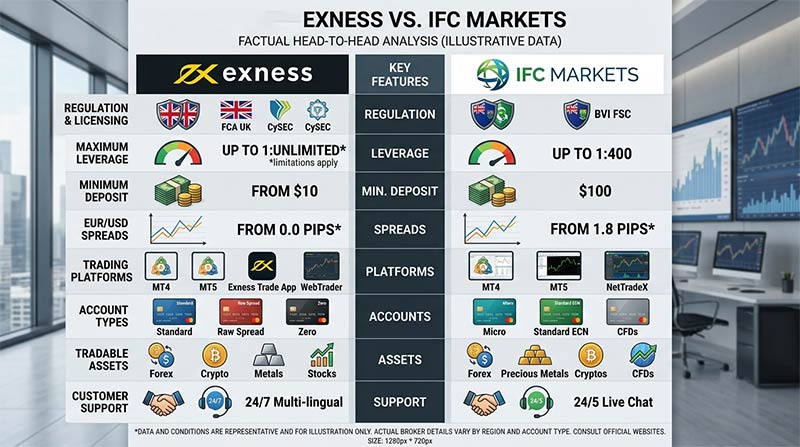
Company Background & Regulation
Exness was founded in 2008 and has grown into one of the higher-volume retail brokers globally. It operates through multiple entities holding licenses from the FCA (UK), CySEC (Cyprus), FSCA (South Africa), FSA (Seychelles), FSC (BVI and Mauritius), CBCS (Curaçao), and others. In practice, most non-EU/UK retail clients land under the offshore entities that allow higher leverage, while the Tier-1 licenses exist and add credibility. Client funds are segregated, negative balance protection is standard, and the broker has built a reputation for processing the vast majority of withdrawals automatically.
Head to the official site
IFC Markets traces its roots to around 2006. The main operating entity is regulated by the BVI FSC, with additional oversight via Labuan FSA (Malaysia) and an FSCA intermediary arrangement in South Africa for certain clients. There are group-level mentions of CySEC-related entities, but the primary client-facing regulation is offshore. They offer segregated accounts, negative balance protection, and professional indemnity insurance (Lloyd’s of London is frequently cited). The regulatory footprint is narrower and generally considered lighter than Exness’s multi-entity setup.
On pure safety and fund protection, Exness vs IFC Markets regulation favors Exness for most traders. The broader licensing network and longer track record of handling large retail volumes give me more comfort when larger balances are involved. That said, neither is an unregulated fly-by-night operation, and both have been around long enough to filter out the worst actors. Always verify the specific entity you are onboarded under and understand what investor compensation (if any) applies to your jurisdiction.
Trading Conditions – Spreads, Commissions, Leverage, Execution Quality
This is where the rubber meets the road, and where my live testing produced the clearest distinctions.
Spreads and commissions Exness offers commission-free Standard and Standard Cent accounts with spreads starting from around 0.3 pips on EUR/USD in quiet conditions (typically averaging closer to 0.8–1.2 depending on session). The Raw Spread and Zero accounts deliver spreads from 0.0 pips plus a commission (commonly around $3.50 per side on Raw, lower/variable on Zero). During high-volatility sessions—think London open or major news—the Raw/Zero accounts held up better in my experience; spreads widened less dramatically than many competitors.
Head to the official site
IFC Markets is known for offering fixed spreads (classic accounts often from 1.8 pips on EUR/USD) alongside floating spreads from about 0.4 pips and tighter Pro/ECN-style options from 0.0–0.1 with commission. Fixed spreads are genuinely useful for some traders. What really stood out during high-volatility sessions was that fixed-spread accounts on IFC didn’t suddenly balloon the way variable spreads can. For a pure scalper or news trader, though, the all-in cost on Exness Raw/Zero was usually lower once volume added up.
Leverage Exness vs IFC Markets leverage is one of the biggest gaps. Exness can go up to 1:2000 and, under specific equity and trading history conditions on certain entities/accounts, effectively unlimited. IFC Markets tops out at 1:400 on most accounts. Higher leverage is a double-edged sword, but if you know how to size positions and manage risk, the flexibility at Exness is meaningful—especially for smaller accounts.
Execution quality Both use market execution on their better accounts. In my testing, Exness felt snappier for scalping and quick entries/exits with minimal requotes or unexpected slippage on majors. IFC Markets was solid, particularly on NetTradeX, but I noticed slightly more variability during the most chaotic minutes around high-impact news. Neither is pure A-book institutional quality, yet both are more than adequate for retail strategies.
Overall on trading conditions, active day traders and scalpers will lean toward Exness. Swing traders who prefer the psychological comfort of fixed spreads may find IFC Markets more pleasant.
Platforms & Tools
Both support MetaTrader 4 and MetaTrader 5, the industry standards. Charting, indicators, EAs, and one-click trading work as expected.
Exness adds its own Terminal and a solid mobile app. The Personal Area is clean and makes account management straightforward. Copy trading and social features are available depending on region/entity.
IFC Markets differentiates itself with NetTradeX, its proprietary platform. The standout feature is the GeWorko method (Portfolio Quoting Method), which lets you create personal composite instruments—synthetic pairs or portfolios from existing assets. You can essentially build custom indices or cross-asset relationships and trade them directly. This is genuinely unique and appeals to traders who like thinking in relative value or multi-asset strategies. Server-side trailing stops and flexible order types are also strengths on NetTradeX.
If you live inside MT4/MT5 and just want reliable execution, either works. If the idea of building and trading your own synthetic instruments excites you, IFC Markets has an edge that Exness does not match.
Account Types, Deposits & Withdrawals
Minimum deposits Exness starts from around $10 on Standard/Cent accounts (higher for Pro/Raw/Zero). IFC Markets can go as low as $1 on beginner/micro accounts. Both are accessible.
Account types Exness: Standard, Standard Cent, Pro, Raw Spread, Zero (plus Islamic options). Clear progression from beginner-friendly to low-cost professional pricing. IFC Markets: Multiple combinations across NetTradeX and MT4/MT5—fixed/floating, beginner/micro/standard, Pro, ECN-style. More fragmented, which can feel confusing at first but offers granular choice.
Deposits & withdrawals Deposits are fast on both once payment methods are set up. The real difference is withdrawals. Exness is famous for Exness instant withdrawal performance: the large majority of requests (especially e-wallets and many local methods) process automatically, often within minutes, 24/7 including weekends. I tested multiple e-wallet and crypto withdrawals and consistently saw funds move faster than almost any other broker I’ve used.
IFC Markets withdrawal processing is more conventional. Requests are handled during back-office hours, with times ranging from minutes (certain e-wallets and crypto) to 1–5 business days depending on method. Fees can apply on some channels (percentage or fixed amounts), whereas Exness generally charges zero internal fees. For traders who move money frequently or value psychological comfort of knowing profits are accessible immediately, Exness wins decisively here.
Detailed Pros & Cons
Exness Pros (from my experience)
- Excellent all-in trading costs on Raw/Zero for active trading
- High and flexible leverage
- Truly fast, often instant withdrawals with no internal fees
- Clean account structure and strong mobile/desktop experience
- Broader regulatory presence
Exness Cons
- Spreads on Standard accounts are competitive but not the absolute tightest without moving to commission accounts
- Retail clients outside certain regions are usually under offshore entities
- Fewer unique proprietary analytical tools than IFC
Head to the official site
IFC Markets Pros
- Very low entry barrier ($1)
- Fixed-spread option that stays stable in volatility
- NetTradeX + GeWorko for custom synthetic instruments
- Wide instrument selection including more stocks/ETFs/synthetics in some comparisons
- Long operating history
IFC Markets Cons
- Lower maximum leverage
- Withdrawal speed and fee structure lag behind Exness
- Regulatory depth feels thinner
- Account type matrix can be overwhelming for new users
Who Should Choose Exness? Who Should Choose IFC Markets?
Choose Exness if you are:
- A scalper or high-frequency day trader who cares about tight spreads + low commissions and fast execution
- Someone who values Exness instant withdrawal reliability and moves profits regularly
- Trading primarily forex, gold, and major indices with a need for higher leverage on smaller accounts
- Looking for a straightforward, high-volume retail broker with strong operational infrastructure
Head to the official site
Choose IFC Markets if you are:
- A beginner or low-capital trader who wants the absolute lowest minimum deposit and fixed spreads for peace of mind
- Interested in creating and trading synthetic/custom instruments via GeWorko
- A swing or position trader who prioritizes spread stability over the absolute lowest variable costs
- Someone who likes the NetTradeX environment and broader multi-asset experimentation
High-volume professional traders will generally get more cost efficiency and operational smoothness from Exness. Pure beginners testing the waters with tiny size may start more comfortably at IFC Markets.
After spending several months testing both platforms side-by-side with real money, if I had to choose one for my own trading today it would be Exness. The combination of competitive Raw/Zero pricing, flexible leverage, reliable execution on the instruments I trade most, and especially the near-instant withdrawal experience outweighs the unique tools at IFC Markets for my style. That said, IFC Markets is a legitimate alternative, particularly if fixed spreads or the GeWorko capability fit your edge.
Neither is perfect. Always start with a small live deposit, verify the exact entity and conditions available in your country, and test withdrawals early. Trading conditions change, and your personal risk management matters far more than any broker’s marketing claims.
Practical advice: open demo accounts on both, run the same strategy for a couple of weeks, then fund the one that feels smoother in real conditions. Track your actual all-in costs (spreads + commissions + swaps + any withdrawal friction) rather than relying solely on advertised “from” numbers. And never risk money you can’t afford to lose—leverage amplifies everything, good and bad.
For more detailed individual breakdowns, check related reviews such as the full Exness review or IFC Markets review on brokersss.com, or comparisons like Exness vs IC Markets if you’re evaluating execution-focused alternatives.
Head to the official site
FAQ
Which is better overall, Exness or IFC Markets? For most active retail traders, Exness currently offers the stronger combination of costs, leverage, regulation depth, and withdrawal speed. IFC Markets is competitive for fixed-spread users and those wanting proprietary synthetic tools.
How do Exness vs IFC Markets spreads compare? Exness Raw/Zero can deliver near-zero spreads plus commission; Standard is commission-free with wider but still competitive spreads. IFC Markets offers fixed spreads from around 1.8 pips and floating from 0.4, with tighter Pro options available.
What about Exness vs IFC Markets regulation? Exness holds a wider set of licenses including FCA and CySEC entities (though retail often uses offshore arms). IFC Markets is primarily BVI FSC and Labuan-regulated. Exness generally scores higher on regulatory breadth.
Exness vs IFC Markets leverage – who offers more? Exness, by a significant margin (up to 1:2000 or unlimited under conditions versus 1:400 at IFC Markets).
How fast is Exness instant withdrawal in practice? Very fast for supported e-wallets, local methods, and crypto—often minutes, 24/7, with high automation rates. Bank wires follow normal banking timelines.
What is typical IFC Markets withdrawal time? Depends on method: minutes for some e-wallets/crypto, 1–5 business days for cards and wires. Processing is generally during business hours and may involve fees.
Can beginners use either broker? Yes. Both have low minimum deposits and educational resources. Beginners may appreciate IFC’s fixed spreads and $1 entry, while those who plan to scale quickly often prefer Exness infrastructure.
Do both support MT4 and MT5? Yes. IFC Markets additionally offers its proprietary NetTradeX platform with unique features.

•Most Trusted Broker — Asia 2026
•Broker of the Year — LATAM 2026
These awards confirm our commitment to building a rewarding trading environment and helping you uncover your potential. Thank you for choosing to trade with an award-winning broker!
Why choose MetaTrader 5 with Top Forex Brokers?
•Blazing-fast execution & enhanced stability
•38 built-in technical indicators & 21 timeframes for precision trading
•Optimized for all devices—desktop, mobile & web
•Trade a wide range of assets: Stocks, Commodities, Forex & more!
Disclaimer: Trading forex and CFDs carries a high level of risk and may not be suitable for all investors. Ensure you understand the risks involved and consider your financial situation before trading.