

After spending several months testing both platforms with real money, I kept running into the same question that a lot of traders face: NSFX or Exness? One promises European-style regulation and a more institutional feel; the other delivers tight spreads, high leverage, and withdrawals that actually show up fast. I traded both during quiet Asian sessions, London open volatility, and a few messy news events. What follows is my honest, first-hand comparison based on those experiences — not brochure language.
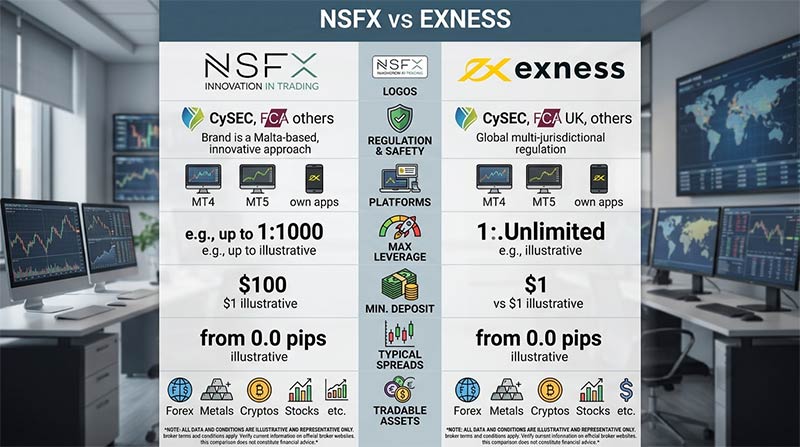
Company Background & Regulation
NSFX (operating under Alchemy Markets Ltd) has been around since roughly 2010–2011 and is regulated by the Malta Financial Services Authority (MFSA) under a Category 3 Investment Services Licence (IS/56519). It operates under MiFID rules, keeps client funds segregated, offers negative balance protection, and participates in the Maltese Investor Compensation Scheme (up to €20,000 for eligible clients). That European licence still carries psychological weight for some traders who want the comfort of EU-style oversight.
Exness, founded in 2008, takes a multi-entity approach. It holds licences from CySEC (Cyprus), the FCA (UK — largely institutional now), FSCA (South Africa), FSA Seychelles, and several others. Most international retail clients end up under the offshore entities. Client funds are segregated, negative balance protection is standard, and the company publishes audited figures and processes enormous monthly volumes (reported in the trillions). In practice, the safety net feels solid on day-to-day operations, but the regulatory tier for the average retail account is lower than a pure EU broker.
Head to the official site
In my experience, both protected funds properly during testing. NSFX’s MFSA licence feels more “European conservative.” Exness feels more operationally mature and transparent about its size. Neither is a pure top-tier retail regulator for every client, so capital risk remains real with both.
Trading Conditions – Spreads, Commissions, Leverage, Execution Quality
This is where the practical differences show up fastest.
Spreads and commissions NSFX offers fixed-spread accounts (EUR/USD often around 2–3 pips with no commission) and ECN-style accounts with variable spreads from roughly 0.3–0.6 pips plus a commission (commonly cited around $8 round-turn per standard lot). During normal conditions the ECN pricing was acceptable; during high-volatility sessions the fixed account felt expensive and the variable spreads could widen more than I liked.
Exness is noticeably sharper on cost. Standard accounts run commission-free with typical EUR/USD spreads around 0.6–1.0 pips. Raw Spread and Zero accounts start from 0.0 pips plus commission (around $3.50 per side on Raw). What really stood out during high-volatility sessions was how stable the Raw/Zero pricing stayed compared with many other brokers. For a scalper or someone trading multiple lots a day, the difference compounds quickly.
Leverage NSFX sticks close to EU retail norms — maximum around 1:50 for most clients (higher possible for professional classification). Exness, depending on the entity and account equity, can go to 1:2000 and, under specific conditions on certain accounts, effectively unlimited. I used moderate leverage on both, but the flexibility at Exness is a clear advantage for experienced traders who understand the risk.
Execution Both support scalping and EAs. On NSFX’s MT4 and JForex I saw occasional slippage on news, nothing dramatic but noticeable. Exness execution felt consistently fast across MT4/MT5, with very low rejection rates even around major data releases. Liquidity depth is simply better at the larger broker.
Overall on trading conditions, Exness wins for most active styles. NSFX is serviceable but not competitive on pure cost or flexibility.
Platforms & Tools
NSFX gives you MetaTrader 4 and its proprietary JForex platform. JForex is solid for charting, strategy building, and more advanced order types — it has a bit of an institutional flavour that some professional traders like. Mobile and web options exist but feel secondary.
Exness offers full MT4 and MT5 (desktop, web, mobile), plus its own Exness Terminal and mobile app. The ecosystem is more polished, with better integration for copy trading, economic calendars, and account management. I ran the same EAs on both; Exness handled them without drama and the interface updates felt smoother.
If you specifically want JForex, NSFX has the edge. For everyday MT4/MT5 work and modern extras, Exness is clearly ahead.
Account Types, Deposits & Withdrawals
NSFX typically requires a minimum deposit around $300. Account types centre on Fixed, ECN, and JForex variants. Deposits via cards, bank wire, and some e-wallets worked fine. Withdrawals were reliable but took the usual 1–3 business days depending on method — nothing that stood out as painful, but nothing that impressed either.
Exness starts at roughly $10 for Standard/Cent accounts and $200 for the professional Raw/Zero/Pro accounts. The range of account types is broader and better matched to different styles. Deposits are instant with most methods. The standout feature is withdrawal speed: a high percentage of requests are processed automatically, often in seconds to a couple of minutes for e-wallets and many local methods. I tested multiple NSFX withdrawal requests and several Exness ones side-by-side. The difference in “Exness instant withdrawal” experience is real and addictive once you get used to it.
Head to the official site
For anyone who moves money in and out regularly, Exness is simply more convenient.
Side-by-Side Comparison Table
| Feature | NSFX | Exness |
|---|---|---|
| Regulation | MFSA (Malta), MiFID | Multi (CySEC, FCA institutional, FSCA, FSA Seychelles, etc.) |
| Min. Deposit | ~$300 | $10 (Standard), $200 (Pro/Raw/Zero) |
| Max Leverage | ~1:50 (retail) | Up to 1:2000 / unlimited (conditions apply) |
| EUR/USD Spreads | Fixed ~2–3; ECN from ~0.3–0.6 + comm. | Standard ~0.6–1.0; Raw/Zero from 0.0 + comm. |
| Commission | ~$8 RT on ECN | ~$3.50/side on Raw |
| Platforms | MT4, JForex | MT4, MT5, Exness Terminal, App |
| Account Types | Fixed, ECN, JForex | Standard, Cent, Pro, Raw Spread, Zero |
| Withdrawal Speed | Standard (1–3 days typical) | Often instant / under 1 minute for many methods |
| Execution Quality | Good, occasional news slippage | Excellent, deep liquidity |
| Negative Balance Protection | Yes | Yes |
Detailed Pros & Cons
NSFX Pros
- Genuine MFSA/EU-style regulation and investor compensation scheme
- JForex platform appeals to more technical traders
- Clean ECN offering for those who prefer it
- Negative balance protection and segregated funds
NSFX Cons
- Higher minimum deposit
- Restricted leverage under retail rules
- Spreads and overall costs less competitive
- Smaller instrument range and less modern platform ecosystem
- Withdrawals functional but not fast
Exness Pros
- Extremely competitive spreads and commissions on professional accounts
- High (and flexible) leverage
- Near-instant withdrawals on many methods
- Excellent execution and liquidity
- Low entry barrier and broad account choice
- Mature, reliable platform suite
Exness Cons
- Most retail clients sit under offshore entities rather than the top-tier licences
- Very high leverage can be dangerous if misused
- Some regional restrictions
Head to the official site
In my experience the pros of Exness outweigh the cons for the majority of active traders, while NSFX’s regulatory angle is its main remaining strength.
Who Should Choose NSFX? Who Should Choose Exness?
Choose NSFX if you specifically value the MFSA European licence and the associated compensation scheme, prefer the JForex environment, are comfortable with lower leverage, and trade larger account sizes where the $300 minimum is irrelevant. It suits more conservative or institutionally minded traders who prioritise regulatory geography over raw trading costs.
Choose Exness if you are a beginner looking for a low barrier to entry, a scalper or day trader who cares about spreads and execution, a high-volume trader, or anyone who values fast access to their money. Swing traders also benefit from the lower overall costs. The platform flexibility and withdrawal speed make it the more practical daily driver for most styles I tested.
Head to the official site
After months of real-money testing across different market conditions, if I had to choose one for my own trading today it would be Exness. The combination of tighter pricing, superior execution, flexible leverage, modern platforms, and genuinely fast withdrawals simply makes trading more efficient and less frustrating. NSFX is a legitimate, regulated option and still has a place for traders who prioritise the specific European regulatory wrapper, but on pure trading conditions and day-to-day usability it has fallen behind.
Practical advice: open demo accounts on both, then fund the smallest live accounts you are comfortable with and trade your actual style for a few weeks. Pay attention to spreads during your active hours, how withdrawals feel, and whether the platform suits your workflow. Regulation and cost matter, but the broker that lets you execute your edge cleanly without friction is usually the better long-term partner.
Risk remains high with any leveraged product — never risk money you cannot afford to lose, and size positions according to your own risk rules rather than the maximum leverage on offer.
FAQ
Is NSFX or Exness safer? Both segregate funds and offer negative balance protection. NSFX’s MFSA licence and €20k compensation scheme give a more European-style safety net. Exness relies more on operational scale and multiple licences; most retail accounts sit under offshore entities. Neither is risk-free.
Which has better spreads – Exness vs NSFX? Exness, especially on Raw Spread and Zero accounts. The difference becomes meaningful once you trade frequently or in larger size.
NSFX vs Exness leverage – who offers more? Exness by a wide margin (up to 1:2000 or higher under conditions). NSFX is capped near EU retail levels around 1:50 for most clients.
How fast are withdrawals at each broker? Exness often processes withdrawals in seconds to minutes on popular methods. NSFX is reliable but typically takes standard banking or payment-processor timeframes.
Can beginners start with either? Exness is far more beginner-friendly thanks to the low minimum deposit and simpler account options. NSFX’s $300 entry and more limited leverage make it less ideal for absolute beginners.
Which is better for scalping? Exness. Tighter spreads, deeper liquidity, and faster execution make a noticeable difference on short-term strategies.
Do both allow hedging and Expert Advisors? Yes. Both support hedging, scalping, and automated trading on their respective platforms.
Where can I read more detailed individual reviews? For deeper dives into specific brokers, check the individual reviews and comparison pages on brokersss.com, including full breakdowns of other popular names in the same category.

•Most Trusted Broker — Asia 2026
•Broker of the Year — LATAM 2026
These awards confirm our commitment to building a rewarding trading environment and helping you uncover your potential. Thank you for choosing to trade with an award-winning broker!
Why choose MetaTrader 5 with Top Forex Brokers?
•Blazing-fast execution & enhanced stability
•38 built-in technical indicators & 21 timeframes for precision trading
•Optimized for all devices—desktop, mobile & web
•Trade a wide range of assets: Stocks, Commodities, Forex & more!
Disclaimer: Trading forex and CFDs carries a high level of risk and may not be suitable for all investors. Ensure you understand the risks involved and consider your financial situation before trading.