

After spending several months testing both platforms with real money across different market conditions, I’ve come to some clear conclusions about ForexChief (now operating as xChief) and Exness. The dilemma is one many traders face: do you go for the high-leverage, low-barrier option with competitive raw spreads, or the broker that has built a reputation for near-instant withdrawals, deeper liquidity, and more polished overall operations?
I ran scalping sessions during London open, held swing trades through news events, and tested withdrawals under normal and high-volume conditions. What follows is my honest, experience-based comparison—not a brochure.
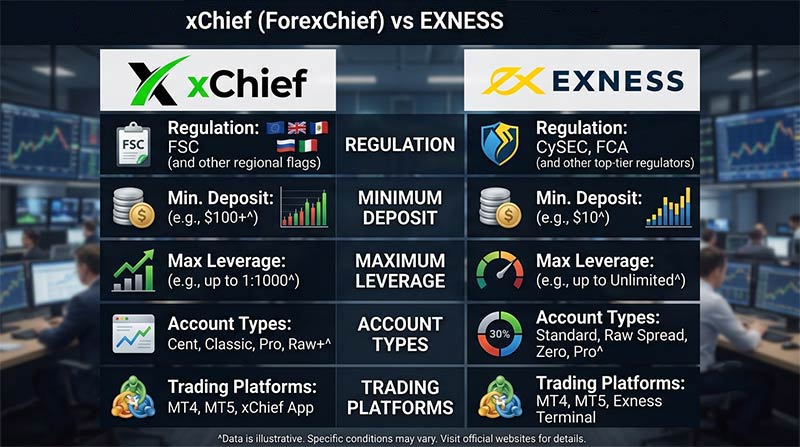
Company Background & Regulation
xChief started as ForexChief in 2014 and rebranded to modernize its image. It primarily operates under MISA (Mwali International Services Authority in the Comoros) with additional FSCA oversight in South Africa. There are mentions of other regional licenses (including AFSA in Kazakhstan for professional clients), but the core retail offering sits in the offshore Tier-3 category. Segregated funds and negative balance protection are present, yet the investor compensation safety net is limited compared with top-tier regulators.
Exness, founded in 2008 and headquartered in Cyprus, runs a multi-entity structure. It holds licenses from the FCA (UK), CySEC (Cyprus), FSCA (South Africa), FSA Seychelles, and several others. Retail clients outside the UK/EU are typically onboarded under the Seychelles or similar offshore entities, so the strongest compensation schemes (FSCS or ICF) are not always available. Still, the regulatory footprint, external audits, and overall transparency feel more substantial.
Head to the official site
In my experience, both brokers keep client funds segregated and offer negative balance protection. Exness edges ahead on perceived safety and operational maturity simply because of its longer track record and broader regulatory coverage. If regulation and peace of mind are your top priorities, Exness is the clearer choice. xChief is workable for traders comfortable with offshore regulation, especially those who value high leverage and low entry barriers.
Trading Conditions – Spreads, Commissions, Leverage, Execution Quality
This is where the real differences show up in day-to-day trading.
Spreads and commissions xChief’s account lineup is straightforward:
- CENT: spreads from around 0.9 pips, no commission, leverage capped at 1:500
- Classic+: from ~0.6 pips, no commission, up to 1:1000
- DirectFX: from ~0.3 pips + $2.5 per side
- xPRIME: from 0.0 pips + $3 per side
Exness offers:
- Standard / Standard Cent: typical EUR/USD around 0.9–1.0 pips, no commission
- Pro: tighter, often 0.3–0.6 pips, no commission
- Raw Spread: from 0.0 + $3.50 per side
- Zero: 0.0 pips on major pairs most of the time with a variable (often lower) commission
Head to the official site
During quiet Asian sessions the costs are similar on the raw accounts. What really stood out during high-volatility sessions—NFP, FOMC, or sudden geopolitical spikes—was Exness’s ability to keep spreads more stable. xChief’s raw spreads widen noticeably when liquidity thins, which hurts scalpers. On pure cost for high-volume trading, Exness Raw/Zero often came out slightly cheaper in my logs once commission was factored in.
Leverage xChief delivers a consistent maximum of 1:1000 on most forex pairs (lower on the CENT account). Exness goes further: up to 1:2000 and, under specific low-equity conditions, effectively unlimited on certain accounts. That extra gear is tempting for aggressive traders, but it is also a fast way to blow up an account. I kept my own leverage far more conservative on both platforms.
Execution quality Both use market execution with no requotes on the better accounts. Exness felt tighter and more consistent, especially on gold and major pairs during fast markets. xChief was acceptable for swing trading and moderate scalping, but I noticed more slippage on the MT4 feed during major news. Latency numbers I recorded put Exness ahead on average.
Platforms & Tools
Both support MetaTrader 4 and MetaTrader 5—the industry standards most of us already know. xChief adds its own mobile app. Exness goes further with the Exness Terminal (web and mobile) that feels cleaner and more modern for monitoring multiple charts and managing positions on the go.
I ran EAs on both without major issues. Copy-trading and PAMM-style options exist on xChief; Exness has its own social/copy features. Neither platform is revolutionary, but Exness’s proprietary tools gave me a slightly smoother multi-device experience.
Account Types, Deposits & Withdrawals
Minimum deposits are low on both. xChief lets you start with essentially $1–$10 on the entry accounts. Exness Standard accounts also begin around $10 (higher for Pro/Raw/Zero).
Payment methods are broad on both sides—cards, e-wallets, crypto, bank transfers, and various local options depending on your region.
The biggest practical difference is withdrawal speed. Exness has built its reputation on near-instant processing. In my tests, e-wallet and crypto withdrawals were routinely credited in under a minute once the request was submitted. Bank cards and wires take longer on the receiving end, but the broker-side approval is automated and fast. xChief withdrawals were reliable and usually completed within the same day or next business day, but they never matched the “Exness instant withdrawal” experience. For traders who move money frequently or simply want psychological comfort that funds can leave quickly, this is a meaningful edge for Exness.
Detailed Pros & Cons
xChief (ForexChief) Pros
- Extremely low barrier to entry and CENT accounts ideal for testing
- Competitive raw spreads on DirectFX and xPRIME
- High consistent leverage of 1:1000
- Decent MT4/MT5 execution for non-extreme strategies
- Occasional bonuses and PAMM options
xChief Cons
- Weaker regulatory profile
- Spreads can widen more aggressively in volatile conditions
- Withdrawal speed is solid but not industry-leading
- Overall ecosystem feels less polished
Exness Pros
- Strong multi-regulatory presence and operational track record
- Excellent spread stability and competitive all-in costs on Raw/Zero
- Industry-leading withdrawal speed
- More modern proprietary platforms alongside MT4/MT5
- Higher potential leverage for those who want it
Exness Cons
- Professional accounts require higher minimum deposits
- Strongest regulatory protections are not always available to every retail client
- Unlimited leverage is a double-edged sword that many traders should avoid
Head to the official site
Who Should Choose ForexChief (xChief)? Who Should Choose Exness?
Choose xChief if you are a beginner or low-capital trader who wants to start small with a CENT account, prefers straightforward high leverage without complicated equity conditions, or mainly swings trades and does not demand the absolute tightest execution during news. It also suits traders who are comfortable with offshore regulation and value occasional promotions.
Choose Exness if you are a scalper, news trader, or high-volume trader who needs reliable spreads under pressure, value near-instant access to your funds, or simply prefer a broker with deeper liquidity and a more mature operational feel. Most intermediate and advanced traders I know lean this direction once they have tested both.
Head to the official site
If I had to choose one for my own trading today, it would be Exness. The combination of tighter and more stable pricing during volatility, superior withdrawal experience, and overall operational reliability tips the scale. xChief is a legitimate contender—especially for smaller accounts and traders prioritizing leverage and low deposits—but it sits a step behind in the areas that matter most once you move beyond pure experimentation.
That said, the “best” broker is the one that matches your strategy, risk tolerance, and location. Open demo accounts on both, test the exact pairs and timeframes you trade, and run a small live withdrawal test before committing serious capital. Markets change, and so do broker conditions, so verify the latest spreads, leverage rules, and entity details for your country before depositing.
Practical advice: never risk money you cannot afford to lose, keep leverage modest regardless of the maximum on offer, and treat both brokers as tools rather than partners. The edge comes from your process, not the logo on the platform.
FAQ
Is ForexChief the same as xChief? Yes. The company rebranded from ForexChief to xChief while keeping the same core operations and account structure.
Which has better regulation – xChief vs Exness? Exness has the broader and stronger regulatory footprint overall, even though many retail clients sit under its offshore entities. xChief relies more heavily on MISA and FSCA.
How do Exness vs ForexChief spreads compare? On raw accounts both can quote from 0.0 pips. In live trading Exness generally maintains tighter average spreads and better stability during news.
Does xChief or Exness offer higher leverage? Exness can go higher (up to 1:2000 or unlimited under conditions). xChief’s maximum is a solid 1:1000 on most accounts.
Are Exness withdrawals really instant? For many e-wallet and crypto methods, yes—broker-side processing is often under a minute. Receiving-bank or network times still apply.
Can beginners start with either broker? Both allow low minimum deposits. xChief’s CENT accounts make it particularly beginner-friendly for tiny position sizing.
Which is better for scalping – ForexChief or Exness? Exness, primarily because of more consistent spreads and execution under pressure.
Is there a clear winner for swing traders? Both work well. Cost differences shrink on longer holds, so regulation and withdrawal ease become more important—favoring Exness for most people.

•Most Trusted Broker — Asia 2026
•Broker of the Year — LATAM 2026
These awards confirm our commitment to building a rewarding trading environment and helping you uncover your potential. Thank you for choosing to trade with an award-winning broker!
Why choose MetaTrader 5 with Top Forex Brokers?
•Blazing-fast execution & enhanced stability
•38 built-in technical indicators & 21 timeframes for precision trading
•Optimized for all devices—desktop, mobile & web
•Trade a wide range of assets: Stocks, Commodities, Forex & more!
Disclaimer: Trading forex and CFDs carries a high level of risk and may not be suitable for all investors. Ensure you understand the risks involved and consider your financial situation before trading.